Stylist partner network
What AI hair tools actually change for stylists
An honest look from the people building one: what these tools do, what they cannot do, and how to use a client's try-on image instead of fighting it.
We build one of these tools, so treat this page as interested rather than neutral. We have tried to be straight about the limits anyway, because a stylist who trusts an overclaim once will never trust us again.
Short version: AI can show a person what a haircut might look like on their face. It cannot cut hair, it cannot feel density, it cannot see a cowlick, and it has no idea what the client does at seven in the morning. Those are the parts that decide whether a haircut works.
What it does change is the conversation you have when the client sits down.
What these tools genuinely do well
They answer one question quickly: what does this shape look like near my face?
That question used to be answered by a photo of a stranger with different hair, which is a poor substitute. Seeing the shape on your own head kills a lot of bad ideas before they reach a salon, and it settles arguments about length that used to be settled with scissors.
They are also good at giving somebody vocabulary. A person who arrives saying "a blunt bob just below the jaw with a soft fringe" is easier to help than one who says "shorter, but not too short".
What they cannot do, and will not do soon
They cannot feel hair. Density, elasticity, porosity, and how a section behaves when it dries are invisible to a photograph.
They cannot see growth patterns. A double crown, a strong cowlick at the fringe, or a hairline that grows forward at one temple will wreck a shape that looked perfect in a render.
They do not know the client's life. Time in the morning, whether they own a hairdryer, how often they can return, whether they swim daily, what their job allows. All of that is consultation, and all of it changes the answer.
And they do not cut. The render is a picture of a destination with no route attached.
The client who arrives with a rendered photo
This is now a normal event, and the instinct to dismiss it costs you.
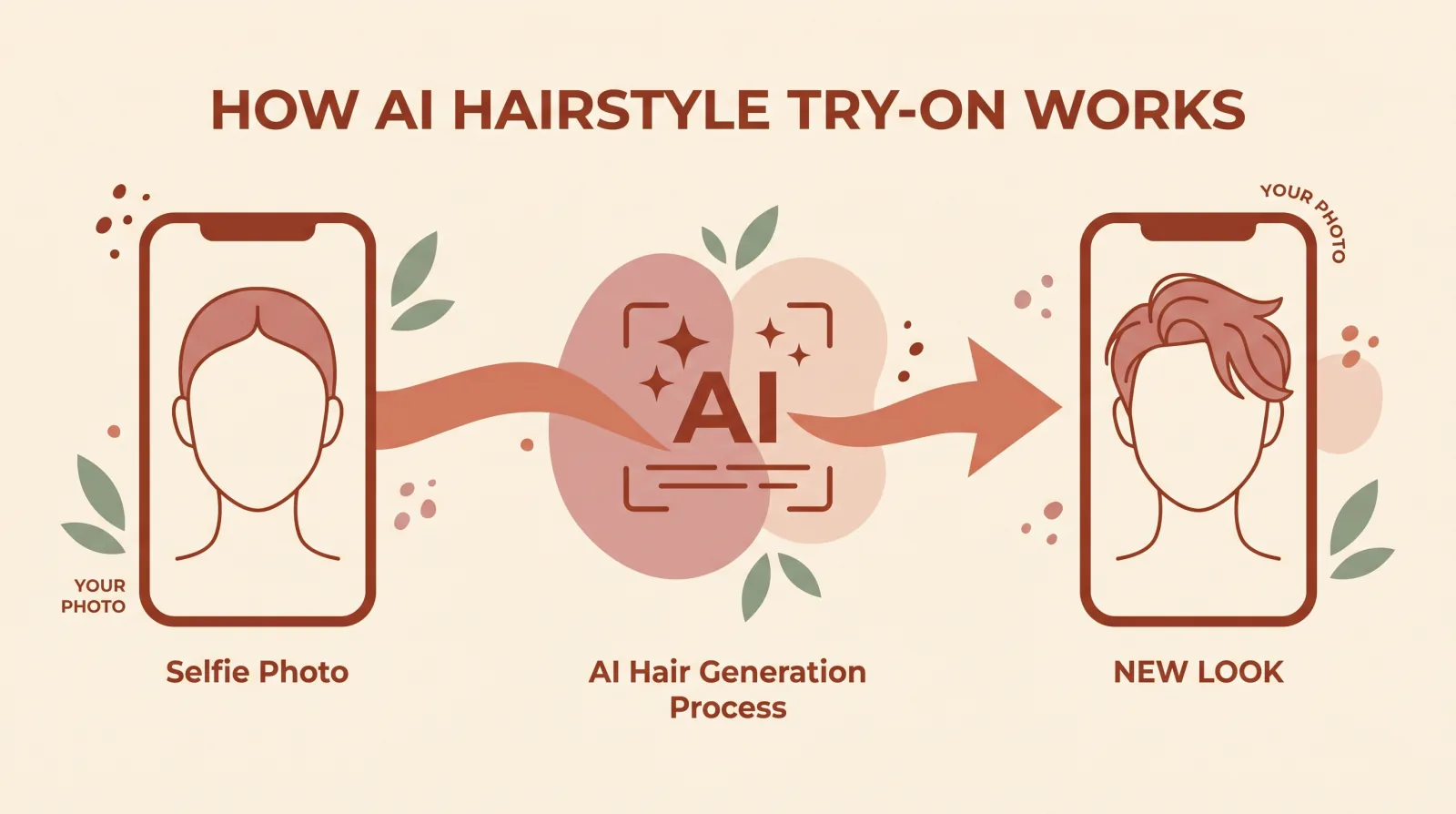
Treat the image as an inspiration photo with one big advantage: it is their own face, so at least the proportion question is already sorted. Ask the same thing you would ask about any photo. What is it about this that you like?
Then say plainly which parts their hair will do and which it will not. "The shape works. Your hair is finer through the ends than that render shows, so the outline will be softer, and I would take it slightly shorter to keep the weight."
You have just given them something no tool can: a professional read on their actual hair. That is the moment a client decides you know what you are doing.
When the render is simply wrong
It happens. The lighting flattens their texture, the model draws hair that is thicker than theirs, or the photo was taken at an angle that changed the proportions.
Say so, without making the client feel stupid for bringing it. The useful phrasing is about the hair, not the tool. "That picture is showing more density than you have got, so we would need to keep more length to fake that weight."
Getting this right matters more than being right. A client who feels mocked for using an app will not show you the next one, and then you are back to guessing.
Using one yourself, if you want to
Some stylists use a try-on in the consultation. It is most useful for the big irreversible decisions: a long-to-short change, a fringe, or a heavy colour shift, where the client is nervous and words are not landing.
It is least useful for fine adjustments. No render is accurate enough to decide half an inch, and pretending it is will make you look worse than not using it.
Nobody has to use one. Plenty of excellent stylists never will, and their clients do not care.
Does this take work away from stylists?
We do not think so, and here is the reasoning rather than a reassurance.
These tools produce pictures, and a picture is not a haircut. What they change is where the decision happens. It used to happen in your chair, slowly, with a client who was not sure. It now often happens on a sofa the night before.
That moves demand rather than removing it, and it moves it towards specifics. Somebody who has decided on a curly cut done dry is looking for a person who does curly cuts done dry, not for the nearest salon. If you are clear about what you are good at, that shift favours you.
The stylists it does hurt are the ones whose value was being the only person who could imagine the outcome. That was never the strongest part of the job.
What we ask of the tool we build
Kurli shows face shape as context, not as a verdict, because the rulebook version is wrong. It gives a reason with every recommendation instead of a bare list. It says when a photo is turned or tilted rather than guessing from a bad angle. And it ends by pointing at a human being, because that is where a haircut actually happens.
If you think we get something wrong, we would rather hear it from a stylist than find out from a client. There is a contact address on the partner pages and a person reads it.
Common questions
Will AI replace hairstylists?
It cannot cut hair, feel density, or see a growth pattern. What it changes is where the client makes the decision, which moves demand towards stylists with a clear speciality.
How accurate are AI try-on images?
Good enough to judge a shape near the face, not good enough to judge half an inch of length or how a texture will dry. Treat one as a sketch, not a specification.
A client showed me a render that is impossible on their hair. What do I say?
Say what their hair will and will not do, in terms of density and texture, and offer the closest achievable version. Blame the hair reality, never the client.
Should I use a try-on tool in my consultations?
It helps most with big, scary changes where words are not working. It adds nothing to routine maintenance appointments.
Do these tools store my client's photo?
It depends entirely on the tool, and it is a fair question to ask before recommending one. Kurli's privacy page sets out what it keeps and for how long.
Are AI recommendations biased towards certain hair textures?
Any model can be, depending on what it was trained on. If you see a tool giving weak advice for coily or tightly curled hair, that is worth saying out loud to whoever built it.
Can AI tell hair type from a photo?
It can make a rough guess from what is visible. It cannot measure density or porosity, which is exactly why the stylist's read still matters.
Is it worth arguing with a wrong face shape result?
No. Look at the proportions in the mirror with the client and adjust from there. You have information the photo did not.
Do clients trust an app over their stylist?
In our experience they use it to get to a starting point and then want a professional to confirm or correct it. Confirming or correcting it well is what earns the rebooking.
Does Kurli claim to know better than a stylist?
No, and any tool that does is overselling. Kurli's own recommendation flow ends by sending the person to find a stylist, because that is where the haircut happens.