The Kurl
Best men's haircuts for a round face: add height, lose width
Kurli is an AI hairstyle advisor: upload one selfie and it reads your face shape, recommends the cuts that suit it, and renders any of them onto your own photo before you commit.
Skip the reading: one selfie, and Kurli shows the cuts that suit your face. The face-shape read and your top pick are free.
A round face is not a problem to fix. It is a set of proportions, and knowing them makes choosing a haircut much less of a guess. The width and the length of a round face are close to equal, the cheeks are the widest point, and the jaw curves rather than turning a corner. Everything below follows from that one fact.
Most articles on this topic give you a gallery of sixty photos and no reasons. That is not much use in a barber's chair. What you actually need is the principle, a few cuts that follow it, and the words to ask for them.
The one rule that decides everything
Build height on top. Keep the sides short and controlled.
That is the whole thing. A round face reads as round because the eye sees roughly the same distance across as up and down. Add two or three inches of height at the crown and you change that ratio, so the face reads longer. Cut the sides tight and you remove width at the widest point, which does the same job from the other direction.
Every good men's cut for a round face is some version of those two moves. Every cut that fails does the opposite, which usually means volume at the sides and nothing on top.
Once you have that in your head you can judge any photo you see. Look at where the bulk sits. If it is above the temples, it will probably suit you. If it sits out over the ears, it probably will not.
Here is the fade height choice at a glance:
| Fade height | Starts | Effect on a round face | Watch out for |
|---|---|---|---|
| Low fade | Just above the ear | Keeps width through the temples and over the ears | Leaves the width you are trying to lose |
| Mid fade | Around the temple | The safest choice, removes width at the widest point | None major, this is the default pick |
| High fade | At the temple or above | The strongest slimming effect, sharpest look | Can look severe on a round crown, grows out fastest |
The cuts that work best
The textured crop with a fade
If you only try one thing, try this. The top is cut to a few inches, texturised so it sits in separated pieces rather than a solid block, and pushed slightly forward and up. The sides are faded.
It works for a round face because texture creates height without needing much length or much styling. It is also forgiving. A crop that has grown out by two weeks still looks intentional, which is not true of a pompadour.
The quiff
The quiff is longer on top, swept up and back off the forehead, with the height concentrated at the front. That front lift is doing real work on a round face, because it is the tallest point of the whole shape and it sits directly above the widest point.
You need about three to four inches on top and you need to style it, usually with a blow dryer and a matte paste. If you will not do that in the morning, pick the crop instead.
The pompadour
A bigger, smoother, more deliberate version of the quiff. The height is higher, the finish is neater, and the sides are usually faded tighter to keep the contrast sharp.
It is the most effective cut on this list for a round face and the most work. It also suits thicker hair. Fine hair struggles to hold a pompadour past mid morning without a lot of product.
The faux hawk and the spiky crop
Both concentrate volume down the centre line of the head, which is exactly where a round face benefits from it. The faux hawk is the more dramatic of the two, and the modern version is much softer than the spiked version from twenty years ago.
These suit men with thicker or coarser hair, because the hair needs enough body to stand up on its own.
The side part with volume
The most conservative option, and a good one for work environments where a quiff looks like too much. The key word is volume. A flat side part does nothing for a round face. A side part with the hair lifted at the root and swept over adds height and gives you a diagonal line across the top of the head, which breaks up the roundness.
Ask for a deep side part rather than one near the middle. A middle part splits the hair into two symmetrical curves, and symmetry emphasises a round shape rather than breaking it up.
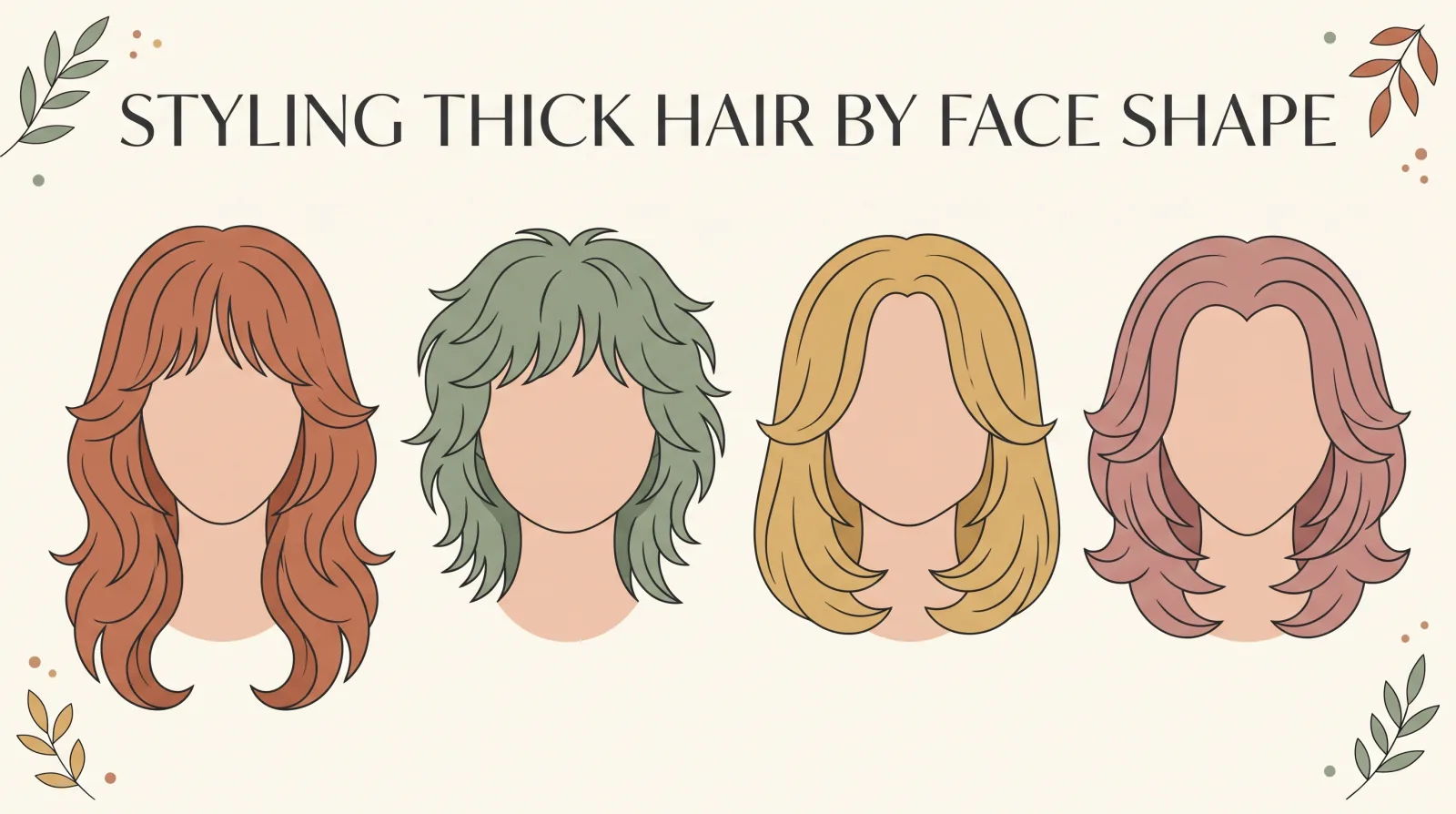 Related readRound face and thick hair: where to remove weight and where to keep it
Choosing your fade height
The fade is where most of the width comes off, so this decision matters more than the name of the cut.
A mid fade is the safest choice for a round face. It starts around the temple, so it removes width at the widest point without pushing the contrast so high that the head looks narrow and tall.
A high fade gives you the most slimming effect and the sharpest look. It is the strongest tool here, but it can look severe if your head is quite round at the crown, and it grows out fastest.
A low fade is the one to be careful with. It leaves the hair full through the temples and over the ears, which is the width you are trying to lose. If you want a low fade for other reasons, compensate with more height on top than you would otherwise need.
There is more detail on how the three compare in our guide to men's fade haircuts by face shape.
What to be careful with
Nothing here is a hard rule, but these are the things that most often work against a round face.
Bowl cuts and heavy straight fringes draw a wide horizontal line across the forehead, which is the last thing a round face needs. A blunt fringe in particular adds width exactly where the face is already soft.
Curtains and centre partings split the head into matching halves and emphasise the curve. If you love a middle part, keep real height at the root so it is not lying flat.
Short all over with no fade, meaning one guard from front to back, leaves the head looking like a sphere. If you want a very short cut, keep a graduation somewhere so there is contrast between the top and the sides.
Long and loose at the sides is the most common mistake. Hair that puffs out over the ears widens the face more than any other single thing.
How hair type changes the answer
Face shape tells you the direction. Your hair type tells you what is actually achievable.
Fine or thin hair cannot hold a pompadour, so do not fight it. A textured crop with a matte clay works much better, because texture creates the illusion of volume without needing weight. Keep the top slightly shorter than you think, since long fine hair falls flat and flat is the enemy here.
Thick, straight hair will hold almost anything, but it can get wide as it grows. Book a trim every three to four weeks and ask your barber to thin the sides rather than only shortening them.
Curly hair is genuinely well suited to a round face, because curl gives you height for free. The trap is width. Curly hair grows out as much as up, so keep the sides tight and let the top do what it wants. A high fade with curls left long on top is one of the best round face cuts there is.
Coarse or coily hair holds shape better than any other type, so faux hawks, high top styles and sponge twists all work. Height is easy for you, so focus on keeping the sides clean.
If you are unsure which matters more in your case, we compared the two in face shape vs hair type.
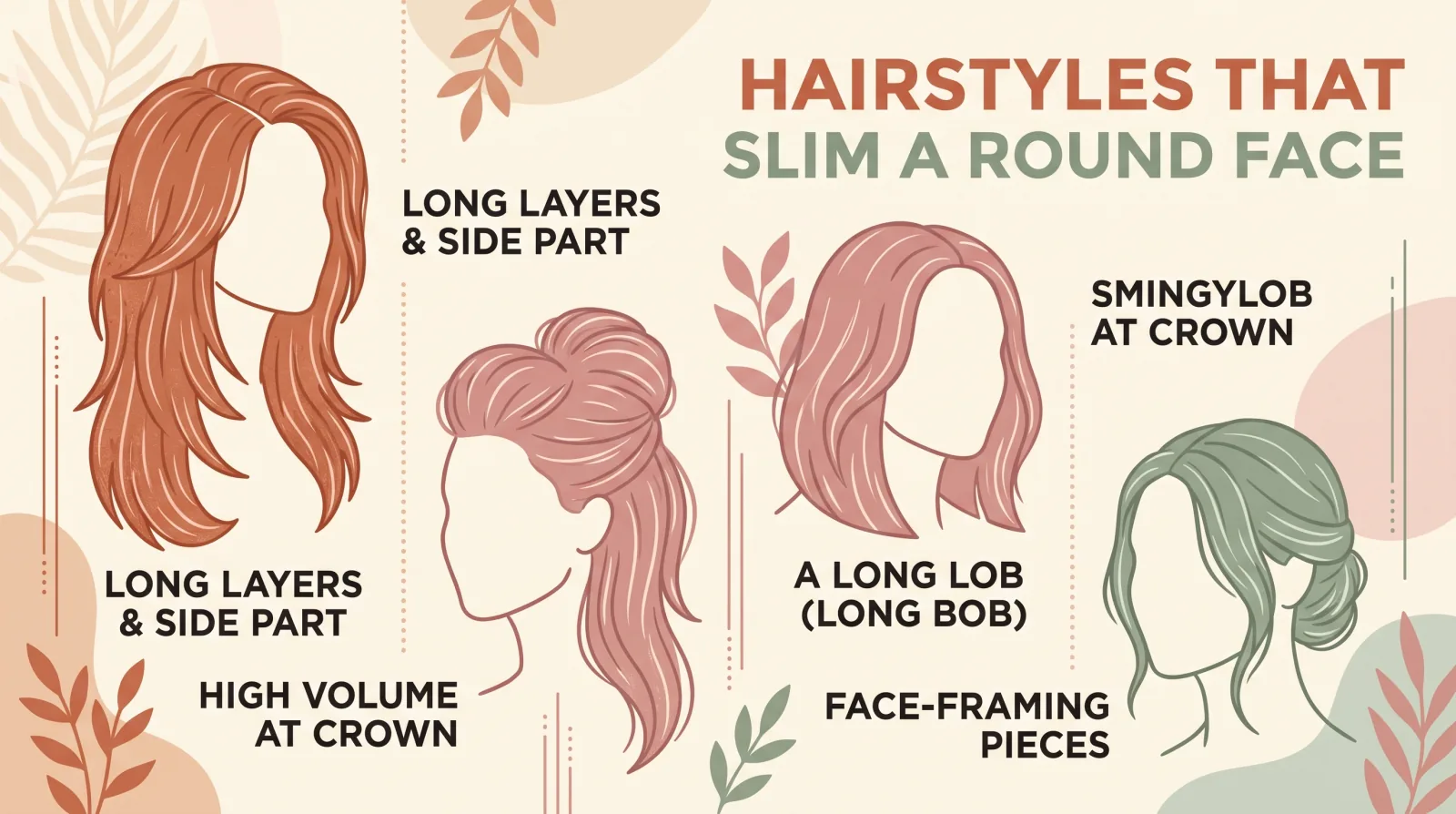 Related readHairstyles for a big forehead and a round face
Beards and a round face
A beard is the fastest way to add length to a round face, and it works from the opposite end to your haircut.
Keep the weight at the chin. A beard that is longer at the bottom and tidy at the sides pulls the whole face downward and adds the vertical line that a round shape lacks. A short boxed beard, a goatee with a defined chin, or a medium beard kept close at the cheeks all do this well.
What works against you is round, full growth on the cheeks. That adds bulk at the widest part of your face and turns the beard into more width rather than more length. Keep the cheek line reasonably high and defined.
Our beard styles by face shape guide goes through the shapes in more detail.
The haircut adds height at the top and the beard adds length at the bottom. Get both pulling the same direction and the effect is much stronger than either alone. The Kurli team
Making it survive the day
A cut that only looks right in the barber's chair is not doing its job. Height is the entire point of a round face cut, and height is what collapses first.
Apply product to damp hair, not dry. Product on dry hair coats the surface and weighs it down. On damp hair it dries into the shape you build.
Blow dry from underneath. Point the dryer at the roots and push them up and back with your fingers or a brush. Thirty seconds of this does more than any amount of paste.
Use a matte clay or a paste rather than a gel or a cream. Anything that adds shine also adds weight, and heavy hair falls.
Get it cut on schedule. A round face cut relies on the contrast between the top and the sides, and that contrast is the first thing to disappear. A fade is noticeably softer after about three weeks and mostly grown out by six, so book the next one before it goes rather than after.
How to ask your barber
Say what you want the shape to do, then name the parts.
Something like: "I have a round face, so I want height on top and the sides kept tight. Can we do a mid fade, leave about three inches on top, and texturise it so it sits up rather than flat."
That gives a barber everything they need. If you bring a photo as well, bring one of someone with a similar face shape rather than a similar hairstyle, because the same cut on a long face and a round face are two different haircuts.
It is worth saying out loud that you want to keep the height, because a lot of barbers will take more off the top than you expect unless you ask.
When to ignore all of this
Face shape is guidance, not a rule, and it is only one of the things that decides whether a haircut suits you. Your hair type, your job, your patience in the morning, and what you actually like all matter, and some of them matter more.
Plenty of men with round faces look great with a buzz cut. The advice above tells you what usually works and why, so that when you break it you are doing it on purpose.
If you are not certain your face is actually round, that is worth settling first, since the advice for a round face and an oblong face are close to opposite. You can check with our face shape quiz, read the full breakdown in the round face guide, or compare all six shapes in the face shape hub.
Common questions
What should I tell my barber if I have a round face?
Ask for height on top and short, controlled sides, and say you want the shape to look taller than it is wide. Those words matter more than a style name, because every barber cuts a quiff or a crop slightly differently. If you name one thing, name the fade height, because that is what sets the width of your head.
How much height on top does a round face actually need?
Usually about two to four inches of length on top, styled up rather than forward. That is enough to build real height without the hair collapsing under its own weight by lunchtime. Less than two inches rarely lifts, and much more than four gets heavy unless your hair is coarse.
Can a man with a round face pull off a buzz cut?
Yes, but it is the hardest option, because a buzz cut removes the height that balances the width. It works best when you have a defined jaw or a strong beard to add angles. If you want short and low effort, a short textured crop with a fade gives you most of the ease and keeps some lift.
Does a beard make a round face look bigger?
A beard usually helps, as long as the weight sits at the chin rather than the cheeks. Length at the bottom of the face pulls the shape downward and makes it read longer. Keep the cheek line fairly high and tidy, because full, round cheek growth adds width exactly where a round face does not need it.
Is a round face the same as a chubby face?
No, and this is a common mix-up. A round face is a set of proportions, meaning the width and length are close to equal with soft angles, and plenty of lean people have one. Face weight can make any shape look rounder, but the underlying shape is about the ratios, not the body.
How do I tell a round face from a square face?
Look at the jaw. Round and square faces are both about as wide as they are long, but a square jaw has a hard corner and a straight line along the bottom, while a round jaw curves. If you cannot see a clear angle where the jaw meets the ear, you are most likely round.
Why does my haircut look good at the barber but flat at home?
Barbers dry your hair upward with a brush and finish with a strong product, which builds height you are not recreating. Blow dry from underneath, pushing the roots back and up, and apply product to damp hair rather than dry. On a round face the height is the whole point, so losing it undoes the cut.
Does a hard part or line-up help a round face?
A hard part can help, because it adds a straight line to a face made of curves and gives the eye an edge to follow. Keep it fairly high on the side. A heavy line-up across a low, rounded hairline can have the opposite effect, since it draws a wide horizontal line across the top of the face.
Can men with a round face wear long hair or a man bun?
Yes, and long hair often works better than people expect, because the length falling past the jaw pulls the shape down. The thing to avoid is width at the sides, so keep long hair tucked or tied rather than loose and puffy around the ears. A high bun helps more than a low one.
Does losing or gaining weight change which haircut suits me?
It can change how round your face reads, so a cut that suited you at one weight may need adjusting. The underlying bone structure stays the same, so the direction of the advice does not change, only how much height and how tight the sides need to be. Recheck the shape if your face has changed noticeably.
See it on your own face
Upload a selfie and Kurli recommends the hairstyles that suit you, then renders each look onto your photo.
The face-shape read and your top pick are free. Your photo is never sold or used to train AI.