The Kurl
Does cutting your hair make it grow faster or thicker? No, and here is why
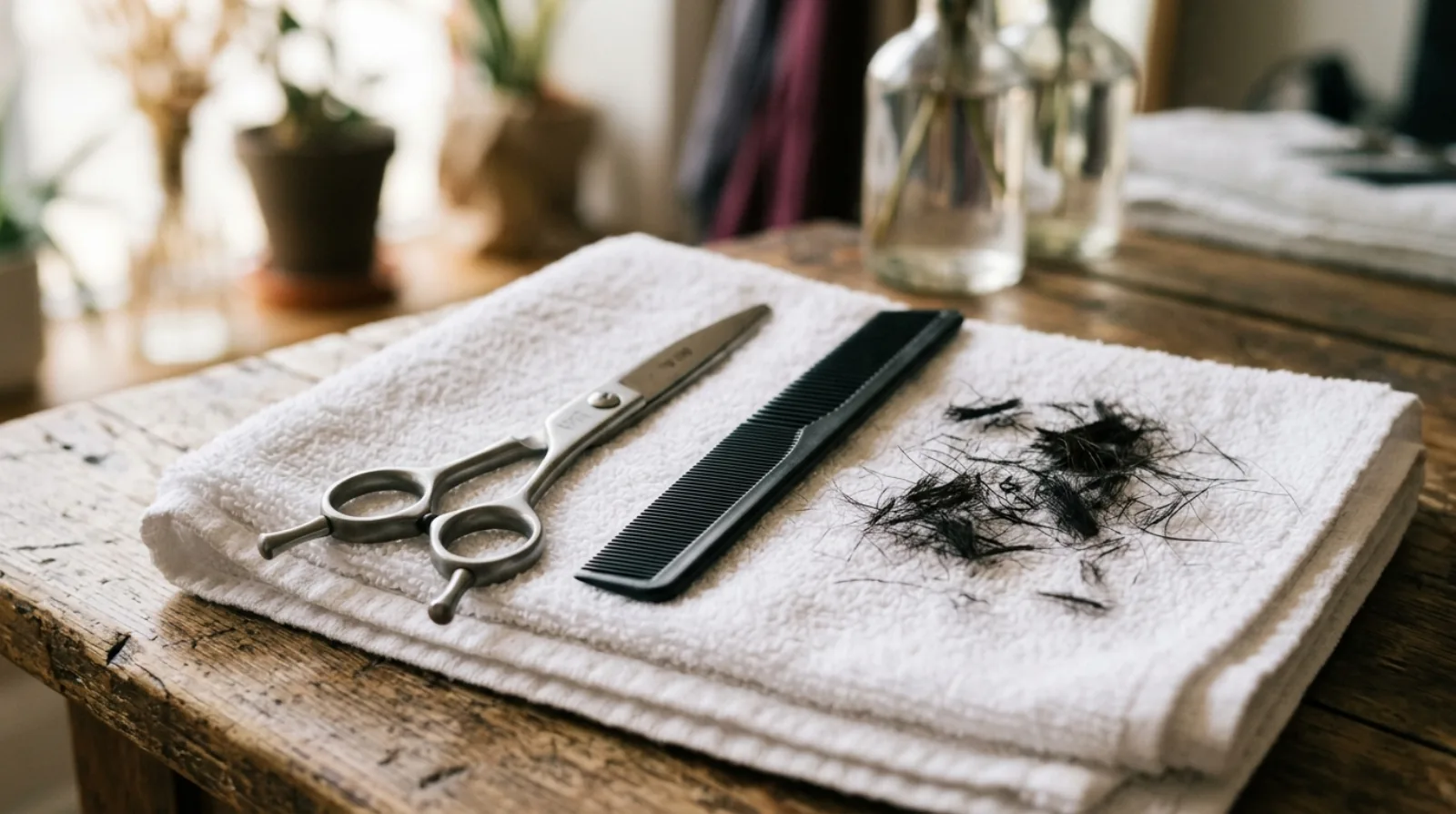
Cutting your hair does not make it grow faster, and it does not make the strands thicker. The American Academy of Dermatology says it in one sentence, quoting board-certified dermatologist Rochelle R. Torgerson: cutting will not make your hair grow faster, because hair growth occurs below the level of the skin and is not affected by cutting (AAD, National healthy skin month).
That is the whole answer to the question as asked. The interesting part is the second half of the same quote, which is that regular cuts do make hair grow healthier, because they remove the hair that would split. So the advice most people were given is useful and the reason attached to it is wrong, which is why the myth has survived so long.
This is general information about hair, not medical advice.
One mechanism explains all of it
A hair has two parts, and they do different jobs.
The follicle sits a few millimetres under your scalp. It is alive, it is fed by blood, and it is the only thing that makes hair. It pushes out scalp hair at about 0.35 mm a day, which is roughly 1 cm a month and 15 cm a year (StatPearls, Physiology, Hair).
The shaft is the part you can see and touch. It is dead keratin. It has no blood supply, no nerve, and no route back to the follicle. Cutting it does not hurt for the same reason that it cannot send a message.
So a pair of scissors at the ends and a follicle under the skin are not connected. There is nothing to signal, and no mechanism by which a signal could travel. Every version of this myth, whether it is about scissors, razors or clippers, runs into that same wall.
Why a fresh cut looks thicker anyway
Something does change, and people are not imagining it.
An uncut hair narrows towards the tip. That fine taper is what a hair end looks like after months of wear. Cut across it and you get a flat cross-section of the full-width strand instead. A whole head of those ends, all finishing at the same length, has more visible bulk at the perimeter than a head of tapered ends finishing at uneven lengths.
The BMJ named this exact effect while reviewing the shaving version of the myth: shaved hair lacks the finer taper seen at the ends of unshaven hair, giving an impression of coarseness (Vreeman and Carroll, Medical myths, BMJ 2007). The same thing happens with scissors, on a larger scale.
There is a second reason a cut reads as thicker. Damaged ends are thinner than the hair above them, because layers of the outer surface have worn off and strands have snapped at different points. Cutting those off removes the thinnest part of your hair, so the average thickness of what remains goes up. Nothing grew. The thin part left.
Every claim that a product thickens your hair is measuring the same thing a haircut does: it removed or coated the thin ends. The Kurli team
Why trims still change the length you reach
This is the part worth keeping, and it has nothing to do with speed.
A split end is a weak point in the strand. Under brushing, tying and drying it keeps breaking, and the break travels upward. So a split you leave alone in March is costing you length in June, from hair that grew normally and then snapped. Damaged hair is fragile, so it tends to break (AAD, 10 hair care habits that can damage your hair).
Run the arithmetic on a year. You grow about 12 cm. If breakage costs you 10 cm of that, you end the year 2 cm longer and conclude your hair does not grow. If trims and gentler handling cut the loss to 4 cm, you end the year 8 cm longer with the same follicles and the same growth rate.
That is the honest case for trimming while growing hair out, and it is the opposite of the usual advice in one way: you are not cutting to make it grow, you are cutting to stop losing what already grew. The full version of that argument, including how to tell breakage apart from a real length limit, is in why won't my hair grow past a certain length.
Shaving, and the trial from 1928
The body-hair version of this myth is the most stubborn one, and it has the oldest evidence against it.
The BMJ review is direct: strong scientific evidence disproves these claims. As early as 1928, a clinical trial showed that shaving had no effect on hair growth, and more recent studies confirm that shaving does not affect the thickness or rate of hair regrowth. The paper also gives the mechanism in plain words: shaving removes the dead portion of hair, not the living section lying below the skin's surface (BMJ 2007).
Two things make people sure it is not true.
Stubble feels coarse, because a razor cuts straight across the shaft and leaves a blunt end where a soft taper used to be. Run your hand over it two days later and it catches. That is a cross-section, not a thicker hair.
New growth looks darker, because it has not spent months in sunlight. The BMJ notes that new hair has not yet been lightened by the sun or other chemical exposures, which gives an appearance darker than the surrounding hair. Leave it to grow for two months and it matches again.
Shaving your head does not reset anything
The scalp version deserves its own mention, because people buzz their hair hoping for a fresh start.
The hair that grows back after a buzz cut is the hair your follicles were already going to make. Same diameter, same colour, same growth rate. What changes is that every strand on your head is now the same length and undamaged, which is genuinely better hair than you had, and it is better because the damaged part is gone rather than because the new part is different.
That distinction matters if you are deciding whether to do it. A buzz cut is a fast way to remove damage and a slow way to regret losing length, and it does nothing at the follicle.
There is one situation where people are half right. If your hair was thin at the ends and patchy from breakage, the regrowth genuinely looks and feels better, because you are now looking at hair that is a few months old instead of hair that is four years old. That is a real improvement and a real reason to do it. It is also a one-time gain. The new hair starts collecting the same wear from the same heat, elastics and colour on day one, and without a change to the routine it arrives back in the same condition on the same timetable.
The calendar myths, and where they come from
Search for this question and the autocomplete fills with days of the week. Should I cut my hair on a Tuesday. Is Saturday bad. What day should I cut my hair for growth. These are asked constantly and almost never answered honestly.
The biology does not have a calendar in it. A follicle producing 0.35 mm a day produces 0.35 mm a day on a Tuesday. There is no published evidence that the day of the week, the phase of the moon, or the season changes the rate at which a haircut is followed by growth.
Those questions come from cultural and religious traditions rather than from biology. People who follow them are following something older and more meaningful than a hair tip, and that is theirs to keep. The point here is narrower: whichever day you choose, the follicle does the same thing, so nobody should sell you a haircut on the promise that the date will add length.
The same goes for the lunar hair-cutting charts that circulate online. If following one makes you book trims on a regular schedule, the regular schedule is doing the work.
What actually changes how thick hair looks
Four things, and a haircut only touches one of them.
Strand width. Set by genetics, and it shifts with age and with some medical conditions. No cut changes it.
How many hairs you have. Set by the number of active follicles. Shedding, thinning and hair loss change this, and a cut does not.
The perimeter. A blunt line at one length reads thicker than a soft, layered, tapered end. This is the one a haircut controls, and it is why a blunt bob looks denser than the same hair left long and thin at the ends.
Condition. Hair that is rough on the surface tangles, sits flat and looks thinner than the same hair with a smooth surface. This is a routine question rather than a cut question, and it is the subject of hair before the cut.
If the goal is fuller-looking hair, the honest ranking is: fix the condition first, then choose a shape that keeps weight at the perimeter. Doing it the other way round means paying for a cut that a month of breakage undoes.
How often, if you are growing it out
There is no fixed interval that suits everyone, and the number people quote (every six to eight weeks) comes from maintaining a shape, not from growing one.
A workable rule while growing: trim the smallest amount that removes the split ends, and book by the state of your ends rather than by the calendar. Hair that is bleached, straightened daily or worn in a tight ponytail needs it more often than hair that is air dried and left down. The trade-off between trimming and keeping length is worked through in how often should you cut your hair, and the underlying rate arithmetic is in how fast hair grows.
One thing to watch for in the chair: ask for the amount in centimetres or inches and say it out loud before they start. "A trim" means different things to different stylists, and the gap between one centimetre and three centimetres is three months of growth.
What this leaves open
Knowing the myth is false does not tell you what your own ends need. Two people with the same haircut can need trims at completely different intervals, because one bleaches and blow dries and the other does not. The rate of breakage is personal and the rate of growth is close to universal.
If you want the state of your own ends read rather than guessed, the Kurli AI Specialist does that from three photographs and gives you one change to start with, plus what to do between washes. The myth has a general answer. Your ends do not.
Common questions
Does cutting hair make it thicker?
No. The width of each strand is set at the follicle, under the skin, and scissors only reach the dead part above it. A fresh cut looks thicker because every hair now ends at the same point with a blunt tip instead of a fine taper, so the ends have more visible bulk. The strands themselves are unchanged.
Does cutting hair stimulate growth?
No. The American Academy of Dermatology puts it directly: cutting will not make hair grow faster, because hair growth happens below the level of the skin and is not affected by cutting. Scalp hair grows about 0.35 mm a day whether you cut it weekly or leave it alone for five years.
Does trimming ends help hair grow?
It does not change growth speed, and it does change the length you keep. A split end is a weak point that keeps breaking further up the strand, so trimming removes the break before it climbs. You still grow about 1 cm a month either way. Trimming decides how much of that centimetre is still attached six months later.
Is trimming ends necessary?
It is necessary if you want to keep length, and optional if you are happy with thin ends. Damaged hair is fragile and breaks, and a split cannot be repaired once it starts. Most people growing hair out do better trimming a small amount on a schedule than waiting until the ends look bad and needing several inches off.
Does cutting hair make it healthier?
It removes the unhealthy part, which is not the same thing. The hair that grows afterwards is exactly what the follicle was already producing. Cutting takes off the section that has collected years of washing, sun, heat and colour, so what is left is in better condition, because the worst of it is now on the floor.
Can cutting hair shorter make it look thicker?
Yes, and the effect is real even though the hair has not changed. Shorter hair carries less weight, so it lifts at the root instead of lying flat, and a blunt shorter perimeter puts every strand at the same length instead of thinning out gradually. Both make the same amount of hair read as fuller.
Does shaving make hair thicker?
No. A 2007 review in the BMJ found that as early as 1928 a clinical trial showed shaving had no effect on hair growth, and later studies confirmed shaving does not change the thickness or the rate of regrowth. Shaving removes the dead part of the hair and leaves the living part under the skin untouched.
Does shaving hair make it grow back darker?
No. New hair coming through has not yet been lightened by sun or by chemical exposure the way older hair has, so it looks darker next to the hair around it. The BMJ review names this as the reason for the impression. The pigment made by the follicle is the same before and after.
Why does shaving make hair look thicker?
Because a razor cuts across the shaft and removes the fine taper at the tip. The BMJ review describes it this way: shaved hair lacks the finer taper seen at the ends of unshaven hair, which gives an impression of coarseness. You are feeling a blunt cross-section of a normal hair, not a thicker hair.
Does shaving baby's hair make it thicker?
No. The same evidence applies, and a baby's hair changes in the first two years anyway as fine early hair is replaced by the hair the follicles will keep making. Parents who shave often credit the shave for a change that was already coming. This is general information, so ask your paediatrician about your own child.
Will shaving legs make hair thicker?
No. Leg hair regrows at the same thickness and the same rate whether you shave it or not. It feels coarser for a few days because the blunt cut end is stiffer than a tapered tip, and it looks darker because the new growth has not been bleached by sun. Both impressions fade as the hair grows out.
Does cutting hair in layers make it thinner?
Layers remove weight rather than strands, so the hair can look less dense at the ends while the amount of hair stays the same. Heavy internal layering or thinning shears do take out hair and can make fine hair look sparse. A long layer cut on thick hair usually does the opposite and makes it sit better.
What happens to hair when you cut it?
Scissors remove length from the dead, keratinised shaft, and nothing reaches the living follicle under your scalp that makes hair. That follicle keeps producing hair at about 0.35 mm a day, whether it was just cut or left alone for years. All a cut changes is how much length is on your head and how the cut ends look, both above the skin, both disconnected from growth.
Why doesn't cutting hair hurt?
Because the part scissors touch has no nerves. The hair shaft above your scalp is dead keratin with no blood supply and no route back to the follicle, which is the same reason it cannot heal or send any signal. The follicle, the living part that makes hair, sits a few millimetres under the skin, far from where the blade meets the strand.
Does cutting hair help with hair loss?
No, and it treats a different problem. Hair loss starts at the follicle, and cutting only reaches the dead shaft above it, so a trim cannot change whatever is affecting the follicle. What cutting does help is breakage: removing a split end stops it travelling further up the strand, which protects length you already have. If hair is thinning at the scalp rather than snapping along its length, that is a question for a dermatologist, not a haircut.
Can cutting hair change texture?
No. Texture, meaning how straight, wavy, curly or coily a strand is, comes from the shape of the follicle it grows from, and a cut happens entirely above the skin. What a cut can do is change how texture reads: removing weight lets a wave show instead of being pulled flat, and a blunt line reads differently than long, thin ends. The strands coming out of the follicle are the same shape as before.
Does cutting hair reduce dandruff?
No. Dandruff is a scalp condition, and cutting only removes length from the dead shaft, the same part that has no route back to the follicle or the skin beneath it, as this post explains for growth. A shorter cut can make flakes less visible against shorter, thinner sections of hair, and that is a cosmetic change, not a scalp change. Treating the scalp is what clears dandruff, not the length of the hair growing from it.
Does cutting hair make it grow back thicker?
No, the regrowth is exactly what your follicles were already producing: same diameter, same colour, same rate. What people notice after a big cut, especially a buzz cut, is that every strand is now the same length and undamaged, which genuinely looks and feels fuller because years of wear are gone, not because the new hair is different. It is a one-time gain, and the new length collects the same wear from day one.
See it on your own face
Upload a selfie and Kurli recommends the hairstyles that suit you, then renders each look onto your photo.