The Kurl
Is it bad to sleep with wet hair? The honest answer
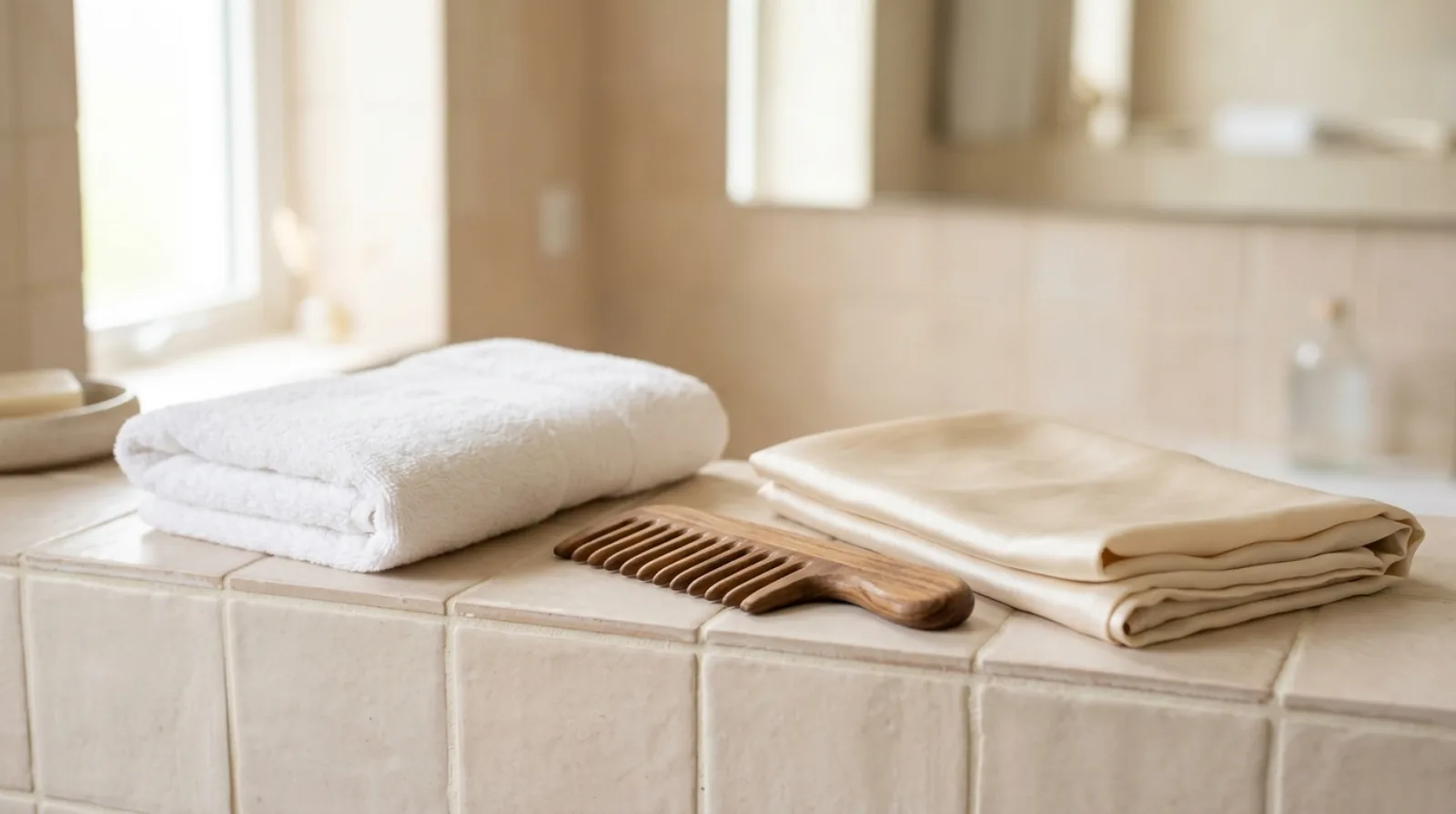
Sleeping with wet hair will not give you a cold. It will cost you hair.
Those are the two halves of an honest answer, and most pages online get one of them wrong. The cold story is folklore. The breakage is real, measurable on your own pillowcase tomorrow morning, and it is the part people wave away.
There is a third piece that sits between the two: what eight hours of damp scalp does under a pillow. That one is real enough for a hospital to name, and nobody has put a number on it. We will say so where it applies.
Wet hair is weaker, and a pillow is hours of friction
The American Academy of Dermatology gives the reason in one line in its tips for healthy hair: hair is delicate when it is wet. Its styling guidance goes further and tells most people to handle wet hair as little as possible, because wet hair breaks more easily when combed or brushed.
Water does this by getting inside the shaft. The review Hair Cosmetics: An Overview in the International Journal of Trichology describes water absorption swelling the hair shaft, and gives the numbers for how far wet hair travels before it gives way: untreated wet hair stretches to 30 per cent past its own length and recovers, changes permanently between 30 and 70 per cent, and fractures at 80 per cent.
You are not stretching your hair 80 per cent on a pillow. That is not the point of the numbers. The point is that wet hair moves further under load than dry hair does, which means a strand pinned under your shoulder as you turn over takes the pull rather than sliding out from under you.
Now add the time. Six to eight hours, several changes of position, a cotton surface, and hair that is in its weakest state for the first few of those hours.
The test that settles it for your own hair
Look at your pillowcase in the morning and sort what is on it into two piles.
Hairs that are your full length with a small pale swelling at one end came out of the follicle. That is normal shedding, and the AAD puts the usual range at 50 to 100 hairs a day.
Short pieces, no bulb, blunt at both ends, are broken hair. The hair is still growing from the scalp. It snapped partway along. If the second pile is the bigger one, something mechanical is breaking your hair, and going to bed wet is one of the few things that happens for eight hours a night.
The cold story is a myth, and it is worth being clear about
Going to bed with wet hair does not give you a cold. Matthew Goldman, a family medicine doctor at Cleveland Clinic, puts it directly in the clinic's explainer on wet hair and illness: hair being wet is not the cause for catching a cold, and a microorganism such as a virus has to be involved.
The same page explains why the belief survives. Colds cluster in cold months because people gather indoors, not because of the weather itself or anything your hair is doing.
So if the only thing stopping you from washing your hair at night is a grandparent's warning, wash your hair.
A damp scalp for eight hours is a different question
This is where the honest answer gets less comfortable.
The same Cleveland Clinic page says sleeping with wet hair can increase your risk of infection, because fungi and bacteria grow in warm, moist conditions. It names two. Malassezia folliculitis is an itchy, acne-like condition caused by a yeast infection of the hair follicle, made worse by sweat, and it can cause dandruff or scalp dermatitis. Scalp ringworm is a contagious fungal infection that shows up as a red, itchy, ring-shaped rash.
Here is the part other pages skip. That is a described risk, not a measured one. We could not find a study that counts how many people who sleep with wet hair develop either condition, or how many nights it takes. A hospital naming a mechanism is a good reason to dry your scalp. It is not a diagnosis, and it does not mean a damp head on Tuesday gives you a fungal infection by Friday.
What it does change is the priority. If you only have two minutes of dryer time, spend them on the scalp and let the ends finish overnight. The roots are the part that must not stay wet. If flaking is already a regular problem, the routine side of it is covered in dandruff and flaky scalp.
Hair loss, or breakage that looks like hair loss
People search for this as hair loss, and the two are separate problems with separate fixes.
Breakage happens along the shaft. The follicle is fine, the hair keeps growing, and what you see is a shorter, thinner-looking length with a halo of broken ends around the crown. Sleeping wet causes this kind, and only this kind.
Hair loss comes from the follicle. Nothing your pillow does reaches that far.
There is one way a wet-hair habit reaches the follicle, and it is the elastic rather than the water. The AAD lists hairstyles that pull as a cause of genuine hair loss over time. A tight bun tied on wet hair sits there all night, and it is harder to release in the morning because the hair dried into the shape you tied. Loose is the whole instruction. If you can slide a finger under the elastic without effort, it is loose enough.
Why your hair looks greasier the morning after
A wet night does not make your scalp produce more oil, and we have not found a source that says it does. What changes is the shape.
Hair that dries pressed flat under a pillow has no lift at the root. Flat roots catch the light in one continuous sheet, and that reads as greasy from across a room even when the scalp is clean. You washed it last night and it looks like you did not wash it for three days.
The fix is mechanical, not chemical. Get the hair off the scalp before you lie down, with a loose clip on top of the head or a loose braid, so the roots dry with some air under them. If your roots turn oily fast whatever you do, that is a different problem and it is covered in oily roots and dry shampoo.
How to go to bed with damp hair and lose the least
Nights happen. You washed at ten, you are up at six, and a full dry is not going to happen. This is the order that costs you the least.
Take the water out with fabric first. The AAD's list of habits that damage hair says to wrap the hair in a towel to absorb water rather than rubbing it, and its healthy-hair page names a cotton t-shirt as an alternative. Two or three minutes wrapped removes more water than five minutes of rubbing, and rubbing is where the frizz comes from.
Then dry the scalp, not the length. Two to three minutes on a low setting aimed at the roots gets the part that matters. The AAD's advice on heat is the lowest setting you can work with, and a short low-heat pass on the roots is a better trade than a damp scalp for eight hours.
Detangle before you lie down, not in the morning. Use a wide-tooth comb, start at the ends, and work up in short sections. That order is the AAD's, and it exists because combing from the top drags every knot down the length ahead of the comb.
Then tie it loosely and off your neck. The AAD's curly hair guidance recommends a loose ponytail on top of the head or a loose braid before sleeping, to cut friction against the pillowcase and the frizz and breakage that friction causes. That advice is written for curls, and the friction argument does not care what texture you have.
What each night-time option is actually for
They are not interchangeable, and people buy the wrong one.
A silk or satin pillowcase reduces friction. Timothy Schmidt, a dermatologist at University of Utah Health, recommends silk or satin over cotton for that reason. Being straight about the evidence: that is a dermatologist's recommendation based on how the fabrics behave, and we have not found a trial that counted broken hairs on one fabric against the other. It is a reasonable buy, not a proven one.
A bonnet solves the same friction problem and adds a new one. It keeps hair off the pillow, and it also seals moisture against your scalp for the whole night, which is the opposite of what the scalp needs. Dry the roots before it goes on.
A braid protects the length and does nothing for the scalp. A towel turban worn to bed holds water against your head for hours and is the option we would skip, though that is our judgement rather than a sourced finding.
None of them make wet hair strong. They reduce how much it is rubbed.
The myths that keep coming back
People type these into Google every day, so they deserve a straight answer rather than silence.
Blindness, facial paralysis and grey hair are the three we see most, and we could not find a medical source connecting any of them to sleeping with wet hair. The hospital pages that address the question list scalp infection and hair damage. Those lists are short on purpose.
Mould in the mattress gets repeated a lot. Hair holds a small amount of water and a mattress is a large object, so we would want to see an actual measurement before repeating that one, and we have not found one.
Headaches after a wet-haired night come up often enough to mention. There is no source we can point to. If it happens to you regularly, it is worth a conversation with a doctor about the headaches rather than about your shampoo schedule.
The general rule holds for all of them. If a page tells you wet hair does something dramatic to your body, look for what it cites. Most of the time there is nothing underneath.
What we would actually do
Wash earlier in the evening when you can, and treat the scalp as the deadline rather than the ends. Damp ends at midnight are a small cost. A wet scalp at midnight is the one worth two minutes of a dryer.
The scalp is the part that must not stay wet. The ends can finish overnight. The Kurli team
If you go to bed damp several nights a week and your hair is breaking, the wet night may not be the only cause. Washing frequency, how you detangle, heat, and whether your hair is holding moisture at all are tangled together, which is why one change rarely settles it. The way to pull them apart is to read your own hair before changing the routine, which is what a hair consultation is for. The Kurli AI Specialist does that reading from three photographs and gives you one change to start with rather than nine.
For the rest of the night-time picture, including the parts that have nothing to do with water, there is night hair care and a longer look at overnight hair protection and sleep routines.
One last honest note. If you go to bed with wet hair tonight because you ran out of time, nothing bad happens. This is a habit question, not an emergency, and the difference between doing it once and doing it four nights a week is the whole difference.
Common questions
What happens if you sleep with wet hair?
Your hair spends six to eight hours being dragged across fabric while it is in its weakest state. The American Academy of Dermatology says hair is delicate when wet, so friction that dry hair would shrug off snaps wet hair mid-length. The scalp also stays damp for hours, which suits yeast and bacteria. One night is harmless. A habit shows up as short broken pieces.
Does sleeping with wet hair make you sick?
No. Cleveland Clinic family medicine doctor Matthew Goldman puts it plainly: hair being wet is not the cause for catching a cold, and a virus has to be involved. Colds spread from people, not from damp hair. The reason colds cluster in winter is that everyone moves indoors together, not that anyone went to bed with a wet head.
Does sleeping with wet hair cause hair loss?
Not from the root. Sleeping wet breaks hair partway along the shaft, which thins the length rather than the follicle, and the hair keeps growing. Tying wet hair into a tight bun or braid is a separate risk: the American Academy of Dermatology lists hairstyles that pull as a cause of real hair loss over time. Keep it loose.
Does sleeping with wet hair cause dandruff?
It can make a flaky scalp worse. Cleveland Clinic says sleeping with wet hair raises the risk of infection because fungi and bacteria grow in warm, moist conditions, and names Malassezia folliculitis, a yeast infection of the hair follicle that can cause dandruff or scalp dermatitis. Nobody has measured how often this happens, so treat it as a reason to dry the scalp, not a diagnosis.
Does sleeping with wet hair cause breakage?
Yes, and breakage is the main real cost. Wet hair swells with water and stretches further before it gives way, so a strand caught under your shoulder as you turn over takes the strain instead of sliding free. Check your pillow in the morning. Short pieces with no pale bulb at either end are broken hair, not shed hair.
Does sleeping with wet hair cause headaches?
There is no medical source connecting the two that we could find. Cleveland Clinic lists the real risks of sleeping with wet hair as scalp infection and hair damage, and a headache is not among them. If you wake with headaches often, that is worth raising with a doctor on its own terms rather than blaming the shower.
Does sleeping with wet hair make it greasy?
It changes how the roots look rather than how much oil your scalp makes. Hair that dries pressed flat against your head under a pillow has no lift at the root, and flat roots read as greasy at a glance even on a clean scalp. Lifting the hair off the scalp before you lie down, with a loose clip or a loose braid, fixes most of it.
How to sleep with wet hair without damaging it?
Get it from wet to damp first. Wrap it in a towel or a cotton t-shirt to absorb water, which the American Academy of Dermatology recommends over rubbing, then give the roots two or three minutes of low heat so the scalp is dry even if the ends are not. Detangle with a wide-tooth comb from the ends upward, then tie it loosely off your neck.
Should you sleep with wet hair in a bonnet?
A bonnet solves friction and does nothing for dampness. It keeps hair off a cotton pillowcase, which is the point, but it also holds moisture against the scalp for the whole night. If you wear one, dry the scalp first with low heat and put the bonnet on over hair that is damp at the ends, not soaking at the roots.
Should I sleep with wet hair in a braid?
A loose braid is one of the better options. The American Academy of Dermatology recommends a loose braid or a loose ponytail on top of the head before sleeping to cut friction against the pillowcase. Keep the tension low and the elastic soft. A tight braid tied on wet hair dries into that shape and pulls when you take it out in the morning.
Should kids sleep with wet hair?
The same rules apply, with more patience. Children move more in their sleep than adults, so friction is higher, and fine young hair snaps easily. Towel the water out, dry the scalp with a low setting for a minute or two, comb the ends with a wide-tooth comb, and leave the hair loose or in one soft braid.
Does sleeping with wet hair make you blind?
No. We could not find any medical source linking damp hair to eyesight, and the hospital pages that cover this question list scalp infection and hair breakage as the real risks. This one travels as family advice rather than medicine. If a page tells you otherwise, look for the source it cites before believing it.
Does wet hair look thinner?
Yes. Water flattens each strand against its neighbours and removes the separation that makes a head of hair look full, so wet sections read as thinner than the same hair dry. This is a styling illusion rather than a measurement of how much hair you actually have, which is why judging density from a wet photograph, including your own consultation photos, gives a misleading answer.
Is wet hair more fragile?
Yes. The American Academy of Dermatology says hair is delicate when wet and tells most people to handle it as little as possible, because it breaks more easily when combed or brushed. Water gets inside the shaft and lets it stretch further before it snaps, so a knot that a dry strand would resist can pull a wet one past the point it recovers. That is why technique matters most in the minutes right after a wash.
Is wet hair easier to detangle?
For curly and coily hair, yes, especially with conditioner still in it. The American Academy of Dermatology's curly hair guidance recommends detangling wet, with a leave-in and a wide-tooth comb, because a curl fought dry breaks and frizzes. Straight hair gains less from being detangled wet, since it has no curl pattern to protect, so waiting until it is partly dry and combing gently causes less breakage overall.
Does wet hair weigh more?
Yes, hair absorbs water and swells as it does, adding real weight while it stays wet. That extra weight pulls straighter and flatter against the scalp, which is one reason wet hair against a pillow presses harder into fabric than dry hair would. The weight is temporary: once the water evaporates, the strand returns to roughly its dry weight and its normal shape.
How to sleep with wet hair so it looks good in the morning?
Dry the scalp first, then protect the shape while the rest finishes overnight. Two to three minutes of low heat at the roots stops hair drying flat against the scalp, which is what reads as greasy from across a room even on clean hair. Lift the hair off your head with a loose clip or braid before you lie down, so the roots dry with some air under them rather than pressed flat all night.
How to sleep with wet hair curly?
Get the scalp dry, keep the curl loose, and skip the tight elastic. Two or three minutes of low heat on the roots handles the part that must not stay damp for hours. The American Academy of Dermatology's curly hair guidance recommends a loose ponytail on top of the head or a loose braid before sleeping, which cuts friction against the pillowcase, and a soft elastic tied on wet hair will not pull when you take it out in the morning.
See it on your own face
Upload a selfie and Kurli recommends the hairstyles that suit you, then renders each look onto your photo.