The Kurl
Why does my hair tangle so easily? The real causes
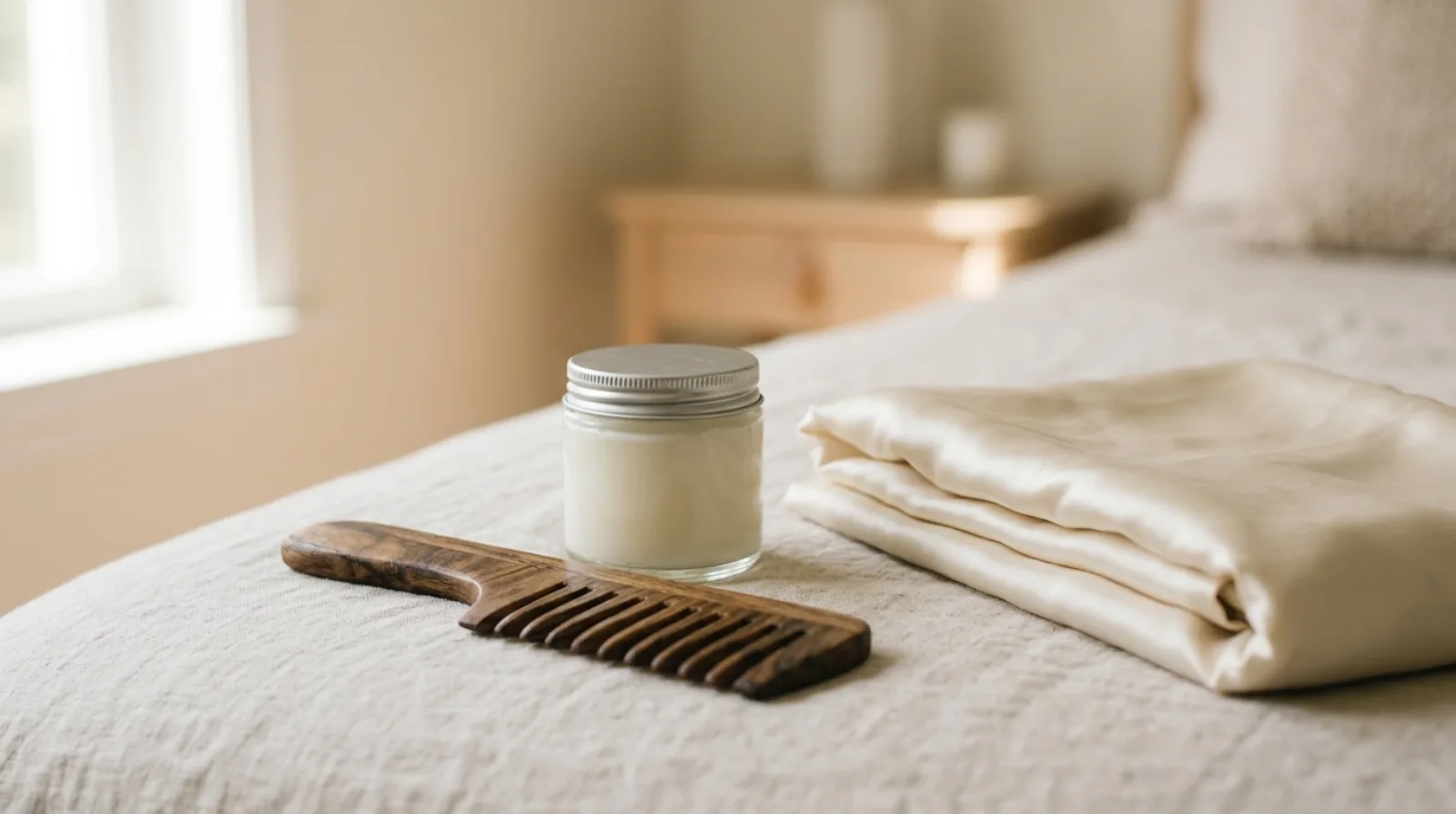
Your hair knots within an hour of brushing it, even on an ordinary day. Tangles start where the outer layer of the hair, the cuticle, is raised or roughened instead of lying flat. That rough surface catches on the strand next to it instead of sliding past. Dryness, length, texture, sleep, wind and how you detangle all change how often that catching happens, which is why the same hair can tangle constantly in one season and barely at all in another.
Below are the causes worth checking, and a detangling method that removes knots without adding to the damage that caused them.
A raised or damaged cuticle catches on its neighbours
Every strand of hair is covered by a cuticle, described by StatPearls as flat, overlapping cells covering the hair shaft from the root to where it exits the skin. When those cells lie flat, strands slide past each other with almost no resistance. When the cells lift, chip, or are stripped away by heat, chemical treatment or rough handling, the surface turns rough at a microscopic level.
That change causes the tangle. Two strands with lifted cuticles hook into each other and stop sliding. The more of the strand has a lifted cuticle, and the more often two such strands cross paths, the more knots form for the same amount of handling. This is also why hair that was behaving normally can start tangling suddenly after a change like heat styling, a colour service, or a lot of sun, since all three roughen the same surface.
Run a fingernail along a dry strand from the scalp toward the ends, then back the other way. It takes ten seconds. Hair with a flat cuticle feels smooth on the way down and rougher on the way back up, because the cell edges point toward the ends. Hair that feels rough in both directions has more of its cuticle lifted, and that is the hair most likely to knot the moment it touches its neighbours.
Dry hair tangles more than moisturized hair
Dry hair carries the same lifted-cuticle problem as damaged hair, for a related reason: a cuticle that has lost moisture does not lie as flat against the strand as one that is properly hydrated. Curly and coily hair is drier than other hair types by nature, as the American Academy of Dermatology notes on its curly hair care page, which is part of why those textures tangle more even when the hair itself is not damaged.
Conditioning the full length of dry or curly hair, mid-lengths as well as ends, keeps more of the cuticle lying flat for more of the day. This is a routine fix, not a one-time treatment: dryness returns within a day or two of the last wash for hair that runs dry, so the conditioning step needs to repeat on the same schedule to keep working.
Length and fine texture bring more strands into contact
Longer hair has more surface area in motion at any given moment, and more chances for two strands to cross and catch. Fine hair adds to this because thin strands bend and wrap around each other more easily than thick, stiffer strands do, and there are usually more of them per area of scalp doing the wrapping.
Length and fine texture are not faults to fix. They are facts about the hair you have. The useful response is to adjust how often and how carefully you detangle. Longer, finer hair generally needs a wide-tooth comb daily, or close to it, while shorter or coarser hair may go several days without needing one at all.
Sleeping without protection for the hair
A pillowcase creates friction against hair all night, every night, for as many hours as you sleep. The American Academy of Dermatology's curly hair care guidance is direct about the result: friction against the pillowcase while sleeping can make hair frizzy and easier to break, and it recommends tying hair into a loose ponytail or braid before bed specifically to reduce that contact.
A full routine for protecting hair overnight, including which fabrics create less friction and how to style hair before bed by length and texture, is in night hair care. The short version: eight hours of loose hair on a pillow is more contact time than any other habit on this list gives it, so it is the first thing to change. A loose braid takes under a minute and holds the length in one piece, so the pillow rubs against the surface of the braid instead of against every strand.
Wind and everyday movement
Wind moves strands against each other fast, in directions they would not otherwise cross, for as long as you are outside in it. A single windy commute can undo a detangling job that took several minutes that morning.
Tying hair back, or keeping it in a single braid on a windy day, limits how much of the length is free to move on its own. A braid does this better than a ponytail, because a ponytail still leaves the tail free to whip and knot. This is a fix for windy days, not a permanent change to how you wear your hair.
A scarf or a hood adds a second kind of friction on top of the wind itself, since hair rubs against fabric every time the head turns. A smoother fabric close to the hairline helps. So does tucking loose ends inside the collar instead of leaving them to blow against it.
Brushing the wrong way, at the wrong time
Hair is at its most fragile when wet, and the American Academy of Dermatology's healthy hair tips page is specific about the tool: use a wide-tooth comb instead of a brush to detangle wet hair. A brush pulls through several strands from multiple points at once, and on wet, swollen hair that pull is more likely to snap strands than smoothly separate them, and the broken pieces then catch on the hair around them and create more tangles than existed before.
The same source recommends combing gently, starting at the ends and working upward, instead of starting at the root and dragging a knot down the full length. That order matters: pulling a tangle downward pulls it tighter and forces it through hair that is not yet detangled, while working from the ends up removes small knots before they can join a larger one.
Layers that are too short for the length
Short layers mixed into longer hair create pieces that move independently of the length around them, which raises the chance of a short strand wrapping around a longer one nearby. This is a design trade-off rather than a mistake: layers add movement and shape precisely by letting sections move independently, and that same movement is what increases tangling in hair with a lot of contrast between its shortest and longest pieces.
If a haircut update is what is driving new tangling that was not there before, the layers themselves, not a scalp or hair health issue, are the most likely explanation. A stylist can soften the transition between lengths to reduce it without removing the layering altogether.
Fine hair with short layers tangles more than thick hair cut the same way, because the same wrapping problem covered earlier applies again here: a thin, short piece has less structure to hold its own shape and wraps around a longer neighbour more readily than a thicker one would. Mentioning both your texture and how much tangling bothers you before a cut gives a stylist the information needed to place layers where they add movement without adding more contact points than you want to manage day to day.
Curls and coils tangle by structure, not damage
Tightly curled and coiled hair bends back on itself many times over a short distance, which brings far more of the strand's length into contact with its neighbours than a straight strand covering the same distance ever does. Combined with the dryness curly and coily hair carries by nature, this means tangling is a normal, expected feature of the texture and not a sign that something is wrong with the hair.
The goal is to manage how often tangling happens, since removing it entirely is not realistic for this texture. The same core habits that help every texture apply here: keeping the hair conditioned, detangling wet hair with product in it instead of dry, and protecting the hair overnight.
Detangling that removes knots without adding damage
The method the American Academy of Dermatology describes across its hair care pages is consistent: remove tangles gently, using a moisturizing conditioner if necessary, and use a wide-tooth comb rather than a brush. Its healthy hair tips page adds the direction that matters most: comb the ends of your hair first, then keep combing higher, rather than dragging the comb through the full length at once. Work in sections about two fingers wide, and finish one before starting the next. The comb itself matters as much as the technique; a full comparison of comb and brush types by hair length and texture is in brushes and combs for your haircut.
Avoiding pulling and tugging, which the same source warns against directly, is the step most likely to keep a tangle from turning into breakage. A section that will not release with gentle, repeated combing is better left with extra conditioner worked in and a few minutes' wait than forced through with more pressure.
What to change first
Start with what happens overnight, since it runs for the most hours with the least attention: protect hair while you sleep and detangle before bed instead of in the morning. Add conditioner through the full length, not the ends alone, if your hair runs dry, and switch to a wide-tooth comb on wet hair if you are currently using a brush. Change one thing at a time and give it a week, so you know which change did the work.
If tangling changed suddenly rather than being a constant feature of your hair, look for what changed in the two weeks before it started: a new heat tool, a colour service, or new layers. That is usually a faster answer than trying every fix on this list at once, and it is the same reasoning the Kurli AI Specialist applies when it reads your own hair in photographs rather than working from a general list.
Common questions
Why hair tangles at ends?
The ends are the oldest part of the hair and have been through the most washing, brushing and styling, so the cuticle there is more likely to be lifted or worn away than it is at the roots. A rougher cuticle catches on the strand next to it instead of sliding past it, and that catching is what a tangle is. Trimming worn ends periodically reduces this by removing the most damaged section.
What type of hair tangles easily?
Dry, curly, coily and fine hair all tangle more than average, each for a different reason. Curly and coily hair bends back on itself many times over a short distance, fine hair wraps around itself easily, and dry hair carries a rougher, less flat cuticle than well-conditioned hair. Hair with more than one of these traits at once, such as fine and curly together, usually tangles the most.
Is tangled hair bad?
Not on its own. A tangle is friction between strands with a roughened surface, not a sign of disease or permanent damage. It becomes a problem only if it is pulled apart roughly, which can break the hair, or left long enough to mat into a section that is hard to separate without cutting. Gentle, regular detangling keeps ordinary tangling from reaching that point.
Are hair knots bad?
A single knot is not harmful on its own, but repeated knotting in the same spot usually means that section of hair has a rougher cuticle than the hair around it, often from heat, colour or friction. Removing the knot gently with conditioner and a wide-tooth comb, rather than pulling it out, prevents an ordinary knot from turning into breakage.
Can tangled hair cause headaches?
We know of no research connecting ordinary tangling to headaches. A tight knot or a matted section close to the scalp can pull on hair follicles and feel sore while it is being handled, which some people describe as a headache-like feeling, but it resolves once the tangle is removed and is not evidence of an underlying problem.
Why does my hair tangle so easily?
Most often because the cuticle, the outer layer of the strand, is raised or roughened instead of lying flat, from dryness, heat, colour treatment or friction, and roughened strands catch on each other instead of sliding past. Texture adds to this: fine, curly, coily or longer hair brings more strand-to-strand contact into every movement. Identifying which of those applies to your hair points to a specific fix rather than a general one.
Why hair tangles at nape of neck?
The nape gets more friction than almost any other section, from collars, scarves, backpack straps and the back of a chair, all rubbing against hair that is also harder to see and check. That repeated friction roughens the cuticle in that one spot faster than elsewhere, so it tangles first and worst. Wearing hair up or braided when using a backpack or scarf reduces this directly.
What does it mean when your hair tangles easily?
It usually means the outer layer of your hair, the cuticle, is not lying flat, either from dryness, heat or chemical damage, or from a texture that naturally brings more of the strand into contact with itself, such as curls or coils. It describes your hair's current condition and structure, not a diagnosis of anything wrong, and it can change as damaged sections grow out or your routine changes.
How do you get hair knots out?
Work conditioner into the knot while the hair is wet, then use a wide-tooth comb starting below the knot and moving upward in small sections, rather than pulling from above it. This releases the tangle gradually instead of tightening it. A knot that will not release with repeated gentle combing is better left with more conditioner and a few minutes' wait than forced with extra pressure.
Does thick hair get tangled easily?
Thick hair, meaning a high number of strands per area of scalp, tangles less easily than fine hair in general, because sturdier strands bend and wrap around each other less readily. Thick hair that is also dry or curly can still tangle often, since dryness and curl pattern matter more than density for how much strands catch on one another.
Does curly hair get tangled easily?
Yes, more than straight hair on average, because curls bend back on themselves repeatedly over a short distance, which brings much more of each strand into contact with the strands around it. Curly hair is also drier than other hair types, as the American Academy of Dermatology notes, and dryness roughens the cuticle further. Regular tangling is a normal feature of curly hair, not a sign of damage.
Does wavy hair get tangled easily?
Less than tightly curled hair, but more than straight hair, since a wave still bends back on itself, just less often over the same length. Wavy hair that is also fine or dry tends to tangle more than wavy hair that is thick and well conditioned, so the combination of traits matters more than the wave pattern alone.
Does fine hair get tangled easily?
Yes, because thin strands bend and wrap around each other more easily than thick strands do, and fine hair often grows in higher density, which puts more strands in contact with each other at once. Fine hair that is also long or curly tangles the most, since length and curl both add more chances for strands to cross and catch.
Does sleeping on a cotton pillowcase make hair tangle more?
Any pillowcase creates friction against hair overnight, and the American Academy of Dermatology's curly hair guidance names that friction as a cause of frizz and breakage, recommending a loose braid or ponytail before bed to reduce it. Smoother fabrics create less drag than rougher ones, but the bigger factor is simply how much hair is left loose against any pillow for eight hours.
Is it bad to brush your hair when it's wet?
Brushing wet hair with a standard brush is one of the more damaging habits for tangle-prone hair, since wet hair is more fragile and a brush pulls through several strands from multiple points at once. The American Academy of Dermatology recommends a wide-tooth comb instead, used gently, for wet hair, which separates strands with far less force than a brush applies.
Can layers make hair tangle more?
Yes. Short layers mixed into longer hair create pieces that move independently, and that independent movement raises the chance of a shorter strand wrapping around a longer one nearby. This is a normal trade-off of layered movement rather than a mistake, and a stylist can soften the length transition to reduce it without removing the layering.
What is the best comb for detangling hair?
A wide-tooth comb, used on wet or damp hair with conditioner in it, starting at the ends and working upward. The wide spacing separates strands with less pulling force than a brush or a fine-tooth comb, which matters most on hair that already tangles easily. A full comparison of combs and brushes by hair length and texture is in brushes and combs for your haircut.
Should I detangle my hair before or after washing it?
Both, if your hair tangles easily. A light comb-through before washing removes loose knots before water and product make hair more fragile, and a second, more thorough detangling after conditioner is applied removes anything that formed during washing, while the hair is at its most slippery and easiest to work through.
See it on your own face
Upload a selfie and Kurli recommends the hairstyles that suit you, then renders each look onto your photo.