Virtual try-on
AI buzz cut simulator
The least reversible haircut there is. Look at it on your own head first.
A buzz cut simulator shows you a shaved head on your own face before anyone picks up clippers. Upload a front-facing selfie to Kurli, pick a guard length from a close number one to a longer number four, and the AI renders it onto your photo. It is the least reversible haircut there is, so seeing it first matters.
Tap to pick a selfieDrop a selfie here, or click to browse
Front-facing, well-lit photos work best.
Your photo is used only to render the style and isn't stored.
Key takeaways
- A buzz cut is measured in clipper guard numbers, where each number is roughly an eighth of an inch of remaining length.
- Head shape becomes fully visible once the hair is gone, which is the thing most people have never actually seen on themselves.
- A buzz cut exposes the scalp to sun, and dermatologists treat a shaved scalp as skin that needs protecting.
- Growing a buzz cut back to a short crop takes roughly four to six months at normal growth rates.
- Buzzing does not change how thick hair grows back, despite the persistence of that belief.
- A taper or fade at the sides softens the outline without adding any length on top.
Variations to try
Tap any one to load it into the box above, then press see it on me.
Buzz cut guard lengths compared
| Guard | Length left | Scalp visible? | Re-cut every | Grow out to a crop |
|---|---|---|---|---|
| No guard | Under 1 mm | Yes, clearly | 1 to 2 weeks | 5 to 7 months |
| Number one | About 3 mm | Yes | 2 weeks | 5 to 6 months |
| Number two | About 6 mm | Slightly | 2 to 3 weeks | 4 to 6 months |
| Number three | About 10 mm | No | 3 to 4 weeks | 4 to 5 months |
| Number four | About 13 mm | No | 4 weeks | 3 to 4 months |
Who a buzz cut suits
The honest answer is that a buzz cut suits head shape far more than it suits face shape, and head shape is the one thing almost nobody has ever seen on themselves. That is the whole argument for previewing it.
With the hair gone, the outline of the skull becomes the outline of your silhouette. A flat spot at the back, a pronounced occipital bone, or an uneven hairline that was invisible under length becomes the main event. None of that is a problem in itself, but it is information you would rather have before than after.
Strong features generally carry a buzz cut well, because there is nothing else competing for attention. A defined jaw, prominent cheekbones, or a strong brow all give the eye somewhere to land. Softer features are not disqualified at all, but many people find a number three more comfortable than a number one, since a little length keeps some frame around the face.
A buzz cut is also the standard answer for a receding hairline, and for good reason. Shortening everything removes the contrast between the thin areas and the thick ones, which is what actually makes recession obvious.
The fuller breakdown by face shape is in the guide linked above.
One more thing worth knowing before you decide. A buzz cut changes how people read your face, not just your hair. With no length to soften the outline, expression carries more weight, and most people find they notice their own ears, brows, and neck far more in the first week than anyone else does. That reaction settles quickly, but it is real, and it is easier to handle if you were expecting it rather than discovering it in the mirror on day one.
How to describe a buzz cut to the AI
Buzz cuts are the easiest style to describe accurately, because the industry already uses numbers.
Give the guard number. Number two buzz cut is precise. Short back and sides is not. If you do not know the numbers, the comparison table above maps each one to a length in millimetres.
Say whether it is uniform. All one length, or shorter at the sides than the top. A uniform buzz and a burr cut look different in a render and different in the mirror.
Mention the edges if you want them. A squared-off line-up at the front hairline is a distinct choice and the model will include it if you ask. Left unsaid, you will get a natural hairline.
Add colour separately if you want it. Bleached buzz cut to platinum is a reasonable prompt, and short hair is genuinely the cheapest place to test a colour you are unsure about.
Run several guard numbers rather than one. The gap between a number one and a number three is a few millimetres of hair and a surprisingly large difference in how the render reads.
What the render gets right, and where it is approximate
Reliable. The overall silhouette, how much of your ears and neck are exposed, how the hairline sits across your forehead, and roughly how a given guard length changes the balance between the top of your head and your face. These are the questions that decide whether you go through with it.
Approximate. Exact stubble texture and how much scalp shows through at very short lengths, which depends heavily on your natural density and the contrast between your hair and skin tone. Someone with dark hair and pale skin will see far more contrast at a number one than the render is likely to show.
Not modelled at all. Scars, birthmarks, and the shape of the back of your head, none of which appear in a front-facing photo. Any unevenness in your hairline at the temples. How grey hair reads once it is very short, which is often quite different from how it reads long.
A buzz cut is the one style where it is worth being cautious about a good render, because the downside is measured in months. If you are on the fence, cut to a number four first and look at that in a mirror before going shorter. The render narrows the decision. It should not make it for you.
Before you book, and the week after
You do not really need a consultation for a buzz cut. You need a guard number and a barber, and the whole thing takes about ten minutes. What you do need is a plan for the fortnight afterwards.
Protect your scalp. A shaved head puts skin that has never seen direct sun straight into it, and the American Academy of Dermatology treats scalp as skin that needs the same protection as anywhere else. Sunscreen or a hat, from day one, not from the first time you burn.
Expect the first three days to feel strange regardless of how good the render looked. Almost everyone reports this, and almost everyone stops noticing by the end of the first week.
Budget for maintenance. A number one needs re-cutting roughly every two weeks to stay looking deliberate, which is more often than most longer cuts, even though each visit is quicker and cheaper. Clippers at home pay for themselves within a couple of months if you plan to keep it.
And if you decide against it, nothing is lost. That is exactly what the preview is for.
Common questions
Can I see what I would look like with a buzz cut?
Yes. Upload a front-facing selfie to Kurli, name the clipper guard you are considering, and the AI renders that length onto your own photo while keeping your face. It is the only way to see it without cutting anything.
What clipper guard number should I ask for?
A number two is the most common starting point at roughly six millimetres. A number one is closer and shows scalp, a number three leaves enough to look soft. Preview two or three before deciding, because the difference is larger on a face than it sounds in millimetres.
Does a buzz cut suit my head shape?
That is the real question, and it is why previewing helps. A buzz cut makes the outline of your skull your silhouette, and most people have never seen their own head shape. The render shows you the outline before you commit to it.
Is a buzz cut good for a receding hairline?
Very often, yes. Recession is most visible as contrast between thin areas and thick ones, and taking everything short removes that contrast. It is one of the most commonly recommended approaches for thinning at the front.
Does shaving your head make hair grow back thicker?
No. Cutting hair does not change the follicle, so it does not change how thick or how fast hair regrows. Regrowth feels coarser because a blunt cut end is stubbier than a tapered one, which is where the belief comes from.
How long does a buzz cut take to grow out?
Getting back to a short crop takes roughly four to six months, depending on the guard you started from. Scalp hair grows about a centimetre a month, so the timeline is fairly predictable.
Do I need to protect my scalp after a buzz cut?
Yes. Your scalp is skin that has been shaded by hair, and taking that cover away exposes it directly to sun. Dermatologists advise sunscreen or a hat on an exposed scalp from the first day, not after the first burn.
How often does a buzz cut need re-cutting?
Every two weeks at a number one, stretching to about four weeks at a number four. Shorter buzz cuts lose their deliberate look faster, though each appointment is quick and cheap.
Can women get a buzz cut?
Of course, and the simulator works exactly the same way. The same guidance applies: head shape matters more than face shape, and previewing a number three before a number one is a sensible order to go in.
Is the buzz cut simulator free?
Browsing styles and reading the guides is free. Rendering a look onto your own photo uses a credit, because that step runs an image model that costs money on every render.
Sources
Hair facts on this page are supported by these sources. What the render will look like on you is a preview, not a promise.
- Hair removal: How to shave, American Academy of Dermatology
- Hair Loss Resource Center, American Academy of Dermatology
- Physiology, Hair, StatPearls, NCBI Bookshelf
- Folliculitis, MedlinePlus, U.S. National Library of Medicine
Try another style
Keep reading
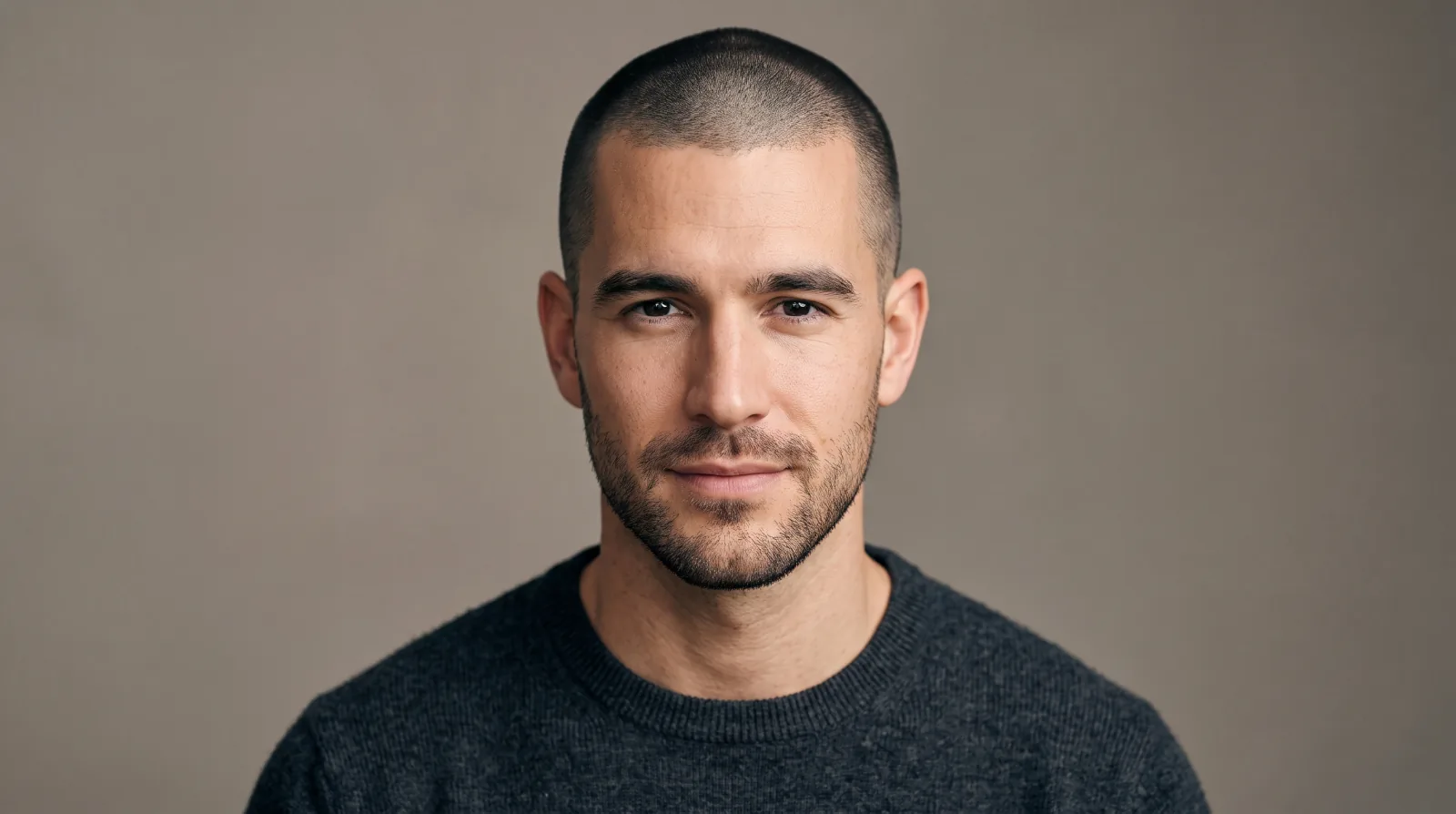
Illustration: Kurli