The Kurl
Does towel drying damage hair? Yes, if you rub it
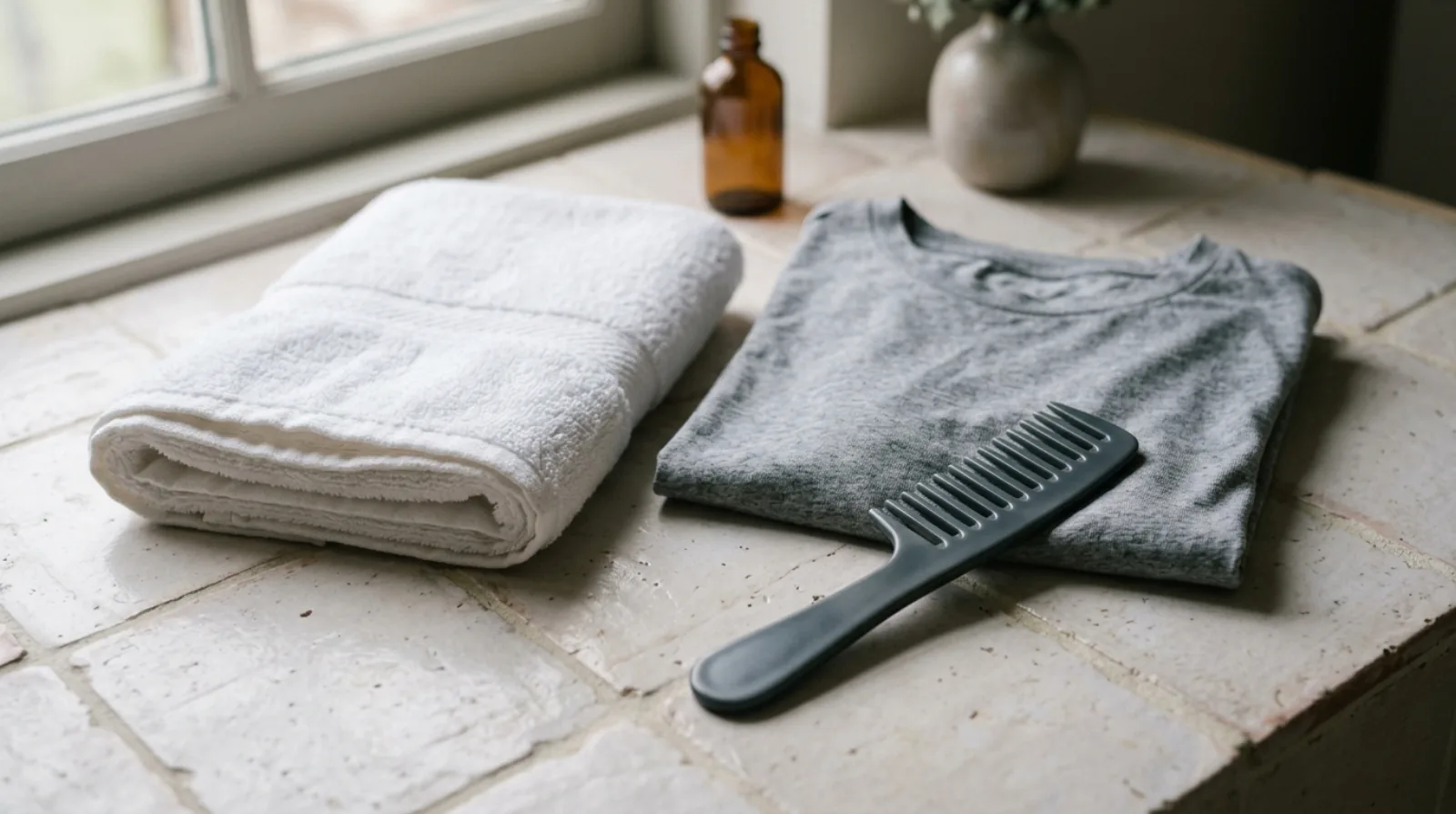
Nobody in dermatology tells you to stop using a towel. They tell you to stop rubbing with one, and the difference between those two instructions is the whole answer.
The American Academy of Dermatology's tips for healthy hair puts it in a single sentence: wrap your hair with a towel or a t-shirt to gently absorb the moisture, because roughly rubbing your hair dry can cause damage. Its list of habits that damage hair names towel rubbing as one of the ten, and gives the same replacement: wrap the hair in a towel to absorb the water.
So the towel is fine. The scrubbing motion your parents used on you as a child is the problem.
Why wet hair loses this fight
Wet hair is the weakest version of your hair. The AAD says hair is delicate when it is wet, and its styling guidance tells most people to handle wet hair as little as possible because it breaks more easily.
Water does this by getting inside the shaft. The review Hair Cosmetics: An Overview in the International Journal of Trichology describes water absorption swelling the hair, and gives the stretching limits: untreated wet hair travels 30 per cent past its own length and recovers, changes permanently between 30 and 70 per cent, and fractures at 80 per cent.
Now picture what a rub does. Hundreds of strands, each pointing a different direction, pinned between two moving surfaces. Some are pulled, some are folded back on themselves, and the ones caught in a knot get the full force of your arm. A dry strand in that situation tends to stop. A wet strand stretches into it first.
What squeezing does that rubbing does not
Squeezing works by capillary action. You press the fabric against the hair, the fabric takes water out of it, and the hair itself barely moves. There is contact but almost no sliding, and sliding is where the damage comes from.
Rubbing takes out the same water and adds a few thousand small drags across the outer surface of the hair. That surface is made of overlapping plates that lie flat when hair is smooth. Lift them and hair catches on itself, tangles more, and scatters light instead of reflecting it, which is the dull, fluffy look people call frizz.
The two motions take about the same amount of time. That is the part worth sitting with, because there is no trade here. You are not choosing between a fast rough method and a slow gentle one. You are choosing between two methods that cost you the same two minutes.
Microfiber, cotton and the t-shirt
This is where we are going to disagree with most of the internet.
Microfiber hair towels are light, they hold a lot of water for their size, and they stay on your head without a heavy turban hanging off your neck. All of that shortens the time you spend handling wet hair, and we use them.
What we cannot tell you is that microfiber is proven gentler than cotton. Every comparison we found was published by a company selling microfiber towels. No dermatology body we can find ranks the two fabrics against each other. The AAD names a towel or a t-shirt and stops there, which is a reasonable place to stop when there is no evidence for going further.
The cotton t-shirt deserves the attention it gets, and for a reason people rarely state. Jersey, the knit a t-shirt is made from, is a flat surface. Terry towelling is made of raised loops, and loops are what a strand of hair catches on. That is a difference you can see by holding both up to the light, and it does not need a study.
So our honest ranking, stated as an opinion rather than a finding: a t-shirt or a microfiber towel over a thick terry bath towel, and the verb you use matters more than any of the three.
How long to leave hair wrapped
Two or three minutes takes out most of the water that a towel can reach. After about ten minutes the fabric is close to holding what it can hold, and you are mostly keeping your head warm.
There is a reason not to leave it much longer than that. Cleveland Clinic's page on wet hair and illness notes that fungi and bacteria grow in warm, moist conditions, and names Malassezia folliculitis, a yeast infection of the hair follicle that can cause dandruff or scalp dermatitis. A towel wrapped around your head for an hour is a warm, moist condition by definition.
Nobody has measured how many minutes is too many, and we are not going to invent a number. What we would do: wrap, do something else for a few minutes, unwrap, and let the rest of the drying happen with air reaching the scalp.
The same logic applies to sleeping in a towel, which people ask about often. We would not, for the same reason, and because a towel shifts all night, which is the rubbing you were avoiding. More on the overnight version of this question is in is it bad to sleep with wet hair.
Plopping, and what it is actually for
Plopping is laying a t-shirt or a flat towel on a surface, tipping your head forward so the hair falls into the middle of it, and wrapping the fabric up and around your head so the curls sit piled on top rather than hanging down.
It is a curl technique, not a drying technique. It removes some water, and the reason people do it is that the curls dry in a stacked position rather than being pulled straight by their own weight. That gives shorter, tighter curls with more volume at the root.
If your hair is straight, plopping does nothing for you and a normal squeeze is faster.
If your hair curls, twenty minutes is the usual window people use. Long enough to take water out, short enough that the curls are still wet when they come down and can settle into place. Anything past forty minutes and you are back to the warm damp scalp problem. The wider method for drying curls is in diffusing and air drying curls.
How to towel dry, step by step
Start in the shower. Squeeze water out with your hands before you reach for anything, working down the length. That is free water removal and most people skip it.
Lay the towel flat over your hand. Take one section of hair into it, bring your other palm up underneath, and press for three or four seconds. Release. Move to the next section. Four or five sections covers most heads.
For curls, press upward toward the scalp rather than downward along the length, so the curl stays compressed in its own shape.
Then wrap the whole head loosely for two or three minutes. Loose matters: a tight turban pulls at the hairline the same way a tight ponytail or braid does, and the American Academy of Dermatology lists hairstyles that pull as a cause of genuine hair loss over time. A rough rub breaks hair along its length. Sustained pulling at the root is the more serious risk, and it is the one a loose wrap avoids. If the fabric leaves a red line across your forehead when you take it off, it was tied too tight.
Unwrap and comb with a wide-tooth comb, starting at the ends and working higher, which is the order the AAD gives. If your hair is straight, wait until it has dried further before you comb. If your hair curls, comb now while conditioner is still in it.
Then leave it alone. The washing side of the routine, including what happens before the towel ever comes out, is in how to wash your hair.
What towel dried hair means on a label
Product instructions say apply to towel dried hair and then do not explain it, which sends people to search engines in large numbers.
It means damp. The hair has had the water absorbed out of it, so it is not dripping, and it is still cool and heavy when you touch it. That state exists because most leave-in conditioners, curl creams and heat protectants need water in the hair to spread evenly. Put the same product on bone-dry hair and it sits in patches where your hands went.
The quick test: press a palm flat against your head. If it comes away wet, keep squeezing. If a strand feels cool and heavy but leaves nothing on your skin, that is the window. It takes ten seconds and saves you from applying a leave-in twice: once on hair too wet for the product to grip, and again after it has slid straight off.
Short hair, men, and the ten-second rub
Short hair gets rubbed harder than any other length, because it is over in ten seconds and nobody thinks about it.
The hair is still wet and still weak, and the rub is still lifting the surface. On short hair the visible result is different: not frizz down the length, but a rough, dull texture and ends that look fluffy rather than sharp within a week of a cut.
The fix takes no longer. Press the towel against your head and lift it off, two or three times, instead of scrubbing. On a buzz or a short crop this genuinely takes five seconds.
What we would do
Squeeze in the shower, press section by section into a t-shirt or a light towel, wrap loosely for two minutes, comb from the ends, then stop touching it.
That is the whole method, and it costs nothing and no extra time.
One honest limit. Towel technique protects hair you still have. It does not repair hair that is already rough, and rough hair snags on any fabric, which is why some people find that switching towels changed nothing. If your hair tangles badly every wash regardless of how carefully you handle it, the condition of the hair is the thing to fix first, which is the case made in hair before the cut. Working out which part of your routine is causing it means reading your own hair rather than trying one change at a time, and the Kurli AI Specialist does that reading from three photographs.
Common questions
Does towel drying damage hair?
Rubbing does. Wrapping does not. The American Academy of Dermatology advises wrapping hair in a towel to absorb water, and says roughly rubbing your hair dry can cause damage. The difference is friction: squeezing moves water out through the fabric, while rubbing drags every strand back and forth across a rough surface while it is at its weakest.
Does towel drying cause frizz?
Rough rubbing does. Hair has an overlapping outer surface that lies flat when the hair is smooth, and rubbing lifts it. Lifted surfaces catch on each other as the hair dries, and that is what frizz looks like up close. Squeezing water out section by section leaves that surface where it was.
Does towel drying cause split ends?
It contributes, because the ends take the most of it. The ends are the oldest part of the hair and the part a towel handles hardest, and the review Hair Cosmetics in the International Journal of Trichology links short breaks near the ends to split ends spreading. A towel cannot repair a split end. Scissors are the only thing that removes one.
Does towel drying cause hair loss?
It causes breakage rather than hair loss. Breakage snaps the strand along its length while the follicle carries on growing hair, so the length thins and short pieces appear. Real hair loss starts at the follicle. If you are finding full-length hairs with a small pale bulb at one end, that is normal shedding, not the towel.
How to towel dry hair without damaging it?
Squeeze, do not rub. Lay the towel flat, take a section of hair into it, press your palms together for a few seconds, release, and move to the next section. Then wrap the whole head loosely for two or three minutes. Comb afterwards with a wide-tooth comb, starting at the ends, which is the order the American Academy of Dermatology gives.
What does towel dried hair mean?
It means damp, not dry. The water has been absorbed out so the hair is no longer dripping, but it is still cool and heavy to the touch. Product instructions use the phrase because most leave-in conditioners, creams and heat protectants spread evenly on hair that still holds some water and go patchy on hair that is bone dry.
How wet should towel dried hair be?
Damp enough that a strand feels cool between your fingers and leaves no water on your palm. If you press your hand to your head and it comes away wet, keep squeezing. If the ends feel dry and separate easily, you have gone past the window most products are written for and it is worth misting the hair before you start.
How long should you let your hair dry in a towel?
Two or three minutes takes out most of the water a towel can reach. Beyond about ten minutes you are gaining little, and leaving hair wrapped for an hour keeps the scalp warm and damp, which Cleveland Clinic notes is the condition fungi and bacteria grow in. Wrap, wait a few minutes, unwrap, then let the rest happen in the air.
Are microfiber towels good for hair?
They are lighter and hold more water than a thick bath towel, which means less time and less handling. What we cannot tell you is that they are measurably better than cotton, because the comparisons come from companies selling microfiber towels and we found no independent test. The American Academy of Dermatology names a towel or a cotton t-shirt and does not rank the fabrics.
Do microfiber towels dry hair faster?
They absorb water faster than a heavy terry towel, in our experience, which shortens the wrapped stage. The claimed percentages you see online come from the brands selling them. What matters more than the fabric is what you do with it: a microfiber towel used to rub hair back and forth still lifts the surface and still breaks hair.
Should you towel dry curly hair?
Squeeze it, and never rub it. Rubbing separates curl clumps into single strands, and single strands dry as frizz. Cup a section in the towel, press upward toward the scalp so the curl keeps its shape, hold for a few seconds, release. A cotton t-shirt is the usual choice for curls because jersey has no loops to catch on.
Can I sleep with my hair in a microfiber towel?
We would not. A towel worn all night holds water against your scalp for hours, and Cleveland Clinic warns that a warm, damp scalp is where fungi and bacteria grow. The towel also shifts as you move, which is the rubbing you were trying to avoid. Wrap for a few minutes, take it off, then tie the hair loosely.
Does towel drying hair cause balding?
No, and the two are different mechanisms. What a towel can do is snap hair along its length through friction, which thins the look of your hair without touching a single follicle. Balding is a change at the follicle itself, under the skin, where a towel never reaches. If your hair is thinning at the scalp rather than showing short broken pieces on your pillow, that is a question for a dermatologist, not your towel technique.
Does towel drying cause dandruff?
Not directly, and leaving hair wrapped too long can make an existing scalp problem worse. Cleveland Clinic notes that fungi and bacteria grow in warm, moist conditions, and a towel wrapped around your head for an hour keeps the scalp in exactly that state. Two or three minutes of wrapping is enough to take out most of the water, so unwrap and let the rest dry in the air rather than leaving the towel on.
Is it better to air dry or towel dry?
They are not rivals. They are two steps in the same process. Towel drying, done by squeezing rather than rubbing, removes the water a towel can reach in two or three minutes at no cost to the hair. Air drying is what happens to the water left after that, and it can take hours on its own. Most routines that work well use both: squeeze first, then let the rest finish in the air.
Does towel drying make hair straight?
No. Rubbing or squeezing with a towel removes water and does not reshape the hair shaft the way heat or tension does. What towel technique changes is texture, not shape: rubbing lifts the outer surface and adds frizz, while squeezing leaves it smoother, but neither one pulls a wave or a curl straight. Straightening needs heat, a brush pulling the section taut, or a chemical service, not a towel.
Which towel is best for drying hair?
A cotton t-shirt or a microfiber towel, ahead of a thick terry bath towel, and the verb you use matters more than the fabric. Jersey and microfiber are flatter surfaces than the raised loops of terry towelling, which is what a strand of hair catches on. We could not find an independent comparison ranking microfiber above cotton specifically, so treat that part as our opinion. Squeezing rather than rubbing makes a bigger difference than the towel you pick.
How often should you wash your hair towel?
Weekly is a reasonable habit, and sooner if you use it daily. Cleveland Clinic's reasoning about damp scalp conditions applies to the towel itself: it stays damp after use and dries slowly folded on a rail, which is a warm, moist setting fungi and bacteria can grow in. A towel used on wet hair every day and washed only once a month is putting the same growth conditions back on your head each time you use it.
See it on your own face
Upload a selfie and Kurli recommends the hairstyles that suit you, then renders each look onto your photo.