The Kurl
How much hair loss is normal in a day? What to count
One selfie. Your face shape and your best cut are free.
Kurli is an AI hairstyle advisor: upload one selfie and it reads your face shape, recommends the cuts that suit it, and renders any of them onto your own photo before you commit.
Skip the reading: one selfie, and Kurli shows the cuts that suit your face. The face-shape read and your top pick are free.
The figure you are looking for is 50 to 100 hairs a day. The American Academy of Dermatology gives that range in its guidance on hair loss and hair shedding, and most medical sources agree with it.
Now the part that is more use to you: counting hairs is a poor way to judge your own hair, and the number above will not settle the question that made you search for it.
Where the number comes from
Each hair on your head runs through a cycle, and the stages are well described: a growth phase called anagen that lasts two to six years for scalp hair, a short transition of about two weeks called catagen, a resting phase of roughly three months called telogen, and then the hair is shed. At any moment, somewhere between 85 and 90 percent of your follicles are in the growth phase.
Do the arithmetic on a typical head and the daily number falls out of it. With around 100,000 hairs, most of them growing for several years at a time, a small fraction reaches the end of its cycle every day. That fraction is the 50 to 100.
So shedding is not a fault. It is the visible end of a cycle that has been running in the background for years, and a head that sheds nothing would be a head that grew nothing.
Why the published figures disagree
Look at two reputable sources and you get two ranges. The American Academy of Dermatology says 50 to 100. Cleveland Clinic says 50 to 150. Neither is wrong.
The ranges are averages across many different heads, and the real figure for one person depends on things nobody adjusts for:
- How many hairs you have. Dense hair sheds more hairs a day than sparse hair at the same rate, because the rate is a proportion.
- How long your hair is. This changes nothing about shedding and everything about what you notice. A 60 centimetre hair in the drain is obvious; a 10 centimetre one disappears.
- How often you wash and brush. These do not cause shedding, they collect it. Changing your routine changes which day the hairs appear.
- Where you are in your life. Pregnancy, illness, a new medication and a period of stress all shift the number for months at a time.
Given all that, any single day's count sits inside a range so wide that it cannot tell you much.
 Related readIs sulfate-free shampoo better? When it helps and when it does not
Why the shower looks worse than everywhere else
Almost everyone who worries about shedding worries about the shower, and there is a simple reason.
When a hair finishes its cycle it does not drop out at once. It sits loosely in the follicle until something moves it. Washing moves it: the massaging, the lifting, the rinsing. So the hairs you find in your hands were already lost, and the shower is where you found out.
Add in the gap between washes. Cleveland Clinic notes that washing fewer than once or twice a week can produce a normal rise in shedding on wash days, because the loose hairs have had longer to gather. Three days between washes means three days of hair arriving at once.
This is also why cutting down on washing does not help. It moves the same hairs to a different day and makes that day look worse.
What to check instead of counting
Here is the shift that makes the question answerable. The thing you want to know is not how much hair is leaving. It is whether as much hair is coming back.
Four checks answer that, and none of them involve a count.
Photograph your part line. Same spot, same light, same angle, once a month. Hair takes months to thin visibly, so your own memory is a poor record and a photograph is a good one.
Measure your ponytail. Put a tape measure around it, not along it, and write the number down. A ponytail that has gone from 10 centimetres around to 8 has lost real density, and the tape notices long before you do.
Look for new scalp. Not how much scalp you can see if you look for it, but whether it shows through where it did not before, in ordinary light, without you parting the hair to check.
Check the hairs themselves. A shed hair is full length with a small pale bulb at one end. A broken hair is short, with no bulb, and often with a split or a pale point. Broken pieces mean damage, which is a different problem with different answers, and we set out the home checks in how do I know if my hair is damaged.
Photograph your part line once a month. It answers the real question, which is whether hair is coming back, not how much is leaving. The Kurli team
Shedding and loss are not the same thing
This is the distinction that most of the confusion sits on, and the guide on shedding versus thinning goes through it in detail.
Shedding is hairs completing their cycle and falling, with new hairs replacing them. The total stays about the same. You see it in the drain.
Loss is hairs not being replaced, or coming back finer each cycle. The total drops. You see it in the mirror, as a wider part or a thinner ponytail.
A lot of hair in the drain with no change in the mirror is shedding. No unusual hair in the drain with a part line that has widened over a year is loss. The second is the one that needs a diagnosis, and it is the quieter of the two.
 Related readWhat does clarifying shampoo do? Buildup, colour, and how often
The common cause of a real increase
When shedding genuinely rises, the usual explanation is telogen effluvium: a group of follicles pushed out of their growth phase early by a shock to the body, so they all reach the shedding stage at about the same time. The American Academy of Dermatology describes this as excessive hair shedding and notes it often stops on its own.
The triggers are familiar: childbirth, a high fever or illness, surgery, rapid weight loss, a new medication, a thyroid problem, low iron, and periods of severe stress.
The timeline is the part worth memorizing. The hairs come away two to three months after the event, because they have to finish the resting phase first. So by the time the shedding starts, the cause is often in the past, and people hunt for a reason in the wrong month. We go through this in does stress change your hair, and the postpartum version has its own timeline in postpartum hair loss.
Most of these settle within six to nine months once the trigger is gone, with the hair returning at normal growth speed, which is about a centimetre a month.
Does the season change it?
Plenty of people notice more hair in the drain in late summer and autumn, enough that dermatologists field the question every year. If that matches what you see, it is a common pattern rather than a sign of something new, and it usually settles within a couple of months with no treatment.
Two cautions go with it. The first is that a seasonal label is easy to reach for and easy to get wrong, so it only fits if the shedding also stops. Shedding still running at three months is not seasonal, whatever month it started in. The second is that other things cluster in the same part of the year: a summer of sun, chlorine and salt water, more heat styling for events, and for some people a round of illness as the weather turns. Any of those can raise shedding on its own.
The practical answer is the same either way. Note the date you first noticed it, take the monthly photograph, and give it eight weeks. If the drain is calmer and the part line is unchanged, it was a passing increase. If either is still going, it is time for the blood test rather than another month of waiting.
When to take it to a doctor
Go, rather than wait, if any of these apply:
- shedding that has gone on for more than three months
- hair coming out in distinct patches rather than evenly
- a scalp that is sore, scaly, red or painful
- a part line or crown that is visibly wider or thinner than in older photographs
- shedding alongside other symptoms, such as tiredness, weight change or changes to your nails
- any shedding in a child
A doctor can check iron, thyroid function and a few other common causes with a blood test, and look at your scalp directly. Those tests exist, the causes they find are treatable, and no routine change substitutes for them. Our guides on what a trichologist does and when a consultation should send you to a doctor cover who to see for what.
What not to do while you are waiting
Do not stop washing. It moves the hairs to another day and leaves your scalp worse.
Do not start a supplement because of the shedding alone. If your iron or vitamin D is low, you want to know the number and treat it properly. If it is normal, taking more does nothing for your hair.
Do not pull on your hair to test it. Repeated tug tests damage hair and give a result you will misread.
Do not count every day. It raises the anxiety and tells you nothing the monthly photograph does not tell you better.
If you want a read on your own hair and scalp while you sort out the medical side, the Kurli AI Specialist works from three photographs, face on, a small turn to one side, and the top of your head, plus four tapped questions. It writes back a routine: what it reads in your hair type, texture, density, scalp and damage, the one change to make first, wash-day steps with reasons, what to do between washes, a seven-day calendar, which ingredients to look for and avoid, your photographs marked up, and a plain note when something belongs with a doctor instead. It is care guidance, not medical advice, and it is not a diagnosis.
The thing to hold on to is the reframe. Shedding is the end of a cycle that worked. What matters is whether the next cycle starts, and a photograph of your part line answers that better than any number in a drain.
Common questions
How much hair loss is normal in a day?
The American Academy of Dermatology puts normal shedding at 50 to 100 hairs a day. Cleveland Clinic gives a wider figure of 50 to 150. Both are averages across many people, and your own number depends on how much hair you have, how long it is, and how often you wash and brush it. A single day's count tells you much less than a change you can see over two months.
How much hair is normal to lose in the shower?
A few dozen hairs in your hands and on the shower wall is ordinary, and more than that is ordinary if you do not wash daily. Washing dislodges hairs that already finished their cycle and were sitting loose in the follicle. If you wash every third day, you collect three days of loose hairs in one go, which is why the shower looks alarming and the brush does not.
How much hair loss is normal when washing hair?
Most people see somewhere between 20 and 100 hairs on a wash day, and people with long or dense hair see more because each hair is more visible. The figure rises the longer you go between washes. Cleveland Clinic notes that washing fewer than once or twice a week can produce a normal increase in shedding on wash days, since the loose hairs have had longer to collect.
How much hair loss is normal when brushing?
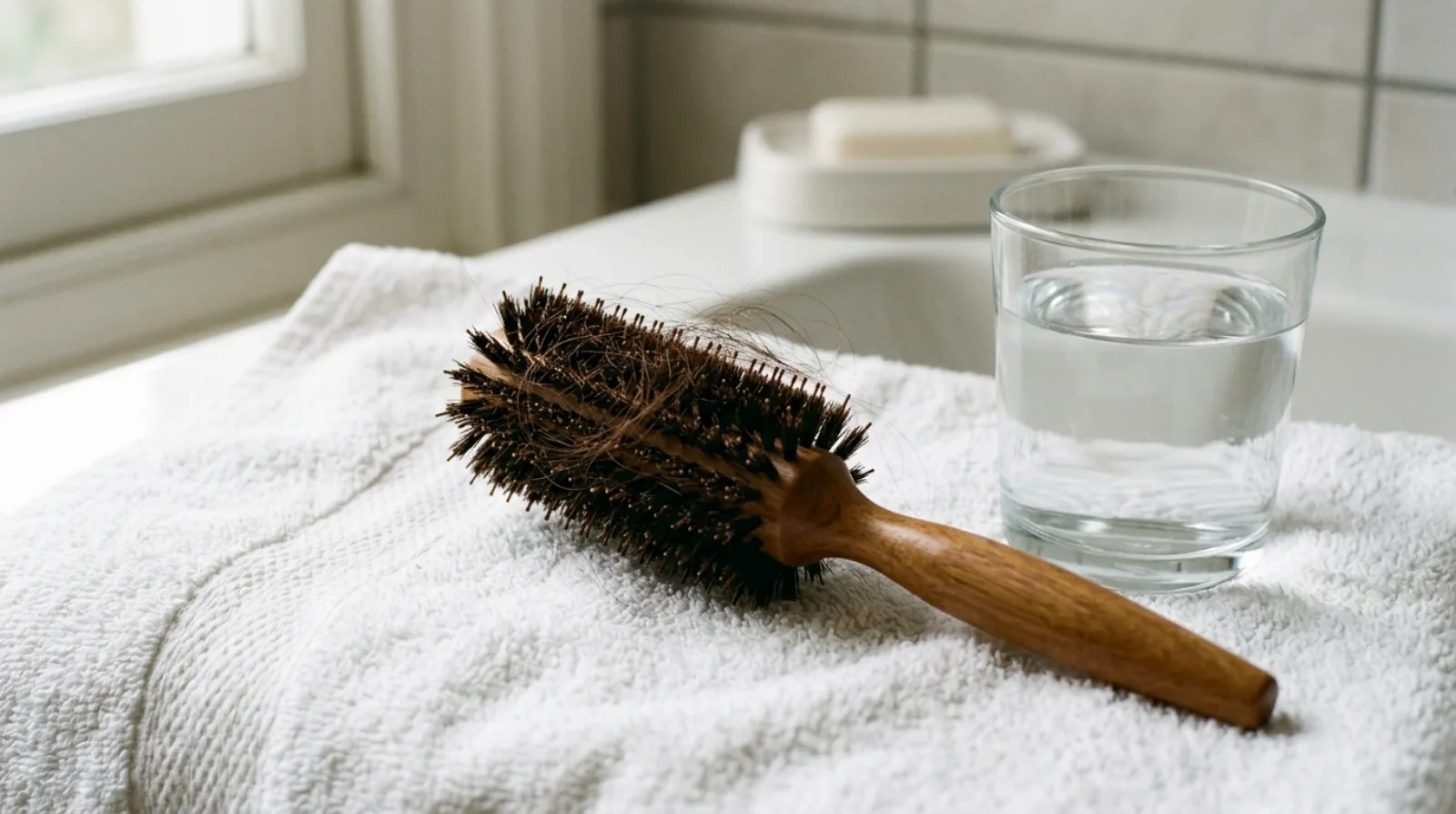
Five to fifteen hairs in the brush after a normal brushing is typical, and more after a few days without brushing. What is worth noticing is hair that comes away with no resistance from several places at once, or short broken pieces rather than full-length hairs with a small white bulb at one end. Broken pieces are breakage, not shedding, and they have different causes.
Am I losing too much hair?
Look at the pattern rather than the pile. Shedding that has lasted more than three months, a part line that is wider than it was, a ponytail that measures thinner around, or scalp showing through in new places all point to a real change. A day with a lot of hair in the drain, with no other change, usually does not.
Why do I lose more hair in the shower?
Because washing moves hairs that were already detached. A hair that reaches the end of its cycle stays loosely in the follicle until something pulls it free, and the massaging and rinsing of a wash does exactly that. The hair was lost before you got in the shower; the shower is only where you noticed it.
Is it normal to lose 100 to 200 hairs a day?
It can be, for someone with long, dense hair who washes and brushes often, but it sits at the top of the published ranges. One high count means little. A count that stays high over several weeks, together with a wider part line or a thinner ponytail, is worth taking to a doctor, because that combination suggests more hair is leaving than returning.
Does washing your hair cause hair loss?
No. Washing releases hairs that had already finished their cycle; it does not pull growing hairs out of the follicle. Cutting back on washing moves the same hairs to a different day rather than saving them. Cleveland Clinic's guidance on shedding suggests washing one to three times a week as a reasonable balance for most people.
Does washing less often reduce hair loss?
No, it concentrates it. The hairs that would have come away over three separate washes all come away in one, which makes a single wash look worse while the weekly total stays the same. If anything, going long between washes leaves more product and oil at the scalp, which has its own costs. Wash at the frequency that suits your scalp.
What can you do to stop your hair from falling out?
First work out whether it is shedding or loss, because the treatments differ. Shedding that follows a stressful event, illness, childbirth or a crash diet often settles on its own once the trigger has passed. Loss that comes with a widening part or a thinning crown is a pattern worth a doctor's assessment, since the treatments that work for it need a diagnosis first.
Is it normal to lose more hair in autumn?
Many people do notice more shedding in late summer and autumn, and it is a common enough pattern that dermatologists are asked about it every year. It usually settles within a couple of months without treatment. Seasonal shedding that keeps going past three months, or comes with visible thinning, deserves the same attention as shedding at any other time of year.
How do I count how much hair I am losing?
If you want to try, collect everything for one day: the drain, the brush, the pillow and your clothes, and keep it in one place. Do it on a non-wash day and again on a wash day, because the two numbers are not comparable. Most people find the exercise reassuring once, and then useless, which is why photographs of your part line are a better tool.
Does hair loss in the shower mean I am going bald?
Not by itself. Pattern hair loss shows up as hair getting thinner and finer in specific places, usually the part line, the temples or the crown, rather than as more hair in the drain. The useful test is whether your scalp is more visible than it was in photographs from a year ago, not how much hair you can see after a wash.
What is the difference between hair shedding and hair loss?
Shedding means hairs completing their cycle and falling out, with new hairs growing to replace them, so the total amount of hair stays about the same. Loss means hairs are not being replaced, or are coming back thinner each cycle, so the total drops over time. Shedding shows up in the drain; loss shows up in the mirror.
How long does it take to notice hair thinning?
Usually several months, because hair has to lose a fair proportion of its density before the change is visible. That is why photographs taken in the same light every month are more useful than daily inspection. By the time most people notice thinning, it has been happening for a while, which is an argument for photographs rather than for panic.
When should I see a doctor about hair loss?
See one if shedding has lasted more than three months, if hair is coming out in patches, if your scalp is sore, scaly or visible in new places, or if the shedding came with other symptoms such as fatigue or weight change. A doctor can check for the common treatable causes, including thyroid problems and low iron, with a blood test and an examination of your scalp.
Does long hair make shedding look worse?
Yes, and that fools a lot of people. A shed hair 60 centimetres long is far more visible in a drain than a shed hair 10 centimetres long, and it also tangles with its neighbours into a clump. The number of hairs did not change when you grew your hair. Cutting it shorter does not reduce shedding, it reduces how much of it you see.
Can stress make me lose more hair in a day?
Stress can increase shedding, but not on the same day. A stressful event pushes a group of follicles out of their growth phase early, and the hairs they are holding come away weeks later, which is why the shedding usually starts two to three months after the event that caused it. By the time hair starts falling, the stressful period is often over.
See it on your own face
Upload a selfie and Kurli recommends the hairstyles that suit you, then renders each look onto your photo.
The face-shape read and your top pick are free. Your photo is never sold or used to train AI.