The Kurl
Should I brush my hair wet or dry? It depends on your hair
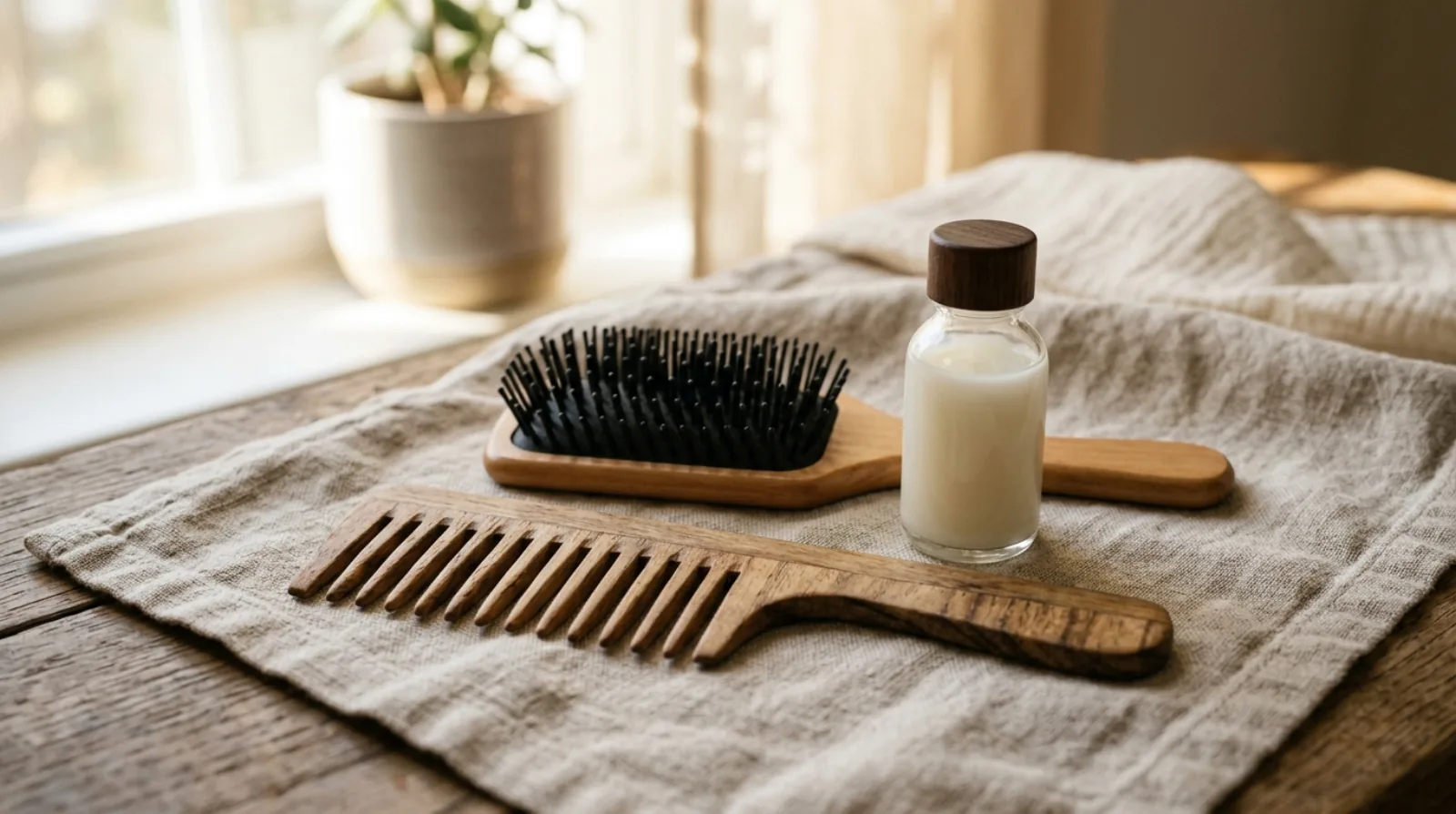
There is a rule that gets repeated everywhere: never brush your hair when it is wet. It is good advice for some people and bad advice for others, and the people it is bad for are the ones with curls.
The American Academy of Dermatology settles it in two sentences, sitting next to each other on the same page about habits that damage hair. For straight hair: let it dry before you gently comb it with a wide-tooth comb. For textured hair or tight curls: always comb it while it is damp, with a wide-tooth comb.
That looks like a contradiction until you understand what each hair type is protecting itself from.
What water actually does to a strand
Wet hair is weaker. The AAD says so plainly in its tips for healthy hair: hair is delicate when it is wet, so use a wide-tooth comb rather than a brush to detangle it. Its guidance on styling without damage adds the version most people quote: wet hair breaks more easily when combed or brushed, and most people should handle it as little as possible.
The mechanism is water getting inside. The review Hair Cosmetics: An Overview in the International Journal of Trichology describes water absorption swelling the hair shaft, and gives the stretching figures: untreated wet hair goes to 30 per cent past its own length and recovers, changes permanently between 30 and 70 per cent, and fractures at 80 per cent.
A dry strand meeting a knot tends to stop. A wet strand meeting the same knot stretches into it first, and by the time it stops it may already be past the point where it recovers.
So far this argues for never touching wet hair. It is only half the story.
Straight and wavy hair: wait until it is damp
If your hair dries flat or in a loose wave, there is nothing to be gained from combing it soaking wet. It has no curl pattern that needs setting while the water is still in it. Combing it wet is friction with no return.
The AAD's instruction is to let it dry first, then comb gently with a wide-tooth comb. The useful detail is how far to let it dry. Bone dry is not the target either, because a dry knot in fine straight hair snaps rather than slides. Damp is the window: past dripping, still cool to touch, before the ends feel dry between your fingers.
Wavy hair sits in the middle and this is where most people guess wrong. If your hair dries into an S shape that you like, treat it as curly and detangle it in the shower. If it dries into a wave you fight with a straightener anyway, treat it as straight and comb it damp. The test is what you want the hair to do, not what a chart says it is. If you are unsure which category yours falls into, the hair type chart walks through it properly.
Curly and coily hair: wet, with slip, in sections
Curls are the reverse case, and following the straight-hair rule on curls causes the damage the rule was written to prevent.
The AAD's curly hair guidance is specific: wet the hair thoroughly, apply a leave-in conditioner, and detangle with your fingers or a wide-toothed comb, working in sections. It says to avoid dry brushing, which causes breakage and frizz.
Two things are happening. Water and conditioner give the comb something to slide on, which curls need more than straight hair because every coil is a place a knot can form. And a curl left to dry undisturbed sets in its own pattern; a curl brushed out after drying is separated into individual strands, and separated strands are what frizz looks like.
The sections matter more than people expect. Four sections, clipped, one at a time, takes longer the first time and less time by the third wash, because you stop re-tangling the part you already finished.
Coily and type 4 hair follows the same rule with more conditioner and more patience. It shrinks as it dries, which means the window where it is easy to comb is short. Work while it is wet and still full of product.
The two kinds of breakage, and which one you have
This is the detail that explains why both sets of advice are right.
The trichology review draws a line between them: combing dry hair is associated with short segment breaks, and wet combing with long segment breaks, and the short breaks are the ones related to split ends.
In plain terms, dry combing tends to snap small pieces off near the ends, which is how split ends spread. Wet combing tends to take out longer pieces from further up. Neither is good. They show up differently on your pillowcase and in your brush, and the one you are getting tells you which habit to change.
Collect what comes out over a few days and look at length. A pile of short fragments points at dry handling and ends that need cutting, which is covered in split ends and breakage. Long pieces with blunt ends and no pale bulb point at how you are handling wet hair.
Tools, and what each one is for
A wide-tooth comb is the tool both AAD instructions name. Wide teeth mean fewer contact points, and fewer contact points mean less to catch on.
Your fingers are the gentlest option and the slowest. They find a knot before they pull it, which a comb cannot do. For tight curls, the AAD lists fingers alongside the comb as a first choice.
A flexible detangling brush, the kind with bristles on springs, is gentler than a stiff paddle brush on wet hair. It is still a brush, and no dermatology body recommends one over a comb for wet detangling. If you use one, use it on conditioned hair and from the ends up.
A boar bristle brush is for dry hair, for moving oil along the length and smoothing the surface. The bristles are packed close together, which is exactly what you do not want in a wet knot.
A round brush is a drying tool, not a detangling tool. Section, comb the section first, then bring the round brush in. More on which tool matches which cut is in brushes and combs for your haircut and the fuller brushes and combs guide.
Technique beats tool choice
The AAD gives the order in one sentence: comb the ends first, then keep combing higher, to detangle with the least damage.
Almost everyone does the opposite. Starting at the scalp gathers every knot in the length and drives them down ahead of the comb into one hard mass at the ends, which then has to be pulled through or broken through.
Working from the bottom, in short sections of a few centimetres at a time, means each knot is dealt with while it is still alone.
When the comb stops, do not push. Take it out, open that knot with your fingers, and start again from below it. A comb that is being forced is a comb that is breaking hair, and you can feel the difference in your hand.
Brushing dry hair has a limit too
The old instruction to brush a hundred strokes a night is wrong, and the AAD says so directly on the same page: hair never needs 100 brush strokes a day, and that is a myth. Its styling guidance adds that brushing your hair 100 strokes each day can cause split ends.
The replacement rule it gives is simple. Brush and comb your hair only to style it. Once in the morning to shape it, once at night to get the tangles out before you sleep, and nothing in between for its own sake.
Brushing dry curls is its own category of mistake and it is worth repeating. Unless you want the volume that comes from breaking the pattern apart, and some people do, leave dry curls alone.
The awkward cases
Fine hair breaks at both ends of the scale. It has less width to give, so a wet knot takes it out and a dry knot also takes it out. The answer for fine straight hair is damp, conditioner in the mid-lengths, and one gentle pass rather than several careful ones.
Thick hair has the opposite problem: it holds water so long that waiting for it to be damp can mean waiting an hour. Split it into four sections and comb each one as it reaches damp, starting with the section that dries first, usually the front.
Extensions and any attachment at the root change the rule, because the tension lands on the join rather than on the hair. Comb below the bond, hold the hair above it with your other hand so nothing pulls at the scalp, and use a comb every time.
Children have fine hair and no patience, which is a difficult combination. Wet, with plenty of conditioner, in small sections, holding the hair above where you are combing so they do not feel it at the scalp. The holding hand is the part adults forget, and it is what makes the difference between a comb-through that hurts and one that does not.
If your hair is chemically straightened, relaxed or colour treated, treat it as one step more fragile than its natural texture. Processing raises the cuticle, raised cuticles catch on each other, and hair that catches needs more slip and fewer passes.
What we would do
If your hair dries straight or in a loose wave: towel the water out without rubbing, leave it ten minutes, then comb from the ends with a wide-tooth comb. One pass. Do not go back through it.
If your hair curls: detangle in the shower with conditioner still in, in four sections, fingers first and comb second. Then do not touch it again until it is dry.
If you cannot tell which one you are, that is a fair position to be in, and it is the question that decides everything else in this post. Wavy hair gets the wrong routine more often than any other type, usually because someone was told once that their hair was straight and fluffy rather than wavy. A reading of the hair itself sorts it, which is what a hair consultation does. The Kurli AI Specialist does that from three photographs and then tells you which of these two instructions is yours, along with what to do between washes.
One more thing worth saying. If your hair tangles badly every single wash no matter how carefully you comb it, the tangling is the problem to fix, not the combing. Rough, raised cuticles catch on each other, and that is a condition question rather than a technique question. Fixing the hair changes how it behaves before any change of tool does, which is the argument made in hair before the cut.
Common questions
Should you brush wet or dry hair?
It depends on your texture. The American Academy of Dermatology tells people with straight hair to let it dry partly before combing gently with a wide-tooth comb, and tells people with textured hair or tight curls to always comb while it is damp with a wide-tooth comb. Both instructions are on the same page, and they disagree because the two hair types fail in different ways.
Does brushing wet hair cause breakage?
Yes, more than brushing dry hair does. The American Academy of Dermatology says wet hair breaks more easily when combed or brushed, and advises most people to handle wet hair as little as possible. Water swells the shaft and lets it stretch further before it gives way, so a knot pulls the strand past its limit instead of sliding free.
Does brushing wet hair cause frizz?
On curly and wavy hair, yes. Brushing separates a curl clump into single strands, and single strands read as frizz once they dry. That is why curls are detangled wet with conditioner and then left alone. On straight hair the frizz comes from a different source: rubbing the hair with a towel before combing it.
Should you brush wet curly hair?
Comb it rather than brush it, while it is wet and full of conditioner. The American Academy of Dermatology recommends wetting the hair thoroughly, applying a leave-in conditioner, and detangling with your fingers or a wide-toothed comb, working in sections. Detangling curls once they are dry causes breakage and frizz, which is the opposite outcome from the same tool.
Should you brush wet straight hair?
Wait until it has partly dried. The American Academy of Dermatology tells people with straight hair to let it dry before gently combing with a wide-tooth comb, because straight hair has no curl pattern that needs setting while wet and nothing is gained by handling it at its weakest. Damp is the target, not soaking and not bone dry.
Does brushing wet hair make it straight?
It flattens the wave for that day, and it does not change the hair. Hair dries in the position it is held, so combing wet hair straight and letting it dry undisturbed gives a straighter result than letting it set in its own pattern. The cost is breakage and a loss of body, and the effect ends at the next wash.
How to brush wet hair without damage?
Start at the ends and work upward in short sections with a wide-tooth comb, which is the method the American Academy of Dermatology gives. Add conditioner or a leave-in for slip before you start. If the comb stops, do not pull it through: take the comb out, separate that knot with your fingers, then comb again from below it.
Can brushing wet hair cause hair loss?
It causes breakage rather than hair loss. Breakage snaps the strand partway along while the follicle keeps growing hair, so the length thins and short broken pieces appear around the crown. Real hair loss comes from the follicle and has other causes. If you are pulling hard enough to feel it at the roots, that tension is a separate problem worth stopping.
Are wet brushes good for your hair?
Flexible detangling brushes are gentler than a stiff paddle brush on wet hair, and they are still a brush. No dermatology body recommends one brand, and the American Academy of Dermatology's advice for wet hair is a wide-tooth comb. If you use a flexible brush, use it on conditioned hair, from the ends up, and never on dry curls.
Is a boar bristle brush good for wet hair?
No. Boar bristle is packed tightly and designed to move oil along dry hair and smooth the surface, which makes it the worst tool to drag through a wet knot. Keep it for dry hair, on a day you are styling rather than detangling. For wet detangling, use a wide-tooth comb or your fingers.
Should you brush wet hair before blow drying?
Detangle before you start, then section as you go. A blow dryer needs a knot-free section to pass through, and forcing a round brush into a tangle mid-dry is worse than combing it out first. Use a wide-tooth comb on damp hair, work from the ends, and leave the round brush for sections that are already smooth.
Does brushing wet hair make it dry faster?
It spreads the water out, so hair feels drier sooner without much change in total drying time. Separating the hair lets air reach more of it, which is why a comb-through feels like progress. Combing wet hair repeatedly just to speed drying is a poor trade, because each pass is friction on hair in its weakest state.
When to brush wet hair?
Only if your hair curls, and then straight away in the shower with conditioner still in it. If your hair dries straight or in a loose wave, wait until it is damp rather than soaking, since combing it fully wet is friction with no benefit and combing it bone dry snaps a dry knot instead of sliding through it. Damp, not dripping and not dry, is the window for straight and wavy hair.
Why shouldn't I brush wet hair?
Because water gets inside the strand and lets it stretch further before it breaks, so a brush meeting a knot in wet hair pulls the strand past the point it recovers rather than sliding free. That is true for straight hair, which gains nothing from being brushed wet since it has no pattern to set. It is not true for curls, where the American Academy of Dermatology recommends detangling wet with a comb, not a brush, and with conditioner in it.
Does combing wet hair damage it?
Less than brushing does, and the same physics still applies. A wide-tooth comb has fewer contact points than a brush, so it catches less of the lifted, swollen surface of wet hair, but a comb forced through a tight knot still breaks strands. The technique matters more than the tool: start at the ends, work upward in short sections, and stop and open a knot with your fingers rather than pulling the comb through it.
Can hair brush cause split ends?
Yes, more from a stiff brush on dry hair than most people expect. The trichology review behind this post's advice ties short segment breaks near the ends to how split ends spread, and dry brushing is a common source of that kind of break. A wide-tooth comb, used from the ends up, and fingers for the tightest knots, reduce the small snaps that a brush's closely packed bristles cause.
Does brushing hair 100 times work?
No, and the American Academy of Dermatology calls it a myth directly: hair never needs 100 brush strokes a day. Its styling guidance adds that doing it can cause split ends rather than prevent them, since each stroke is friction the hair does not need. Brush or comb only to style it, once in the morning and once before bed, and skip the rest.
Can you brush wet hair extensions?
Comb rather than brush, and always below the bond. Extensions and any attachment at the root change the rule, because tension lands on the join instead of on the hair itself. Hold the hair above the bond with your other hand so nothing pulls at your scalp, work a wide-tooth comb from the ends up, and use it every time, whether the hair is wet or dry.
See it on your own face
Upload a selfie and Kurli recommends the hairstyles that suit you, then renders each look onto your photo.