Hairstyles by hair type
Hair type chart
The 1A to 4C system in plain English: what every type looks like and how to find yours at home.
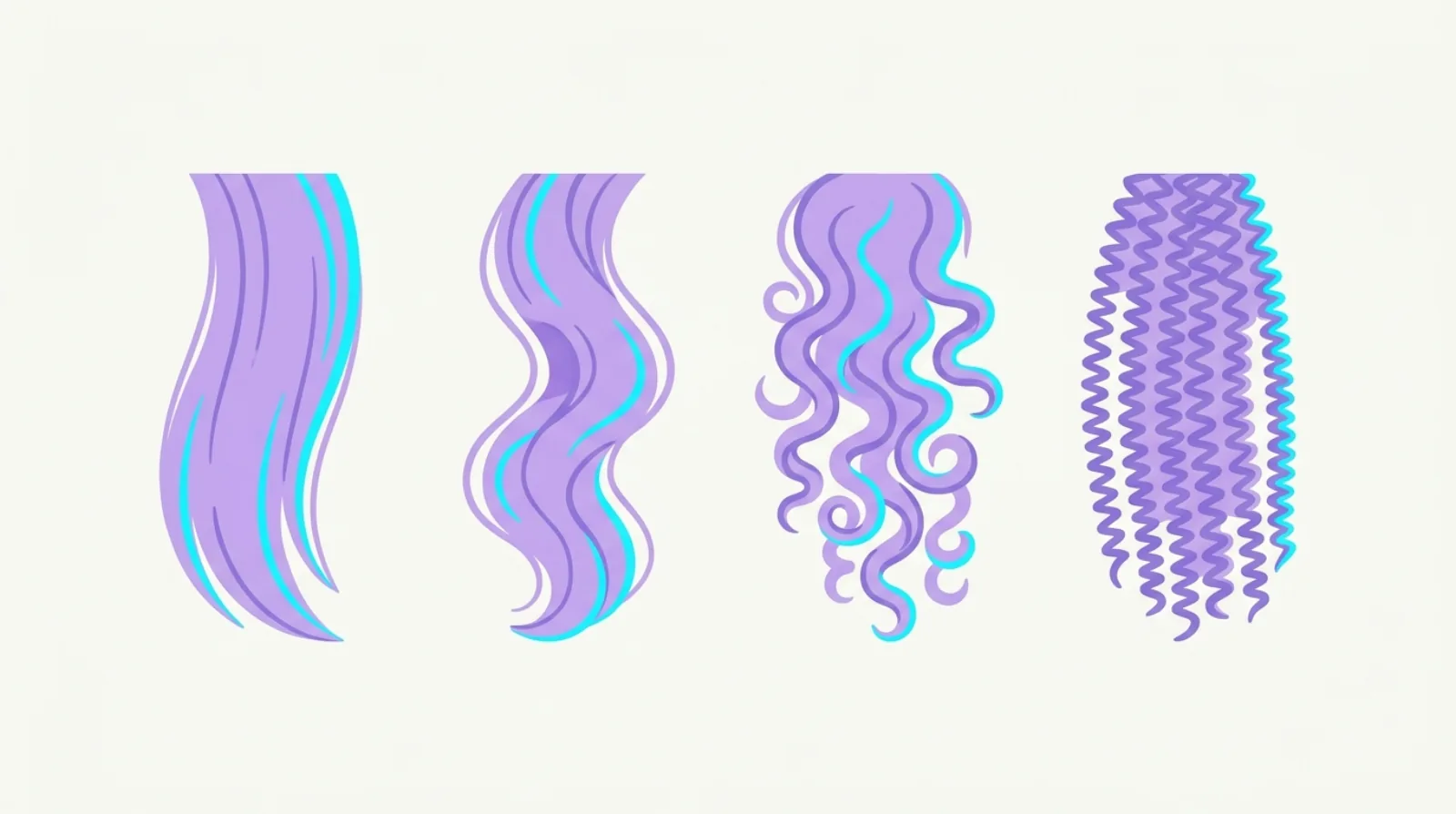
Spend five minutes reading about hair care and you will run into codes like 2B, 3A, or 4C. They come from the hair type chart, a simple system that sorts hair into four families by pattern: straight (type 1), wavy (type 2), curly (type 3), and coily (type 4). Each family splits into three sub-types, A to C, from the loosest version of the pattern to the tightest. The chart is not a science exam and there is no better or worse type. It is a shared shorthand that helps you pick products, describe your hair to a stylist, and find advice written for hair that acts like yours. This page walks through every type, shows you how to find your own, and is honest about what the chart cannot tell you.
Find out whether this suits your face. One selfie, and the face-shape read and your top pick are free.
Kurli is an AI hairstyle advisor: upload one selfie and it reads your face shape, recommends the cuts that suit it, and renders any of them onto your own photo before you commit.
How the chart works
The system is simple once you see the two parts. The number names the pattern family. Type 1 hair grows straight. Type 2 bends into S-shaped waves. Type 3 forms springs and loops. Type 4 grows in tight coils and zigzags. The letter says how strong the pattern is inside its family: A is the loosest, B sits in the middle, and C is the tightest. So 2A is barely wavy, 2C is almost curly, and 4C is the tightest coil pattern there is.
The pattern itself starts under your skin. Each hair grows from a tiny pocket called a follicle. A round follicle grows a straight strand, and a flatter, more oval follicle grows a strand that bends. That shape is set by your genes. Heat and chemicals can change the pattern for a while, but the natural one always grows back.
Stylists and the natural hair community built this chart up over the past few decades, and it stuck because it is easy to use and easy to share. Hair researchers describe texture with other measures, so treat the chart as a helpful shorthand, not a lab result.
Type 1: the straight hair types (1A, 1B, 1C)
Type 1 hair grows straight from root to tip with no bend. It reflects light in one clean line, which is why straight hair reads as the shiniest type. The sub-types split by body rather than by curl. 1A is completely straight, fine, and soft, and it tends to lie flat against the head. 1B is straight with more body and a slight bend at the ends, and most straight hair falls here. 1C is straight but coarse or heavy, with enough body that a few loose bends show, and it can frizz in damp air.
All three share the same behaviours. Oil from the scalp slides down the smooth strand quickly, so straight hair turns greasy faster than any other type. And it drops a curl within hours, because the strand wants to return to flat. If this is you, the straight hair guide covers volume tricks, the best cuts, and how to make a style actually hold.
Type 2: the wavy types (2A, 2B, 2C)
Type 2 hair bends into an S-shape along the strand. It sits between straight and curly, and it can lean toward either depending on weather, product, and handling. 2A is nearly straight at the roots with soft, wide waves toward the ends, and it flattens easily under heavy product. 2B has a clearer S-shape from the mid-length down. This is the classic beach wave, and it starts to frizz on top in humidity. 2C has strong S-bends that begin near the roots, with a few real curls mixed in, usually underneath. It is the wave most often mistaken for curly hair.
Wavy hair's main struggles are flat roots, frizz, and a pattern that changes day to day. The full wavy hair guide explains how to read your sub-type and how to bring the wave out on purpose instead of hoping it shows up.
Type 3: the curly types (3A, 3B, 3C)
Type 3 hair grows in defined springs and loops, and the sub-types split by the width of the curl. 3A curls are loose and wide, about the width of a piece of sidewalk chalk. They shine easily but lose definition fast if you brush them out. 3B curls are springy and tighter, closer to the width of a marker. 3C curls are tight corkscrews about the width of a pencil, packed close together, with lots of volume and the most shrinkage in this family.
All curly hair shares one key fact: the bends in the strand slow your scalp's natural oil on its way down, so the ends run dry. That is why every good curly routine is built around moisture and gentle handling. The curly hair guide covers cuts, washing, and frizz control for this whole family, including why cutting curls dry gives a better result than cutting them wet.
Type 4: the coily types (4A, 4B, 4C)
Type 4 hair grows in tight coils and sharp zigzags. It has the most volume and the most shrinkage of any type. It is also the driest and the most fragile, because oil struggles to travel down the strand and every bend is a point where the strand can snap. 4A forms small, springy coils with a visible curl pattern. 4B bends in tight z-shapes with sharp angles instead of round loops. 4C is the tightest and densest pattern, and its coils are so small the pattern can be hard to see until you stretch a strand.
Coily hair rewards a routine built on moisture, sealing, and low-tension styling, and it holds sculpted shapes no other type can. The coily and type 4 guide walks through wash day, protective styles, shrinkage, and the cuts that suit this texture best.
How to find your hair type
You cannot judge your type from styled hair, because heat, brushing, and product all hide the real pattern. Use the wash test instead. Wash your hair with a gentle shampoo, condition, and rinse. Add no product at all. Do not brush it, rub it with a towel, or touch it. Let it air dry completely, then look in a mirror.
Read what you see. Hair that dries flat with no bend is type 1. A soft S-shape through the length is type 2. Defined loops and springs are type 3. Tight coils, zigzags, or dense hair with heavy shrinkage is type 4. Then place the letter by strength: barely there is A, clear is B, and strong or tight is C.
Check more than one spot, because the pattern often differs around your head. If you sit between two labels, act on the curlier one, since it needs more moisture and gentler handling. And run the test on a normal-weather day, because very humid or very dry air can push the result a step in either direction.
Most heads have more than one pattern
Almost nobody is one clean type from ear to ear. Looser waves at the front with real curls underneath is common. So is a 4A crown with 4C edges, or a straight top layer over a wavy under-layer. This is normal, and it does not mean the chart failed. It means your follicles vary across your scalp, which is simply how heads work.
Here is how to handle a mixed head. Care for the driest, curliest section, because it sets the moisture bar for the whole routine. Style for the section people see most, usually the top and front. And tell your stylist about the mix before a cut, because a stylist who knows your under-layer curls tighter can adjust the shape so the cut works everywhere. If your patterns sit far apart, say wavy on top and coily underneath, read both matching guides and combine them. In practice that usually means the wash routine of the tighter pattern paired with the styling of the looser one.
Why type guides product weight
Product advice that ignores hair type is close to useless, because the same cream that saves one head flattens another. The rule of thumb: the straighter the hair, the lighter the product, and the tighter the pattern, the richer the product.
Type 1 hair needs almost nothing: light sprays, mousse, and dry shampoo, with oils kept away from the roots. Type 2 wants light creams and wave sprays that add hold without weight. Type 3 needs real moisture: leave-in conditioner plus a curl cream or gel. Type 4 needs the most of all: leave-in, cream, and an oil to seal, layered in order.
The reason is oil flow. Scalp oil coats a straight strand within a day or two, so adding more richness makes it lank. On bends and coils the oil never arrives, so the product replaces what nature cannot deliver. Dryness is also behind most frizz, which the frizzy and dry hair guide covers, and how easily your strands absorb any product depends on their porosity.
Why type guides your cut
The same haircut lands completely differently on different types, so your type should be in the room when you choose. Straight hair shows every line, which makes precise, blunt cuts look sharp and hides nothing. Wavy hair wants layers that release the S-shape instead of a heavy block that drags it straight. Curly hair springs up as it dries, so it is best cut dry, in its natural pattern, with shrinkage planned in. Coily hair holds sculpted shapes no other type can, from tapered cuts to rounded afros, and it also benefits from dry cutting.
One warning applies across the board: thinning shears behave differently by type. They can slim a heavy straight bob nicely, and they can wreck a curl pattern by cutting coils at random points. A stylist who works with your texture regularly is worth seeking out. Whatever your type, the cut still needs to suit your face, which is where the face shape quiz comes in.
What the chart cannot tell you
The chart reads pattern and nothing else, and pattern is only one of the things that decide how your hair behaves. Density is how many strands you have. Strand width is how wide each one is, from fine to coarse. Porosity is how easily your hair takes in and loses water. Two people with identical 2B waves can need opposite routines if one has fine, low-density hair and the other has coarse, dense hair.
So after you find your type, check the rest. The hair density and thickness guide has simple tests for how much hair you have, and the porosity guide covers absorption. If your strands run skinny, read the fine and thin hair guide. If your hair is heavy and bulky, the thick hair guide is for you. Hair also changes with life: grey and mature hair often grows in coarser and drier, colour-treated hair becomes more porous, and a drop in density belongs in the thinning hair guide. The chart is the start of the map, not the whole map.
Common questions
What are the hair types?
There are four hair type families: type 1 is straight, type 2 is wavy, type 3 is curly, and type 4 is coily. Each family splits into three sub-types, A to C, from the loosest pattern to the tightest, giving twelve labels from 1A to 4C. The number names the pattern and the letter says how strong it is.
How do I know my hair type?
Wash your hair, add no product, and let it air dry without touching it. Hair that dries with no bend is type 1, a soft S-shape is type 2, defined loops are type 3, and tight coils or zigzags are type 4. Check a few spots on your head, because most people have more than one pattern.
What are the straight hair types?
Straight hair is type 1, and it splits into 1A, 1B, and 1C. 1A is completely straight, fine, and flat. 1B is straight with more body and a slight bend at the ends, and it is where most straight hair falls. 1C is straight but coarse, with enough body to show a few loose bends and some frizz in damp air.
What is the difference between 3C and 4A hair?
3C curls are tight corkscrews about the width of a pencil, with a clearly visible loop. 4A coils are smaller and springier, with a tighter pattern and more shrinkage. The line between them is blurry, and many people sit right on it. If your hair is very dry and shrinks a lot, follow type 4 care.
Can my hair type change over time?
The pattern is set by your follicles, so it is mostly stable, but it can shift with hormones, age, pregnancy, and some medicines. Grey hair often grows in coarser and drier too. A gradual shift is normal. A sudden texture change across your whole head is worth showing to a dermatologist.
Is the hair type chart scientific?
No. It is a stylist's shorthand, built up by stylists and the natural hair community, not a medical scale. Hair researchers measure curl, density, and strand width in other ways. The chart is still useful, because it puts a shared name on your pattern so you can find advice and products that match it.
I have two curl patterns. Which one do I follow?
Follow the care routine of your curliest, driest section, because it needs the most moisture and the gentlest handling. Style for the section people see most, usually the top and front. Mixed patterns are the rule rather than the exception, so tell your stylist about them before a cut.
Does the hair type chart apply to men?
Yes. The chart describes the pattern your follicles produce, which has nothing to do with gender. A man with 3B curls has the same moisture needs and the same shrinkage as anyone else with 3B curls. Shorter cuts change the styling choices, not the type.
What type is frizzy hair?
Frizz is not a type. It is a condition, and it almost always means the hair is dry, with a lifted outer layer grabbing moisture from the air. Any type can frizz, though wavy, curly, and coily hair frizz more because they run drier. Fix the dryness and the frizz calms down on every type.
Do I need to know my hair type to pick a haircut?
It helps a lot. Your type decides how a cut behaves: straight hair shows precise lines, waves need layers to spring, and curls dry up shorter than they look wet. Your face shape decides where the cut should add or remove volume. Use both together for the best result.
What matters more, my hair type or my face shape?
They answer different questions. Face shape sets the goal, meaning where volume and length flatter you. Hair type sets what is realistic day to day. In practice type often wins, because a shape your hair will not hold is not a shape you can wear. Check both before a big change.
Does hair type affect how often I should wash?
Yes, strongly. Straight hair gets oily fast and may need washing every day or two. Wavy hair usually manages two to four days. Curly hair often does best washed every three to five days, and coily hair once a week or every two weeks. The tighter the pattern, the less often it needs washing.
Sources
Hair biology and hair-care facts on this page are supported by these sources. Styling recommendations are guidance.
- Physiology, Hair, StatPearls, NCBI Bookshelf
- Hair Follicle, Cleveland Clinic
- Tips for healthy hair, American Academy of Dermatology
- Everyday hair care, American Academy of Dermatology
- Essentials of Hair Care often Neglected: Hair Cleansing, International Journal of Trichology (PMC, NCBI)
See it on your own face
Kurli reads your face from a selfie, recommends styles that suit you, and renders each one onto your photo.
The face-shape read and your top pick are free. Your photo is never sold or used to train AI.