The Kurl
Why is my hair different textures in different places on my head?
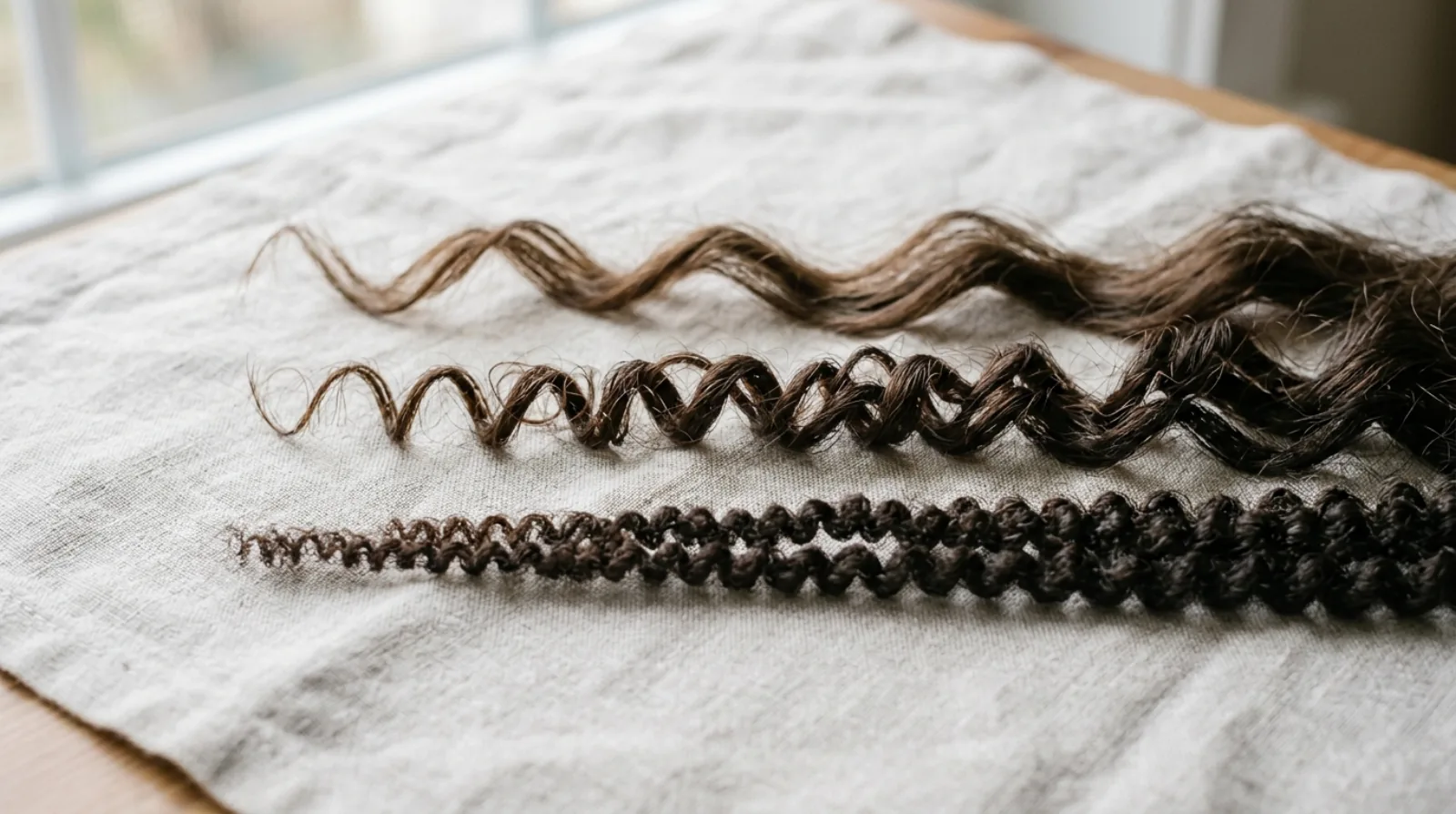
Most heads carry more than one curl pattern at once, and this is normal. The nape often curls tighter than the crown. The front hairline often sits straighter than the rest. The reason is the individual hair follicle. Each follicle decides the pattern of the strand growing out of it, and the follicles across one scalp are not all the same shape, just as they are not the same from one person to the next.
Why one head rarely has a single texture
A hair type chart or quiz gives a useful starting label, and we cover how to read one properly in the hair type chart guide, part of the wider guide to hairstyles by hair type. What that chart will not tell you is that the label usually describes an average: the pattern that is most visible or most common across your head. It is not a reading that applies everywhere. Ask a curly or coily person which section of their head is the "true" texture and you will often get two answers, one for the nape and one for the crown.
The follicle decides the pattern
The shape of an individual hair follicle is the main factor in whether the strand growing from it comes out straight, wavy, curly, or coily. A review of curly hair biology explains that curved follicles, with a bend near the base, produce curly fibres, while straighter, more upright follicles produce non-curly hair. A follicle is, at its simplest, the small tube-shaped structure in the skin that a hair grows from, as Cleveland Clinic describes it. The strand takes the shape of the tube it grows through, so a bend in the tube becomes a bend in the hair.
Curl comes from the shape of each follicle, not from one instruction for the whole scalp. Follicles across a real scalp are not identical. So different areas can grow different patterns on the same head. StatPearls notes more broadly that hair varies in length, colour, diameter, and cross-sectional shape, creating the different profiles seen across populations, and the variation that exists between people can also exist between regions of one scalp.
The nape and the hairline often differ most
The two areas that most often show the biggest contrast are the nape, at the base of the skull, and the front hairline. In our experience the nape holds the tightest curl or wave on a head, and the front hairline runs straighter or finer than the rest. Part of this may be a real follicle-shape difference. Part of it is wear. The nape spends the day under a collar or against a chair back, shielded from sun and from the brush, while the front hairline meets both every day. We have not found a study that measures this, so treat it as a common pattern and not as a rule for every head.
The underneath layer stays protected and often curls more
The same logic applies to any layer under the visible top layer, beyond the nape alone. Hair under the top layer gets less direct sun, less heat from styling tools, and less wear from the brush, because the top layer covers it for most of the day. Two sections that started with the same natural pattern can look different after a few years. The covered one has spent less time being pulled straight.
Heat and damage can straighten sections that started curlier
A section that used to curl and now reads straighter is not always a follicle question. Curl depends on the protein structure inside the strand holding a bend, and heat weakens that structure. The American Academy of Dermatology's guidance on habits that damage hair notes that frequent heat styling is one of the leading causes of hair damage, and damaged structure cannot hold a curl the way intact structure does. Picture a front section that meets a flat iron three times a week and a nape section with the same natural pattern that has never been heat styled. After a year the front reads straighter. The difference is damage, not follicle shape.
Hormones and age can shift the pattern too
Hormones act on hair. The American Academy of Dermatology describes postpartum shedding as a direct result of falling estrogen levels after childbirth. That source is about shedding, though, and the research on hormones and curl pattern is thinner. Many people report their curl pattern shifting during puberty or pregnancy, or after starting a medication. We could not find a dermatology study that measures this change, so it stays a common report, and it is not yet proven.
Aging has more support. A review of hair aging notes that graying hair is often reported to be coarser and less able to hold a set than pigmented hair. The review itself flags that report as anecdotal, and it sets it beside measured reductions in hair diameter and length with age. A head that used to read as one texture can change as more of it grows in gray.
How this differs from simply having "thick" or "fine" hair
Texture gets mixed up with two other words: thickness and density. Texture is the shape of one strand, straight through coily. Thickness is the width of that strand, coarse or fine. Density is how many strands grow per area of scalp, high or low. A head can be fine in thickness everywhere and still show three curl textures across its regions, because thickness and texture are set by different features of the follicle and do not move together. Mixing them up leads people to buy a volumising product for a texture problem, or a curl cream for a density problem.
This matters most when a mixed-texture head also has a real thickness or density difference between sections. The crown is the usual place, since density there often drops first with age, while the nape tends to stay denser for longer. A section that looks like it has "changed texture" has sometimes changed in density instead, and that needs a different response from a texture routine.
How to find your dominant pattern
Wash your hair, apply nothing, and let it air dry fully without touching it. Then look at three areas separately: the nape, the crown, and the front hairline. Photograph each on its own. In each photograph, follow one clean strand. A strand that stays straight from root to tip is straight. One with a soft S bend is wavy. One that forms a full loop is curly, and one that forms tight springs or zigzags is coily. We think the top-of-head photograph is the one most people skip, and it is the only one that shows the crown, a section you cannot see in a mirror without help. A mixed head photographed all at once reads as whichever texture covers the most area, and that is not always the section that matters for a cut or a routine. Do this once, straight after a wash. Mid-week, with product and yesterday's humidity still in the hair, the picture is muddier.
How to cut a mixed head
A stylist working from one glance at the top of your head is planning around one texture and guessing at the rest. Name your patterns and point to where they change. That lets the stylist plan layers and length for all of them instead of a shape that only reads correctly in the section they saw first. Cuts that need one uniform curl pattern to fall correctly are the hardest to wear on a mixed head; a blunt one-length cut is the common example. Layered shapes that let each section move on its own usually blend better. A common starting point is to take the nape a touch shorter, so the tighter curl there does not build bulk under a looser crown, and to leave the front hairline longer so a straighter section does not sit flat against the forehead. Both are points to discuss, and neither is a rule. The haircut consultation questions guide covers how to describe the rest of what you want.
What to expect from a hair type quiz or an AI reading
Any tool that assigns one hair type number, whether a curl chart, a quiz, or an automated photo reading, is choosing which section of your head to describe. Some tools ask you to pick your "most common" curl pattern, which assumes you can name one. Others read whichever section is easiest to photograph, usually the top. Neither approach is wrong. Neither is complete for a mixed head, and it helps to know that before a single label fails to match what you see at the nape.
A better reading treats mixed texture as the expected case and describes what is happening in more than one area, instead of forcing the whole head into a single number.
How to care for a mixed head day to day
One product and one routine for the whole head works when the difference between sections is small. A head with a real split, straight on top and curly underneath, usually does better with different amounts of product in each area. The curlier, drier sections want more leave-in or oil. The straighter, oilier sections want less, and only near the ends. A plain example: you wash on Sunday evening. By Tuesday morning the straight top is shiny at the roots and could take a dry shampoo, while the curly underneath is dry at the ends and wants more leave-in. Same head, two different needs, two days after one wash. Treating both the same way leaves one of them wrong. If you want a routine built from what your own hair is doing, the Kurli AI Specialist reads the hair type, texture and density in your three photographs (your face, a small turn to one side, and the top of your head) and writes the wash-day steps from that reading.
Colour is affected too. Bleach and permanent colour process differently on curlier hair than on straighter hair, because curl changes how evenly a product coats the strand and how long it needs to sit. A colourist working on a straighter crown and a curlier nape sometimes needs to time or apply the product differently across the two sections to get an even result. So mention your mixed texture before the service starts. Once the result comes out uneven it is too late.
The useful thing to take from a mixed head is permission to stop forcing one routine, and one haircut logic, onto hair that was never one texture.
Common questions
Why is my hair curly underneath but straight on top?
This usually means the hair follicles in those two areas are shaped differently, since follicle shape is what decides whether a strand grows straight, wavy, or curled. It is common for the underneath layer to hold more curl because it is more shielded from brushing, heat, and sun, which can loosen the pattern of the top layer over time even when the underlying follicle shape is similar.
Why is my hair wavy underneath but straight on top?
The same follicle-shape difference explains this, with a smaller gap between the two textures than a curly-versus-straight split would show. Top hair also gets more daily heat, brushing, and product than the underneath layer, so some of the difference is wear on the strand rather than a different starting pattern underneath.
Why is my hair curly underneath but frizzy on top?
The top layer likely has a similar curl pattern to the underneath layer, but sun, heat, and handling have worn the surface enough that the curls no longer group into a clean shape, which reads as frizz rather than as looser curl. Treating the top section with the same moisture and gentle handling as the underneath layer is the usual fix.
What to do when your hair is curly underneath and straight on top?
Style to the pattern that is easiest to blend, most often by working with the curlier underneath texture and using a light styling product on the straighter top layer so it sits with the rest of the shape. A stylist can also cut layers that help the two textures move together instead of visibly separating into two different sections.
What are different hair textures?
Hair texture describes the curl pattern of an individual strand, ranging from straight through wavy, curly, and coily. Most classification systems split these into numbered types with sub-categories for how tight the curl or coil is. A single head commonly shows more than one of these types across different areas.
Why is hair different textures?
Because the hair follicles across a scalp are not all shaped the same way, and follicle shape, not the person's overall hair type, is what determines whether an individual strand grows straight or curled. Genetics set the range, and then damage, heat, and handling shift how much of that natural pattern is visible day to day in any one section.
Why do different hair types exist?
Because follicle shape is set individually across the scalp rather than as a single setting for the whole head, likely as part of the same genetic variation that gives different people entirely different hair types. Add in that some areas of the scalp get more sun, brushing, and heat than others, and a visibly mixed head is a common, unremarkable result.
Can you have different hair textures on different parts of your head?
Yes, and it is common. The follicles across one scalp are not all the same shape, so one head can grow a tighter pattern at the nape and a looser one at the crown or hairline. The exact layout differs from person to person, and the contrast usually shows more as the hair gets longer, because a longer strand shows more of its pattern.
Can you have multiple hair textures?
Yes. It is normal for hair to vary from straight to wavy to curly across a single head, and it does not indicate anything is wrong with the hair or the scalp. The variation usually becomes more noticeable with length, since a longer strand shows more of its pattern than a short one does.
Is everyone's hair different?
Between people, yes, because genetics set the shape of each follicle and follicle shape sets the strand's pattern. Within one head, many people also carry more than one pattern at once, most visibly between the nape, the crown, and the front hairline. Neither kind of variation is unusual. Most hair type systems describe an average across the head, not one uniform reading.
Does hair texture change during menopause?
Many people report coarser hair or a looser curl around menopause, and the hormone changes of menopause do affect hair thinning. The research that ties menopause to a change in curl pattern is much thinner than the research on thinning. So a texture shift at menopause is a common report, and it is not yet proven.
Can hair texture change during puberty?
Puberty changes body hair: hormones turn fine vellus hair into thicker, pigmented hair in some areas. Many people also report the curl pattern of their scalp hair shifting around this time. The mechanism behind that shift is less established than the vellus-to-terminal change, so count it as a common report and not a settled fact.
Can hair texture change due to stress?
Stress affects shedding: a stressful period can start a temporary shedding phase about three months later. Reports of stress changing curl pattern itself, separate from shedding or thinning, are common but have far less research behind them. Treat that link as reported and unproven.
Why does my hair texture feel different?
The most common reasons are a change in length, since longer hair shows more weight and a looser pattern than short hair of the exact same texture, damage from heat or chemical services loosening a pattern that used to hold tighter, or a hormonal shift such as puberty, pregnancy, or aging. Comparing a recent photo to one from a year or more back usually clarifies which applies.
Who determines hair texture?
Genetics set the shape of each hair follicle, which is the main factor in whether a strand grows straight, wavy, curly, or coily. Both parents contribute to this, which is why siblings, and even different areas of one person's own scalp, can show a noticeable range of textures despite sharing the same genetic background.
Should I cut my hair differently because I have more than one texture?
Often, yes. A cut planned around only the straightest or only the curliest section can leave the rest of the head looking uneven once it dries. Telling a stylist where your patterns change lets them plan layers and length that read as one intentional shape instead of two separate sections.
Does the hair at the back of my head stay curlier because it is protected?
The underneath layer at the nape gets less sun, less brushing, and less heat styling than the top and front, and all three can loosen a curl pattern over time. So the most protected section often keeps the tightest natural curl. We have not found a study that measures this directly, so treat it as a working explanation, not a proven one.
Should I tell my stylist I have more than one hair texture?
Yes, and say where each pattern sits, since a cut is usually planned around whichever section the stylist looks at first. Raise it before the cut. That is the simplest way to get a shape that works with all your hair, instead of only the section the stylist noticed.
See it on your own face
Upload a selfie and Kurli recommends the hairstyles that suit you, then renders each look onto your photo.