The Kurl
Why your hair is still frizzy after conditioning, and what to fix
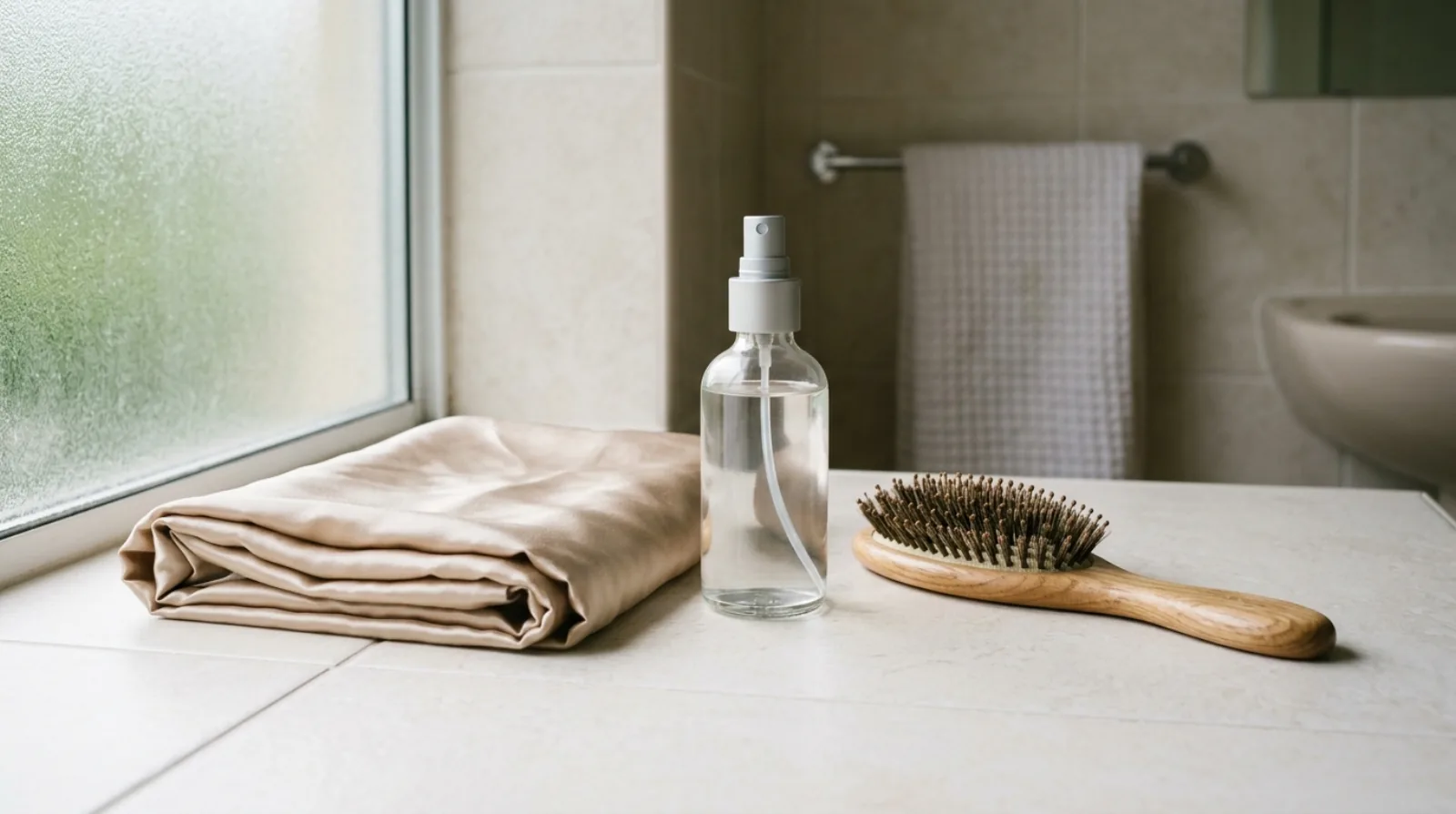
Conditioner works on the outside of the hair while you are in the shower. Frizz is decided in the ten minutes after you leave it. That gap explains most cases, and it is why buying a better conditioner so often changes nothing.
There are six causes worth checking, and they have an order. Three of them cost nothing and take a week to test. Two of them are about your water and your hair's history. One of them is the weather, and no product removes it.
What frizz actually is
The outside of every hair is a layer called the cuticle. StatPearls describes it as flat overlapping cells covering the hair shaft, and says this layer is what gives hair its untangled appearance and shape. Picture roof tiles running down the strand from root to tip.
When those tiles lie flat, the surface is closed and water vapour in the air has a hard time getting in. When they stand away from the strand, water reaches the inside, the strand swells, and the shape it dried in stops holding. That is frizz. It is a water problem before it is a smoothness problem.
This is also why frizz arrives hours after you styled your hair rather than straight away. The air has been working on it the whole time.
Conditioner is aimed at the right target
The 2015 review of hair cosmetics in the International Journal of Trichology explains what a conditioner does: it works by neutralizing the electrical negative charge of the hair fiber and lubricating the cuticle, which reduces how much water the fibre wants to take on.
Read that again, because it matters. The conditioner is going after the exact mechanism of frizz. So the answer to "should I use conditioner" is yes.
The catch is that a coating is only as good as what happens to it next. It has to survive the towel, the brush, the dryer, and eight hours of air. Most conditioner is defeated within a quarter of an hour of being applied, by something in the routine that follows.
It is probably going in the wrong place
Two mistakes, both common.
The first is conditioning the roots. The hair cosmetics review says conditioner should be applied on the hair length while avoiding the scalp, and then rinsed out completely. Hair at the scalp is days old and in good condition. Hair at the ends is years old and is where frizz shows. Conditioner near the roots weighs them down and does nothing for the part that needs it.
The second is the opposite, and it affects curly and dry hair. The American Academy of Dermatology's guidance is split by hair type: for fine or straight hair, apply conditioner to the ends, and for hair that is dry or curly, apply it to the entire length. Its curly hair page goes further and says curly hair is drier than other types, so the whole head should be conditioned rather than the ends alone.
So the answer depends on which of those two you are. Fine and straight: ends only. Dry, wavy, curly, coily: everything from the ears down, and more of it than you think.
You are rinsing it out too fast
There is no published number for how long conditioner needs to sit, and anyone who gives you one is guessing. What we can say is that thirty seconds of it in and straight back out is the version most people do, and the version that produces the least change.
A workable routine: put the conditioner on, then do the rest of the shower, then rinse. A minute or two of contact costs nothing.
While it is in, comb it through with a wide-tooth comb. The AAD says the best time to comb thick curly hair is in the shower, before the conditioner is rinsed out. This is the single change we would make first if you only make one, because it does two jobs at once: it spreads the conditioner evenly along every strand, and it detangles at the moment hair is most slippery and least likely to break.
The ten minutes after the shower
This is where frizz is usually created.
Rubbing with a terry towel drags the surface of every strand in every direction. The AAD tells people to wrap the hair in a towel or a t-shirt to absorb water, because rubbing it dry causes damage. Squeeze, do not scrub.
Brushing while wet separates strands that were drying as a group. Wavy and curly hair dries into clumps, and a brush turns one clump into forty separate hairs standing apart from each other. The AAD's curly hair guidance is blunt about the dry version of this mistake: avoid brushing your hair while it is dry, because it breaks and frizzes the hair.
Touching it while it dries does the same thing in slow motion. Hair sets in the shape it is in as the last water leaves. Every pass of your hand resets that. Shape it once, then let it alone.
And on the dryer: fit the nozzle, point the air from the roots down towards the ends, and use medium heat. Air blown upward, against the direction the hair grows, lifts the cuticle on every strand it crosses. The AAD's advice is to let hair partially air dry before you style or comb it and to handle wet hair as little as possible.
Hard water puts a film between the conditioner and the hair
If your hair changed within weeks of moving house, look at the water before you look at the shampoo. Hard water carries dissolved calcium and magnesium, and some of it stays on the hair.
Here is the honest part. A 2013 study in the International Journal of Trichology soaked hair from fifteen volunteers in hard water at 212.5 parts per million of calcium carbonate for thirty days, and concluded that the hardness of water does not interfere with the tensile strength and elasticity of hair. So hard water is not weakening your hair in the way people often claim.
What it does is leave a film. Shampoo lathers less, conditioner sits on top of the mineral layer instead of on the hair, and the result feels rough and looks dull. The test takes no equipment: if soap will not foam in your shower and the kettle has a white crust inside, you have hard water. A clarifying shampoo every two to three weeks removes the film. Hard water and your haircut has the rest.
Porosity decides how fast the water gets in
Porosity is how easily water moves in and out of the strand. Porous hair takes water in faster, which is exactly why it frizzes sooner on a damp day.
Some of it you were born with. Some of it you caused. The hair cosmetics review notes that bleached and chemically treated hair is more porous than untreated hair, which is why frizz often starts after a colour change and never goes back on its own.
We are not going to repeat the float test and the strand test here, because hair porosity covers the testing properly, including which of the popular tests do not work. Read that, then come back knowing which half of the problem is yours to manage.
Humidity is the one nobody can sell you a fix for
On a day with water in the air, hair takes some of it in. Products slow this down. Nothing stops it.
What you can do is choose the shape you fight for. A style that depends on a flat, smooth surface will lose that surface on a humid day, and you will spend the evening aware of it. A style that already has movement in it absorbs the change without looking wrong, because extra width in hair that was built to have width reads as normal.
That is a cut decision as much as a product decision, which is the part most frizz advice skips.
The order to change things
Do these in sequence, one week each, so you know which one worked.
One: move the conditioner down. Length and ends, off the scalp, more than you were using if your hair is dry or curly.
Two: comb it through in the shower with a wide-tooth comb while the conditioner is still in, then rinse fully.
Three: stop rubbing with the towel. Squeeze with a cotton t-shirt instead.
Four: shape the hair once while wet, put your leave-in product on then, and do not touch it again until it is dry.
Five: clarify once, to see whether mineral film has been the problem all along.
If three weeks of that leaves the frizz where it was, the cause is in the hair itself: damage that is past repairing, or a texture that was always going to do this. That is a different conversation, and a more honest one.
When it is the cut and not the conditioner
Some frizz is a cut problem wearing a routine problem's clothes.
Layers cut too short for a thick or curly head give every layer a free end to stand away from the head. Thinning shears used through the middle lengths leave short broken-looking pieces that never lie down. A blunt heavy line on hair that wants to expand puts all the width in one horizontal band.
The test is where the frizz sits. Frizz spread evenly along every strand is a condition problem. Frizz that appears in a band, or only where the layers start, or only around a fringe, is the cut. Fix the hair or change the cut walks through how to tell, and frizzy and dry hair covers the shapes that hold up in this texture.
If you want the routine written for your own hair rather than for frizz in general, the Kurli AI Specialist reads three photographs of your hair, names the type, texture, density and damage it can see, and writes the wash-day steps with a reason attached to each one. The hair consultation guides cover the same ground for free if you would rather work it out yourself.
One last thing worth saying plainly. Curly and wavy hair frizzes. It is the shape of the strand: the cuticle cannot lie perfectly flat where the hair bends, so those bends take in water first. A person with that hair can reduce frizz, and cannot delete it, and every product promising otherwise is selling a result it has never delivered to anyone.
Common questions
Why is my hair frizzy after using conditioner?
Conditioner coats the outside of the hair while you are in the shower, and frizz is decided after you leave it. Rubbing with a towel, brushing while wet, and hot air blown against the hair all lift the outer layer again. Conditioner reduces how much water the strand takes in. It does not survive rough handling.
Does conditioner make your hair frizzy?
Rarely the conditioner itself, and often where it is put. Conditioner near the scalp weighs the roots down without helping the ends, which is where frizz shows. The 2015 hair cosmetics review in the International Journal of Trichology says conditioner should go on the length of the hair, avoiding the scalp, and be rinsed out completely.
Can over conditioning cause frizz?
It can make hair feel soft and limp rather than frizzy, which people sometimes describe as frizz because the hair will not hold a shape. If your hair feels coated, will not dry with any body, and goes greasy within a day, use less product and wash it out fully. A clarifying shampoo once every few weeks removes what has built up.
Why is my hair still dry after conditioning?
Conditioner smooths and lubricates the surface. It does not replace what damage has removed from inside the strand. If the ends have been coloured, heated, or simply carried around for three years, they will feel dry no matter what is applied. A deep treatment helps for a day or two, and a trim is the change that lasts.
How should hair feel after conditioning?
Slippery while wet, and clean rather than coated once rinsed. A wide-tooth comb should move through it without catching. If it still feels squeaky and rough while wet, the conditioner is not reaching the middle lengths. If it feels waxy after rinsing, you have used more than the hair can hold.
Why is my hair so frizzy after air dry?
Hair that dries while being touched dries frizzy. Every time you run your hands through it, push it back, or check it in the mirror, you separate strands that were drying as a group. Put a leave-in product on while it is wet, shape it once, then leave it alone until it is dry.
Why is hair frizzy after blow drying?
Usually high heat, no nozzle, and air blown from the ends towards the roots. Air that travels against the direction the hair grows lifts the outer layer of every strand it passes. Fit the nozzle, point the air down the length from root to tip, and use a medium heat setting. The American Academy of Dermatology recommends a heat protecting product first.
Does frizzy hair mean damaged hair?
Not on its own. Curly and wavy hair frizzes at normal humidity with no damage at all, because the outer layer cannot lie flat where the strand bends. Damage is a separate question, and the test is the ends: if they are rougher than the hair near your scalp and they snap when stretched, that is damage.
Does frizzy hair need protein or moisture?
Most frizzy hair needs moisture, and hair that stretches and does not return needs protein. Stretch one wet strand slowly. If it stretches a long way and stays limp and stretched, protein is worth trying for a few weeks. If it feels rough, snaps quickly, and drinks up conditioner, moisture is the answer.
Does frizzy hair mean high porosity?
Often, and not always. Porous hair takes in water from the air faster, which is why it frizzes sooner on a humid day. Hair can also frizz because it was brushed dry, towel dried roughly, or cut into layers that are too short for its texture. Porosity is one cause among several, not the diagnosis.
Why does my hair go frizzy when it dries?
Hair holds whatever shape it was in as the last of the water leaves it. If the strands are separated at that moment, by a brush, a towel, or your hands, they dry apart from each other and stand away from the head. Shaping wet hair once and then not touching it is the single change that fixes this for most people.
Will conditioner help frizzy hair?
Yes, and it will not finish the job. Conditioner adds positive charge and lubricates the surface so the strand takes in less water, which is the right mechanism. What it cannot do is survive rough drying, remove mineral film from hard water, or repair ends that are already worn. Treat it as one step of five.
Is frizzy hair genetic?
The tendency is, the amount is not fixed. Curl pattern is inherited, and a curl bends the cuticle away from lying flat at every turn, which lets in water and creates frizz more easily than on straight hair. What is not inherited is how much of that potential shows on a given day: humidity, damage, and how the hair was dried all decide whether the genetic tendency turns into visible frizz.
Does frizzy hair cause breakage?
Not on its own. Frizz is water getting into a strand whose surface has lifted, and that alone does not snap the hair. What often travels with frizz does cause breakage: brushing dry, rubbing with a towel, and heat used to fight the frizz all put the strand under stress. So the two are usually companions from the same rough handling rather than one causing the other.
Does hair get frizzy in humidity?
Yes, and this is the one cause on this list that no product removes completely. Water in the air gets into a strand whose surface is not sealed, the strand swells, and the shape it was styled in stops holding. Products that coat the surface, like a silicone serum, slow this down. A style built with movement already in it, rather than a flat smooth shape, hides the change better on a humid day.
Is frizzy hair curly?
Not always. Curly and coily hair frizzes for a structural reason, because the cuticle cannot lie flat at every bend, but straight hair frizzes too, from damage, hard water, or rough drying. The difference is what a wash and a change in habits can do: on straight hair, fixing the routine usually removes most of the frizz, while on curly hair some frizz is the texture itself and the honest goal is definition, not a flat surface.
Can frizzy hair be fixed permanently?
For most people, no, and that is the honest answer. Humidity, growth, and hair's own texture keep producing conditions for frizz, so the realistic goal is control rather than a permanent cure. Chemical smoothing treatments flatten the cuticle for a few months and grow out, which is temporary rather than permanent. The changes in this post, done consistently, keep frizz down for as long as you keep doing them, and stop working the week you stop.
Can a keratin treatment stop frizz for good?
No, and 'for good' overstates what any smoothing treatment does. A keratin or similar smoothing service coats and temporarily reshapes the outer layer so it lies flatter, which reduces frizz for a few months. New hair growing in has none of that treatment, and the treated hair grows out, so the effect fades at the roots first. Bleached or chemically treated hair is also more porous to begin with, so it can frizz again sooner than untreated hair.
See it on your own face
Upload a selfie and Kurli recommends the hairstyles that suit you, then renders each look onto your photo.