The Kurl
Why is my hair oily at the roots and dry at the ends?
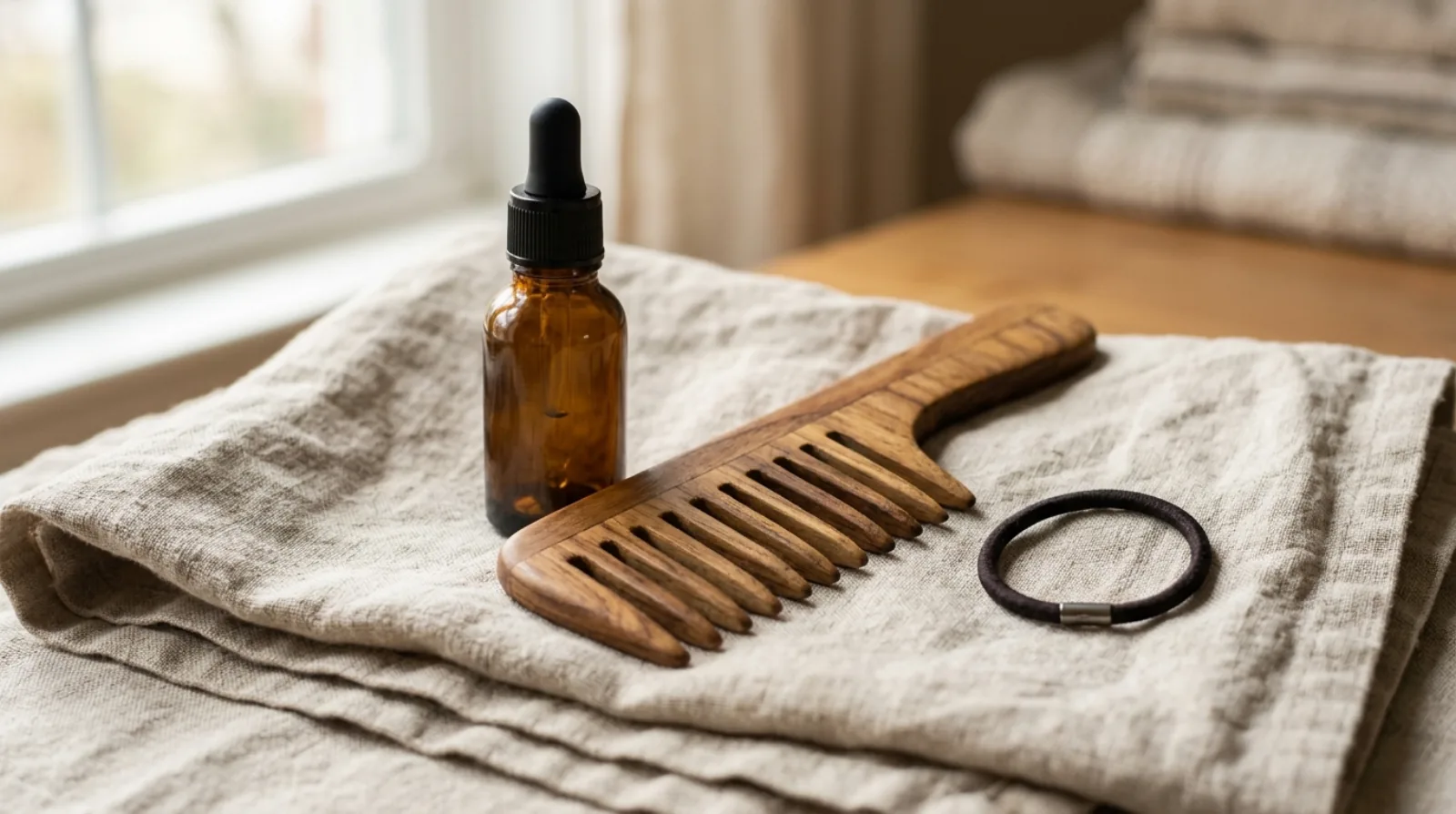
Your roots are shiny by the end of the day and your ends feel rough and look faded. Every product you buy fixes one and makes the other worse.
There is nothing strange happening. Oil is made at your scalp and stays near it, while the ends of your hair are the oldest part of you that is still visible. The top of your head is fresh and coated. The bottom is years old and worn. Those are two different problems and they need two different treatments on the same wash day.
The two halves of your hair are different ages
Scalp hair grows at about 0.35 mm a day, 1 cm a month, or 15 cm a year, according to the StatPearls chapter on hair physiology.
Do the arithmetic on your own head. Hair that reaches 30 cm has tips that left your scalp roughly two years ago. Hair at 45 cm has tips about three years old. Hair down your back is carrying material that formed when you had a different job.
The American Academy of Dermatology puts the same point in one sentence on its Black hair care page, which advises coating the ends with conditioner because they are the oldest and most fragile part of your hair.
Now count what those two-year-old tips have been through. Roughly 200 washes if you wash twice a week. As many towel dries. Brushing, tying back, sleeping on, sun, and in most cases heat. Hair is not living tissue once it leaves the follicle, so there is no repair going on. Every one of those events is still there.
Why the oil never gets that far
Each hair follicle comes with a sebaceous gland attached to it. StatPearls calls the arrangement the pilosebaceous unit: the follicle, its gland and the small muscle that stands the hair up. The gland empties into the follicle, which means oil reaches the surface exactly where the hair leaves your head.
From there it has to travel along the shaft, and it is not good at distance. Three things decide how far it gets.
Length. A centimetre of oil spread over 10 cm of hair coats it. The same amount over 50 cm does not.
Texture. A straight strand lies flat against the scalp and the oil spreads along it. A wave or a curl lifts away from the skin and bends several times, and the oil stops near the root. This is why the AAD's curly hair page states plainly that curly hair is drier than other hair types.
Density. Thick hair with many strands per square centimetre shares the same oil supply across more surface. Fine hair has less to cover.
Put those together and a long, curly, dense head is the extreme case: shiny at the scalp, dry from the ears down, with a hard line between the two. Straight, short, fine hair is the opposite case, which is why some people report the whole length turning greasy at once.
Washing for the roots dries the ends
Here is the trap, and most people are in it.
The roots look oily, so you wash more often. Every wash removes oil from the length as well as the scalp, and the length had almost none to spare. The ends get rougher. Rough ends look dull and tangle, so you add conditioner more generously, and some of it lands near the roots. The roots look greasy sooner. You wash more often.
Two or three rounds of that and you have hair that is worse at both ends than when you started, using more product than before.
The AAD's healthy hair tips break the loop with two placement rules that cost nothing. Apply shampoo to your scalp rather than the entire length of your hair. And apply conditioner to the ends if your hair is fine or straight, or along the whole length only if your hair is dry or curly.
Read those as instructions about geography, not about products. Shampoo is for skin. Conditioner is for hair. Most bathroom routines have them the wrong way round, and no upgrade in either bottle fixes a placement error.
The wash-day routine, in order
This is the version that treats the two halves separately. It takes no longer than what you do now.
Before the water, if your ends are rough. Work an oil or a mask through the mid-lengths and ends and leave it while you undress or make coffee. Ten minutes is enough. Its job is to reduce what the wash takes out of the length. It is rinsed away afterwards, so it is not a leave-in treatment and it does not belong on the scalp.
Shampoo. Wet the hair, then put the shampoo on your scalp with your fingertips, not the palm of your hand, and work the skin rather than the hair. If it barely foams, rinse and do it again; a second pass on a genuinely oily scalp is normal and not a sign of a bad product. The dilute run-off is all the length needs.
Rinse. Longer than feels necessary, and finish with the back of your head, which is where people stop early. The AAD lists leftover shampoo on the scalp as a cause of itching, so this step is doing more than it looks like.
Conditioner. Start at ear level and go down, squeezing it through with your hands rather than combing it in at the top. On hair that is dry or curly, take it higher, as the AAD advises. On fine straight hair, the ends only.
Drying. Squeeze water out with a towel rather than rubbing. The AAD's advice on styling without damage is to let hair partly air dry before styling or combing, to reduce how many times a week you blow dry, and to keep flat irons to a low or medium setting no more than every other day. Your ends are the part paying for every one of those sessions.
Colour makes the gap wider
If your hair is coloured, the split between the two halves is usually sharper, and the reason is arithmetic again.
Your roots are new hair with its natural structure intact. Your ends have taken every colour session since they grew out. The AAD's page on colouring and perming does not soften it: many treatments that improve the look of hair damage it and leave it dry and brittle, and lightening more than three shades needs higher volumes of peroxide, which causes more damage.
There is a practical consequence people miss. A root touch-up that is painted onto the new growth alone does far less to the ends than a full-head application, and salons will do it that way if you ask. If you colour at home, the same rule holds: put it on the regrowth, and take it through the length for the last few minutes only, if at all.
Bleached ends also behave differently with water. They take it on faster, swell more, and dry out faster afterwards, which is why the same conditioner that was enough last year is not enough now. That is a porosity change, and it is covered in hair porosity and your haircut.
Four habits that widen the gap
Each of these is a reasonable-sounding move that makes oily roots and dry ends worse.
Oiling the scalp. Oil on skin that already produces plenty adds to what sits there, and the yeast living on your scalp feeds on it. If you use a pre-wash oil, it belongs on the length and it comes off in the wash.
Brushing to spread the oil down. This works on short, straight hair that needs distribution. On long hair, it moves oil three centimetres and drags the roots flat, and it adds friction to the ends. The AAD's page on habits that damage hair says to brush and comb only to style, and calls 100 strokes a day a myth.
Washing only with conditioner. Skipping shampoo protects the ends and leaves the scalp with nowhere to put the week's oil. If you do this, keep a shampoo wash in the cycle for the skin.
Leave-in products applied from the top down. Anything you rake in from the roots lands where the oil already is. Apply from the ends upward and stop before your hands reach your ears, and you will use less of it too.
Between washes
The roots and the ends need opposite things here too.
Roots want to be left alone. Hands out of your hair, no brushing at the scalp to 'spread the oil' if the oil is already the problem, and dry shampoo held to one day rather than four. The between-wash detail is covered in oily roots and dry shampoo.
Ends want protection. Tie hair up loosely rather than tightly, keep it off wool collars and seat belts, and if you sleep on cotton, the friction at the ends every night is part of your 200-event tally. This is also the moment to be honest about heat: the ends cannot be repaired, so every session you skip is a session they do not have to survive.
When conditioning stops working
There is a point where the ends are past treatment, and recognising it saves money.
The test takes ten seconds. Take a dry strand from the ends between two fingers and pull it gently. Healthy hair stretches and springs back. Hair that stretches and stays stretched, or snaps with almost no pull, has lost its internal structure. Conditioner will coat that hair and make it feel better for a day. It will not put back what is gone.
Split ends behave the same way. They travel upwards if left, so cutting 2 cm now is usually cheaper than cutting 6 cm later. The detail is in split ends and breakage.
Which half is actually your problem
People usually name the wrong one. The roots are more visible, so they get blamed, and the ends are what makes the hair look tired in photographs.
A quick way to tell: after a wash, when the hair is clean and dry and unstyled, does it look good? If yes, your problem is the roots and the timeline, which is a wash frequency and placement question. If the hair still looks dull and rough on wash day, the ends are the problem and no change to washing will reach them.
This is also the split a proper reading of your hair is meant to produce. A consultation that says 'oily scalp' and stops has told you what you already knew. What you need is where on the shaft the oil stops, how far the damage reaches up, and which of the two to treat first. That is what a hair analysis actually reads, and it is the reason the Kurli AI Specialist asks for a photograph of the top of your head as well as your face.
Common questions
Why are my roots greasy and ends dry?
Oil is produced at the scalp, in glands attached to each follicle, so it starts at the roots and works outwards. It rarely reaches the ends of long or textured hair. The ends are also the oldest part of the hair and have had years of washing, heat, sun and friction. One half is coated and the other half is worn, which is normal rather than a contradiction.
What causes oily roots and dry ends?
Three things together: sebaceous glands releasing oil at the scalp, hair long enough or curled enough that the oil does not travel to the tips, and accumulated damage at the ends. Washing often for the roots strips the ends further, and conditioning the roots for comfort makes the top look greasier. The routine, not the hair, is usually what needs fixing.
Why are my roots always greasy?
Because that is where the oil arrives. Each sebaceous gland empties into a hair follicle, so oil reaches the surface exactly where the hair leaves your head. How fast it becomes visible depends on texture: straight hair lies flat against the scalp and shows it within a day, while a tight curl lifts away and hides it for longer.
How do I fix oily scalp and dry ends?
Treat them as two jobs. Shampoo goes on the scalp only and is rinsed through the length on the way out. Conditioner starts at ear level and goes down, never at the roots. Add a weekly mask or oil to the ends alone. Stretch wash days only if your scalp stays comfortable, and cut ends that no longer respond.
What shampoo is best for oily roots and dry ends?
One shampoo, applied correctly, beats two shampoos applied everywhere. Choose a plain shampoo you can use on the scalp without drying the skin, and let the dilute run-off be all the length gets. The American Academy of Dermatology advises applying shampoo to the scalp rather than the whole length, which matters more than which bottle you buy.
Does oily scalp cause dry hair?
Not directly, but the response to it often does. People with oily scalps wash more, and every wash and towel dry removes something from the ends that the scalp oil never replaces. The oil is not the problem. The unbalanced routine that grows around it is, which is why the fix is placement rather than a different product.
Why do only my roots get greasy?
Oil has to travel from the scalp along the hair shaft, and it is not good at long journeys. On short or straight hair it covers most of the length. On hair past the shoulders, or on waves and curls, it stops within a few centimetres of the scalp. Everything beyond that point is living on whatever you put there.
Can oily hair be dry?
Yes, and it is the usual combination rather than an unusual one. Oily describes the scalp and the first few centimetres. Dry describes the mid-lengths and ends. They are separate areas with separate histories, and a routine that treats the head as one surface will always leave one of them wrong.
Can oily hair be frizzy?
Yes. Frizz comes from the outer layer of the hair being roughened and from the hair taking on water from the air, and neither is prevented by oil at the roots. Hair can be flat and shiny at the top and lifted and rough at the ends on the same day. Frizz is a mid-length and end problem, so treat it there.
What causes dead ends in hair?
Time and accumulated wear. Scalp hair grows about 1 cm a month, so hair 30 cm long has tips that formed roughly two years ago. Those tips have been washed, brushed, dried, tied back and often heat styled several hundred times. Hair has no repair system, so the damage stays until it is cut off.
How do I get volume at the roots of my hair?
Remove weight rather than adding lift. Keep conditioner and styling product below ear level, rinse shampoo out fully, and dry the roots first, lifting sections away from the scalp with your fingers while they dry. Hair sets as it cools, so a cool blast at the root holds the position. Oil and residue at the root defeat all of it.
Should an oily scalp be oiled?
There is a real use for it, and it is not moisture for the scalp. Pre-wash oil sits on the length to reduce what the wash takes out, and it is rinsed away afterwards. Adding oil to a scalp that already makes plenty, and leaving it there, gives the yeast on your skin more to feed on. Oil the ends, not the skin.
Does oily hair cause dry scalp?
No, they are close to opposites at the scalp itself. Oily scalp means the sebaceous glands are active; dry scalp means the skin is short of moisture, and the two can happen in the same person at different times but not as cause and effect. What is common is an oily scalp with dry ends, because the oil never travels the length of the hair. That is a different pairing from an actual dry scalp.
Does oily hair grow faster?
No. How fast a hair grows is decided inside the follicle, and nothing about the oil sitting on top of the scalp changes that rate. Oily hair can look like it is growing well because the strands clump together and lie flat, which reads as fullness, but that is an appearance, not a growth change. Washing the oil away does not slow growth either. Growth speed and how the hair looks are separate questions.
Can split ends cause hair thinning?
Not thinning in the sense of fewer hairs growing, but they cause length loss that can look like thinning. A split travels upward if it is not cut off, and eventually the hair breaks higher up the shaft, which is breakage rather than a change at the root. The ends look sparser and see-through because more hairs have snapped short, not because fewer hairs exist. Trimming the splits stops that particular kind of loss.
Is greasy hair a sign of pregnancy?
Not reliably. Hormone shifts in pregnancy can change how oily skin and hair feel for some people, in either direction, but plenty of pregnant people notice no change at all. Greasy hair by itself is not a pregnancy sign worth acting on, and a pregnancy test is the only way to actually confirm pregnancy. If oil changes suddenly outside of pregnancy too, that is worth mentioning at a regular check-up rather than guessing from your hair.
How fast do split ends form?
There is no fixed timeline, because it depends on how much wear the ends have taken, not on a schedule. Fine or chemically treated hair can split within weeks of a rough brushing habit, while thick, undamaged hair can go months. What is predictable is the direction: once one split appears, it travels up the strand rather than staying put, so the practical answer is to trim on a schedule rather than wait for a date.
Can a tight ponytail make my ends drier?
Indirectly, yes. A tight tie point concentrates friction and tension at one spot on the hair, and repeated rubbing there wears the outer layer the same way brushing or a rough collar does. The hair at that point ages faster in terms of wear even though it is not chronologically older than the rest. Moving the tie an inch higher or lower each day spreads that wear instead of repeating it in the same place.
See it on your own face
Upload a selfie and Kurli recommends the hairstyles that suit you, then renders each look onto your photo.