Consultation guide
The six things a hair analysis reads, and what each one changes
A reading is a list, not a verdict. Each item on the list moves a different part of your routine.
A hair analysis is six separate readings, and each one changes a different decision. That is the useful way to think about it, because people expect a single label at the end and there is no single label to give.
The six are curl pattern, strand width, density, scalp state, damage, and treatment history. A seventh, porosity, matters as much as any of them, and it is the one a photograph cannot settle on its own.
Below, each reading in turn: what it is, how it is judged, and the exact part of a routine it decides. The home tests for each one live on their own pages and are linked where they belong, so this page can stay on what the answers are for.
Why a reading is a list and not a label
People want to come out of this with one word. Curly. Fine. Damaged. One word is not enough to build anything on, because two of the six readings can point in opposite directions on the same head.
Take a common combination: type 3 curls, fine strands, low density, an oily scalp, and heat damage in the last 10 cm. The curl pattern says use rich creams. The strand width says those creams will flatten it. The scalp says wash more often than a curl guide would tell you. The damage says stop using heat before changing anything else. A one-word answer cannot hold that.
So a good reading gives you six answers and then an order to act in. The order matters more than any single line. Fixing the heat first, then the scalp, then the product weight, works. Buying a cream for the curls and carrying on with the iron does not.
One: curl pattern, and what it decides
Curl pattern is the shape the hair grows in, read on clean hair with no product after air drying. Straight with no bend, a loose S, a defined spiral, or a tight zigzag.
What it decides is how far your own scalp oil can travel down the strand, and therefore how often you wash and how much moisture you add back. Oil moves down a straight strand quickly and stalls on a coiled one. That is why the American Academy of Dermatology's curly hair page sets a floor of washing a minimum of every 2 to 3 weeks, and its Black hair care page says once a week or every other week, while people with fine straight hair are often washing daily.
It also decides how you detangle. The AAD says to comb textured hair and tight curls while damp, with a wide-tooth comb and a leave-in conditioner, and to let straight hair dry partly first. The hair type chart has the full pattern-by-pattern breakdown. Most heads carry two patterns, so expect two answers.
Two: strand width, and what it decides
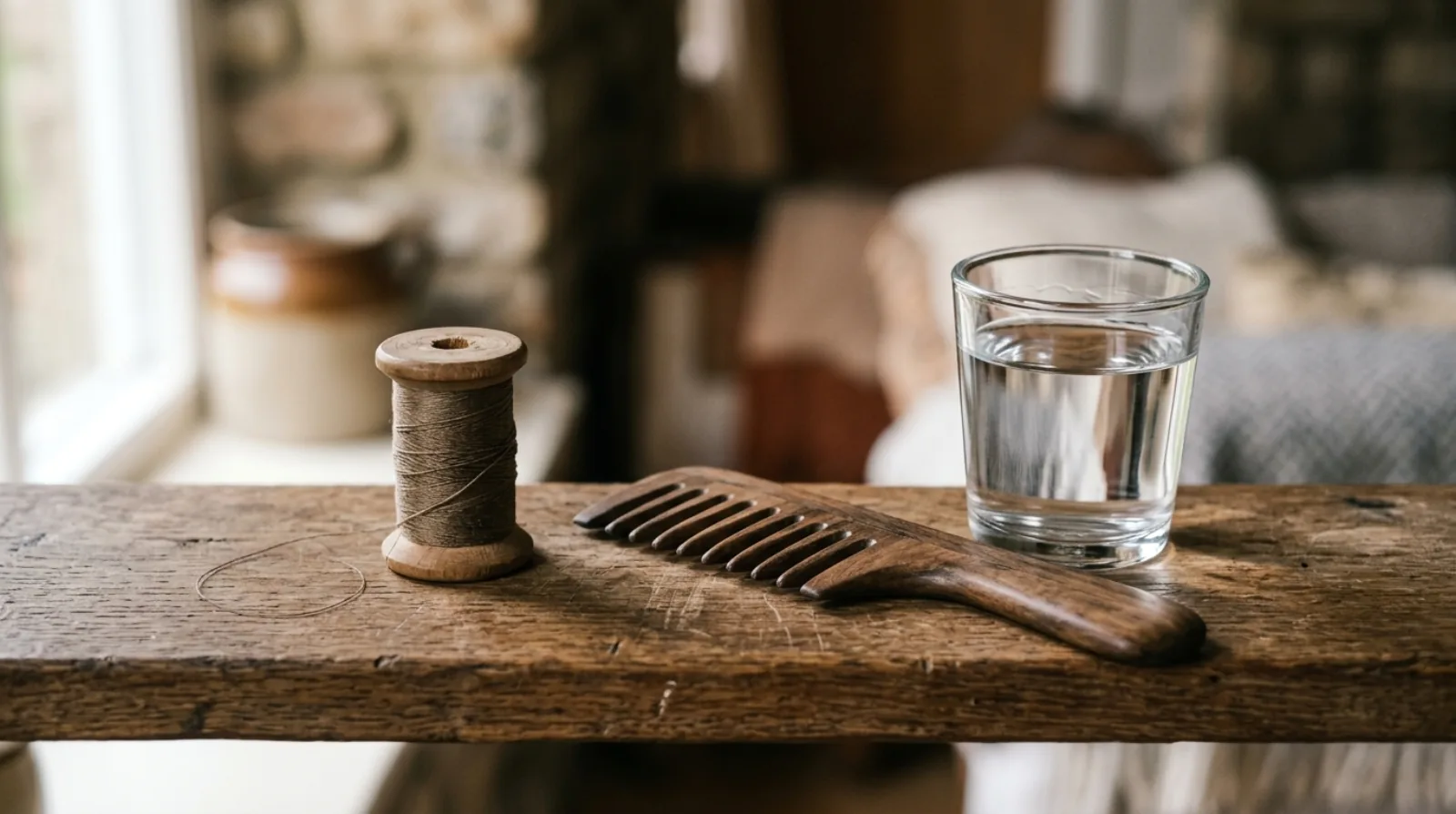
Strand width is what the word texture means in a professional reading: how wide one hair is, judged by rolling a single strand between finger and thumb and comparing it against a piece of sewing thread. Thinner than the thread is fine. About the same is medium. Clearly thicker is coarse.
This one reading decides product weight, and product weight is where most routines fail. Fine hair takes liquids, sprays and light mousses, and collapses under creams and butters. Coarse hair takes creams, butters and oils, and a light spray does nothing at all on it. A well-reviewed product that did nothing for you was usually the right product at the wrong weight.
Strand width is also the reading most likely to have changed since you last thought about it. UCLA Health notes that strand diameter declines with age, and that hair can turn coarse when ageing follicles make less sebum. A routine built at 30 can stop fitting at 50 without anyone doing anything wrong.
Three: density, and what it decides
Density is how many hairs grow per area of scalp, judged by how much scalp shows through when you part the hair in two or three places, and by how thick the base of a ponytail is. It is a separate fact from strand width, and mixing the two is the most common mistake in this whole subject. Fine and dense is normal. Coarse and sparse is normal.
Density decides how much product you need, how heavy a style your hair can carry, and how much weight can be cut out before the shape collapses. It also sets the baseline you compare against later: low density is not hair loss, and knowing your own baseline is what lets you tell a change from a fact of life.
The measurement itself, including the ponytail circumference method, is on hair density and thickness. Take the measurement once and write it down. It is worth more next year than it is today.
Four: the scalp, and what it decides
The scalp is read at the part and at the crown, on day two after washing, for colour, flaking, redness, tenderness and how oily the roots have become.
It decides wash frequency more than anything else does, and it decides which shampoo. This is where naming the problem pays off. The AAD separates dry scalp, which is skin that has lost water, from dandruff, which flakes and is often linked to seborrhoeic dermatitis, and from psoriasis, where patches are raised and the flakes carry a silvery sheen. Three conditions, three different treatments, one identical symptom in the mirror.
Even within dandruff the instruction splits. The AAD tells people with fine or straight hair, or an oily scalp, to wash often and use the dandruff shampoo twice a week. It tells people with coarse, curly or coily hair to wash when needed and use it about once a week, if tolerated. That single pair of sentences is the clearest proof that a reading has to come before a recommendation.
Five: damage, where it sits and what kind
Damage is read by position and by type, and both halves matter.
Position first. Damage at the ends only is age plus wear, and hair that hangs 30 cm below your scalp has been there about two and a half years at roughly 1 cm of growth a month. Damage in a band at the mid-lengths usually points at a hair tie, a seatbelt, or a bag strap. Damage at the roots points at tension, chemistry or the scalp, and is the one worth acting on fastest.
Type next. Splits and white dots at the tips are mechanical wear. Rough, dry mid-lengths that feel like they grip a comb usually come from heat or lightening. Short broken pieces standing up across the top of your head are breakage, not regrowth, which is a distinction people get backwards and then celebrate.
What damage changes is your heat budget and your cut. The AAD's advice on hot combs and irons is to use the lowest heat setting and aim for once a week or less often. On hair that is already breaking, that is a ceiling rather than a target. Heat damage and heat protection covers the rest.
Six: treatment history, the part only you know
Everything above is visible. This one is not, and it changes the advice more than any of them.
The questions are narrow. When was the last colour, and was the hair lightened or darkened. Has there been bleach, a keratin treatment, a perm or a relaxer, and when. How often is heat used, and at what temperature. Is there a regular tight style. The AAD suggests relaxer touch-ups no more often than every two to three months and only on newly grown hair, so a person on a six-week cycle has a different starting point from a person on a twelve-week one.
Dates matter because hair carries the record forward. A bleach in March is still in the strand in September, and it will still be there next March if the hair is long. If you cannot remember, give the season rather than guessing a month. A rough date you believe is worth more than a precise one you invented.
The seventh: porosity, which a photograph cannot read
Porosity is how readily the hair takes water in and how quickly it lets it go. It is the reading that decides whether your conditioner is sitting on top of the hair doing nothing, or soaking in and leaving as fast as it arrived.
It matters because it explains failures that look like nonsense. Hair that takes ages to get wet in the shower and stays wet for hours is low porosity, and heavy creams sit on the surface of it. Hair that soaks water instantly and air dries in twenty minutes is high porosity, usually from colour or heat, and it needs sealing rather than more moisture.
Here is the honest limit. You cannot read porosity from a photograph. A picture shows shine, frizz and how the ends sit, all of which correlate loosely with porosity and none of which prove it. It takes hands, water and a few minutes. The tests that work, and the float test that does not, are on hair porosity. Any reading that claims to have measured your porosity from a picture has guessed.
How the six combine
Put two people side by side who would both be told 'you have curly hair' by a shop assistant.
Person one: type 3 curls, fine strands, high density, a dry scalp, no colour, no heat. Their plan is a light leave-in, conditioner from the mid-lengths down, washing perhaps weekly, and nothing heavy at the roots because density plus weight equals a flat crown.
Person two: type 3 curls, coarse strands, low density, an oily scalp, lightened eighteen months ago with breakage at the mid-lengths. Their plan is a richer cream, conditioner right to the ends, washing more often than a curl guide would suggest because the scalp decides that, a stop on heat, and a cut to remove the broken band.
Same first word. Almost nothing else shared. This is why a reading is worth having done once properly, and why a plan built from it should say the reason next to each instruction rather than only the instruction. The Kurli AI Specialist writes it that way on purpose.
What a reading cannot tell you
It cannot tell you why. A reading records that your part has widened; it cannot say whether that is genetics, iron, thyroid, a medicine, or the year you had. Those answers come from a doctor and usually from a blood test.
Timing is another blind spot. The AAD separates hair shedding from hair loss, and increased shedding often begins around three months after a stressful event and settles over the months that follow. A reading taken in the middle of that window shows a density that is not your normal one.
Nor can it promise a result. A reading tells you what your hair is and what it needs. What happens next depends on doing the routine for long enough, which for anything involving new growth means at least three months, because hair grows about 1 cm a month and you are waiting for hair that has not appeared yet.
Common questions
What can hair analysis tell you?
A condition reading tells you your curl pattern, how wide your strands are, how densely your hair grows, what your scalp is doing, where the damage sits and what kind it is, and how your treatment history is affecting the hair now. It does not tell you why anything is happening inside your body. That needs a doctor.
What does a scalp analysis show?
It shows the colour and condition of the skin, flaking and what kind, redness, how oily the roots are at a known number of days after washing, and how wide the part looks compared with the rest of the head. Flaking has several causes that look identical in a mirror, so naming it is the point of the exercise.
What is a scalp analysis?
It is an examination of the skin your hair grows from, done at the part and the crown, sometimes with a magnifier or a scalp camera. It decides how often you wash and which shampoo you use. It is an assessment of condition, not a diagnosis, and a sore, bleeding or patchy scalp should go to a doctor instead.
How do you do a scalp analysis?
Wait until day two after washing, then part the hair in three places under daylight: the usual part, a second one on the other side, and one at the crown. Look for flaking, redness, tenderness and how much scalp shows. Photograph each part so you can compare against the same three places in six months.
How do I check my scalp type?
Judge it by how the roots look on day two after a wash with no dry shampoo. Visibly oily at the roots by the second day is an oily scalp. Tight, itchy or flaking with small dry pieces is a dry scalp. Larger flakes that keep returning after a clarifying wash point to dandruff rather than dryness.
What hair texture do I have?
In a professional reading, texture means the width of one strand. Pull out a single hair and roll it between finger and thumb next to a piece of sewing thread. Thinner than the thread is fine, about the same is medium, clearly thicker is coarse. Test two or three strands, since one hair is a poor sample.
Does hair texture change with age?
Yes. UCLA Health reports that strand diameter declines with age and that texture can change, partly because ageing follicles make less sebum, which leaves hair drier and coarser to the touch. Grey hair often behaves differently from the hair it replaced. A routine that worked for years can stop fitting for this reason alone.
Is my hair damaged or dry?
Dry hair improves within one wash of adding moisture and holds the improvement. Damaged hair takes the conditioner, feels better wet, and returns to rough as soon as it dries. The other test is position: dryness is usually even along the length, while damage sits in a band, at the ends, or wherever the heat lands.
Does hair damage travel up?
A split that starts at the tip can keep separating further up the strand, which is why a small trim usually removes less length than waiting does. Damage cannot spread to hair that is undamaged, and nothing repairs a split permanently. Cutting the split off is the only thing that ends it, and doing it early costs the least.
Why test hair porosity?
Because it decides whether products get into the hair or sit on it. Low porosity hair resists water and rejects heavy creams, so it needs lighter products and warmth to help them in. High porosity hair takes water instantly and loses it as fast, so it needs sealing. Same conditioner, opposite outcome.
Can hair analysis detect vitamin deficiency?
The condition reading described here does not test for nutrients at all. It looks at the hair and scalp. Hair mineral analysis sold as a nutrient test is a separate product and a contested one. If you think a deficiency is affecting your hair, ask a doctor for a blood test, which is the measurement that gets acted on.
Which of the readings changes my routine most?
Strand width, in our view. It sets product weight, and product weight is where most routines quietly fail. Scalp state comes second because it sets wash frequency. Curl pattern gets the most attention online and is genuinely the third most useful of the three, since it mainly modifies what the first two have already decided.
What does hair analysis show?
A condition reading of this kind shows curl pattern, strand width, density, scalp state, where damage sits and what kind it is, and how past colour or heat treatment is affecting the hair now. Porosity belongs on the list too, though a photograph cannot settle it, since that reading needs water and a few minutes rather than a picture.
Does a hair analysis test for drugs or alcohol?
No, not the kind described on this page. Forensic and workplace hair testing analyses the hair shaft in a lab for traces of a substance, which is a chemistry question answered by a lab, not by looking at the hair. A condition reading only covers how your hair looks and behaves: its curl pattern, width, density, scalp and damage.
Can hair type change?
What most people call hair type is usually curl pattern, and that tends to stay stable through adult life. Strand width is a separate reading, and it does shift: UCLA Health notes that strand diameter declines with age and that ageing follicles make less sebum, which can leave older hair feeling coarser even as it grows finer. A large, sudden change is worth mentioning to a doctor rather than assuming it is only age.
What is the rarest hair texture?
There is no reliable count to answer that with, and any specific figure you see quoted online should be treated as a guess rather than data. What counts as rare also depends on which population you compare against, since texture and curl pattern are distributed differently across ancestries. This page does not rank textures against each other; each of the seven readings is judged on its own, not against a global scale.
Which of the seven readings is easiest to get wrong?
Scalp state, in our experience, because people judge it by how their lengths feel rather than by what the skin at the roots is actually doing. An oily scalp with dry ends is one of the most common combinations there is, and treating the whole head as one surface sends the rest of the routine in the wrong direction from the first step.
Is hair analysis the same as a hair type quiz?
No. A quiz sorts you into a small number of preset categories from a few multiple-choice answers, which is a shortcut rather than a reading. A hair analysis records six or seven separate facts about the hair and scalp you actually have, and gives each one its own answer instead of forcing all of them into a single label.
Sources
Hair biology and hair-care facts on this page are supported by these sources. Styling recommendations are guidance.
- 6 curly hair care tips from dermatologists, American Academy of Dermatology
- Black hair: Tips for everyday care, American Academy of Dermatology
- How to treat dandruff, American Academy of Dermatology
- Is your dry scalp something more serious?, American Academy of Dermatology
- 10 hair care habits that can damage your hair, American Academy of Dermatology
- Your guide to aging and hair, UCLA Health
- Physiology, Hair, StatPearls, NCBI Bookshelf
- Do you have hair loss or hair shedding?, American Academy of Dermatology
See it on your own face
Kurli reads your face from a selfie, recommends styles that suit you, and renders each one onto your photo.