Hair first
Should I cut off damaged hair? It depends on where the damage sits
Hair cannot repair itself. The only choice left is where you cut, and when.
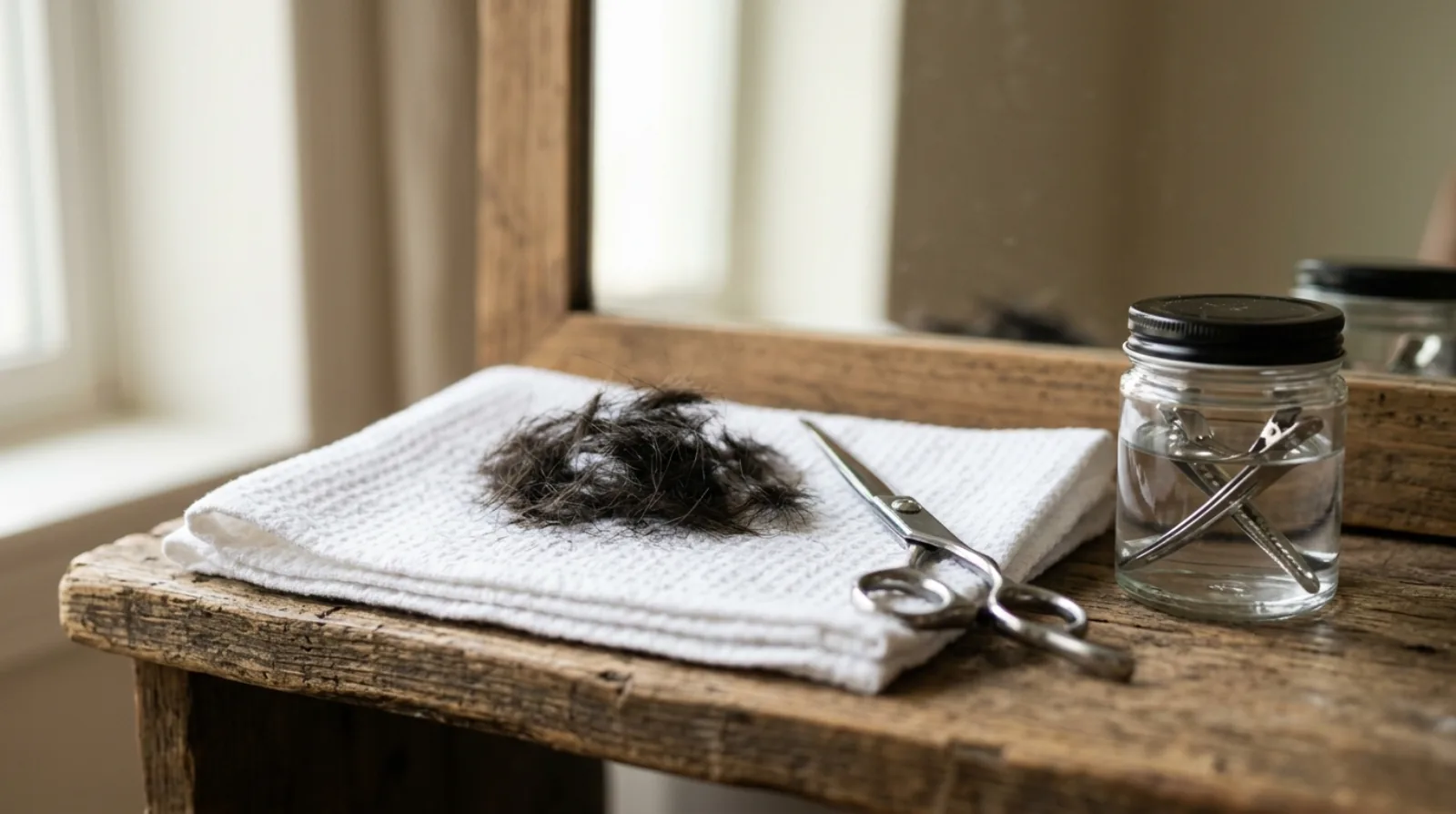
Cut off damaged hair or wait and hope a routine fixes it. That is the wrong choice to be weighing, because a routine cannot fix hair that is already damaged. StatPearls, a peer-reviewed medical reference, describes the visible hair shaft as 'a thin, flexible cylinder of non-living, keratinized epithelial cells.' Non-living tissue does not heal. A strand that has split, snapped or been stripped by bleach stays that way until it is cut off or grows out on its own, at about 1 cm a month.
So the real question is not whether to cut off damaged hair. It is where the damage sits, and that decides how much to remove and when. This page works through four cases: damage in the ends only, damage through the bottom third, damage everywhere, and the situations where cutting should wait.
This page covers damaged hair only. The wider question of whether to change your hair at all is answered at should I cut my hair.
Hair cannot heal, so the decision comes down to timing
Once a strand has split, snapped, or been stripped by bleach, nothing applied to it afterwards mends it. The part of your hair above the scalp has no blood supply and no living cells, which is why conditioners and treatments work on the surface rather than the inside. They can smooth a rough strand and slow the next split from starting. They cannot close one that has already opened.
The American Academy of Dermatology's own pages on damaged hair reflect the same limit. They state that damaged hair is fragile and tends to break, and the advice that follows is entirely about prevention: lower heat, gentler handling, one chemical service at a time. The advice stops there because no repair step exists for hair above the scalp.
The only two ways damaged hair leaves your head are cutting it off, or waiting for it to be pushed out by new growth at the root. Growth runs at about 0.35 mm a day, or roughly 1 cm a month, according to StatPearls. That number turns the decision into a plain trade: cut now and you lose length today, or wait and keep the length while carrying the damage a while longer. There is no third option where the hair you already have repairs itself.
Ends only: a small trim, sometimes called dusting
If the damage is confined to the last 1 to 2 cm, the fix is small. Some stylists call this dusting: removing a sliver so thin it looks like dust falling to the floor rather than a visible drop in length. The goal is not to change how long your hair looks. It is to remove the exact section that has already split, before the split travels further up the strand.
A split does not stay where it starts. Left alone, it runs upward and the hair eventually breaks at that point, costing more length than a small trim would have. Removing 1 cm from ends that are 1 cm damaged is a fair trade, even though it feels like giving something up rather than protecting something.
The test for this case takes ten seconds: hold your hair up to daylight and look at where the fuzz starts. If the top of your length looks smooth and only the outermost tips look pale or frayed, a full haircut is more than the problem needs.
The bottom third: stage the cut over two or three visits
When the rough section runs further up, say the bottom third of your length, removing all of it in one sitting can take more than most people are ready to lose at once. Staging the removal over two or three visits spreads the loss out while still reaching the same clean result.
Here is the arithmetic. Hair grows about 1 cm a month. If a visit removes 2 cm and eight weeks pass before the next one, roughly 2 cm has grown back by the time you return, so each visit is a smaller net loss than the total amount of damage suggests. Over two or three visits spaced about two months apart, the damaged section shrinks from both directions at once: new growth from above, trimming from below.
Tell your stylist you are working through damage in stages rather than asking for one final length. That changes what gets prioritised at each visit: the worst sections go first, instead of an even amount off the whole head. How long it takes to change your hair has the full arithmetic if you want to plan the visits against real dates.
Everywhere: a shorter cut, and a routine that protects what is left
Sometimes the damage is not confined to a section. Bleach that went wrong, months of daily heat, or hair that has simply been long enough to accumulate years of wear can leave the whole length rough rather than just the ends. Staging a trim over months treats a small part of a bigger problem in that case.
A shorter cut removes the worst of it in one visit and gives you a starting point that is easier to protect than the hair it replaces. This is the case where a bigger change earns its cost. It is the fastest route to hair that feels different, even though it is also the option that costs the most length at once.
The cut alone does not stop the same wear from returning. Whatever produced the damage the first time, whether that was heat, bleach or friction, produces it again on the new length unless something about the routine changes too. A haircut and a changed routine belong together here, which is the ground covered in what a haircut can and cannot fix.
When not to cut yet: hair that is mid-shed
If you are finding more hair than usual in the shower or on your pillow, wait before committing to a shorter cut. Shedding like this usually has a cause that happened around three months earlier. The American Academy of Dermatology lists childbirth, high fever, surgery, major stress and rapid weight loss as common triggers, and StatPearls notes that a causative event typically turns up about three months before the shedding starts.
This matters for a cutting decision because the shed is temporary and the timeline is known. StatPearls states that acute shedding lasts less than six months, and the AAD says fullness tends to return within six to nine months of the trigger. A shorter cut chosen while density is temporarily down is a cut chosen for hair that is about to fill back in, and proportions that look right during the shed can look different again once it does.
If the thinning has no clear trigger, has lasted longer than nine months, or shows as a widening parting or a receding line rather than an even reduction everywhere, that is a different question, and it belongs in thinning and hair loss rather than here.
When not to cut yet: right before an event
A haircut is the one change on this page that happens in an afternoon rather than over weeks. That speed is exactly why it carries risk right before something you cannot reschedule.
Removing 8 cm of damage is a decision most people can live with adjusting to over a few days. Removing 8 cm two days before a wedding or a job interview leaves no time to fix a length that reads shorter than expected, or a shape that needs time to settle into how you move, sleep and style it day to day.
Our position: if the damage is bothering you and an event is close, the safer move is the small trim from the ends-only case above, which barely changes the length. Save the bigger cut for once the date has passed and you have time to adjust to it.
What cutting off damaged hair does not do
Cutting is precise about what it fixes. It removes the specific hair that is already damaged. It does not make the hair that stays more resistant to the same cause, and it does not change your growth rate, which stays at about 1 cm a month whatever length you choose.
It is also not a repair for the hair you keep. If you cut 5 cm off a 30 cm length, the remaining 25 cm is exactly as damaged as it was the day before the appointment, just shorter overall and closer to your newest, least worn growth at the fresh ends. A trim does not improve the feel of the length above the cut line. It only removes what was below it.
That is why a cut paired with no change in habits produces the same damage again on a schedule. If bleach, heat or friction caused the first round, expect the same section to need the same trim again within six months to a year unless something about the cause changes too.
Deciding without guessing
Two minutes with your own hair, held up to daylight, tells you which of the cases above you are in. Smooth through most of the length with damage only at the outermost tip is a dusting. Rough for the bottom third is a staged cut. Rough everywhere is the shorter cut. Heavy shedding with no visible damage along the strand is neither, and it needs its own answer.
If you would rather not guess, a hair consultation reads where the damage actually sits before anyone reaches for scissors, covering hair type, texture, density, scalp and damage together. The Kurli AI Specialist does the same reading from three photographs and marks up your own images to show where the wear is, alongside a routine that protects whatever you decide to keep. Start with the hair plan if you want that reading before you book.
Common questions
Should I cut off damaged hair?
Yes, once you know where the damage sits, because damaged hair does not repair itself. If it is confined to the last 1 to 2 cm, a small trim is enough. If it runs through the bottom third or further, plan a bigger cut, staged over two or three visits if you want to keep length. The only exception is hair that is mid-shed, where cutting should wait.
Should I cut off heat damaged hair?
Yes, and lower the heat at the same time, or the same section reappears on the new length within months. Heat damage does not reverse, so the section that feels rough or looks pale needs to be removed rather than treated. Check how far up the roughness goes before you book, since that decides whether a small trim is enough or a bigger cut is needed.
Should I cut off bleach damaged hair?
Yes, working from the bottom up rather than all at once if you want to keep length. Bleached hair does not recover its original strength, so the porous, fragile section stays that way until it is removed. Staging the cut over a few visits, a couple of centimetres at a time, clears it while new, unbleached growth keeps arriving from the root.
Is it better to cut off damaged hair?
It is better than leaving it, since a split or snapped strand cannot mend and tends to travel further up and break at a higher point the longer it is left. Whether to cut a small amount or a larger amount depends on how far the damage runs. Cutting nothing and waiting only works if the wear is genuinely stable, which is rare once a split has started.
Do you have to cut off damaged hair?
No, not immediately, but the damaged section will not improve on its own and will keep wearing until it is removed or grows out completely. Some people choose to live with rough ends for a while and grow the length instead. That choice is reasonable as long as it is made knowingly, rather than while waiting for a product to do a job scissors are the only tool for.
Does cutting off damaged hair help?
Yes, in a specific way: it removes hair that was already going to keep breaking, which stops the damage travelling further up the strand and protects the length above it. It does not make the remaining hair stronger or shinier on its own. Pair the cut with a lower-heat, gentler routine so the newly cut ends do not reach the same state on the same schedule.
Can you cut off damaged hair?
Yes, and it is the only method that actually removes it, since nothing applied to hair changes the non-living tissue underneath. A stylist can take off as little as a few millimetres for light wear, or several centimetres for damage that runs deeper. Decide the amount by how far up the strand the roughness goes, not by a fixed rule.
How much should I cut off my damaged hair?
Only as much as the damage covers, measured by holding a section up to daylight and marking where it stops looking smooth. For ends-only wear that is often 1 to 2 cm. For damage through the bottom third, plan on removing that whole section, in stages if you want to keep length rather than in one visit.
What happens if you don't cut off damaged hair?
The damaged section keeps wearing, since nothing reverses it, and a split that is left in place tends to travel upward until the strand breaks higher than it would have if you had trimmed it sooner. Some people accept that trade to keep length while growing it out. It is a fair choice, as long as you expect the rough section to grow rather than improve.
Should damaged hair be cut off?
Generally yes, because the alternative is carrying hair that cannot repair itself and will keep breaking at the same point. The one clear exception is hair that is shedding heavily from a recent illness, birth or period of stress, where the honest fix is waiting out the shed rather than cutting a shape around temporarily lower density.
Is it best to cut off damaged hair?
It is the only option that removes it, so in that sense yes, though how much and how fast depends on where the wear sits. Ends-only damage needs a small trim. Damage through more of the length needs a bigger cut, which can be staged over a few visits if keeping length matters to you.
Should I cut off dry hair?
Dryness itself is not always a cutting question, since dryness can respond to conditioning and a lower-heat routine within weeks. Cut when the dryness has produced actual damage, such as rough, catching ends or visible splits, rather than for dryness alone. Feel the last few centimetres against the mid-length: if they catch and the mid-length does not, that section is worth removing.
Can split ends heal if I use a repair product instead of cutting?
No. A split has already divided into two separate strands, and no product rejoins them, since the hair above the scalp has no living cells to mend with. A repair or bond product can smooth the split so it catches less and looks less obvious for a wash or two, which is worth doing, but the split itself is still there until it is cut off.
Is it safe to cut damaged hair while I am losing more hair than usual?
It is safe for the hair itself, since a haircut does not affect shedding either way, but it is a poor time to choose a shorter shape. Density is temporarily down and tends to return within six to nine months of whatever triggered the shed. A small trim to remove split ends is fine in the meantime; save a bigger change for once the shed has settled.
Should I trim damaged ends before a big event?
A small trim, yes, if the ends are visibly rough, since removing 1 to 2 cm barely changes the length and settles within a day. Hold off on a bigger cut that changes the shape, because a new length or shape can look different than expected for the first few days, and an event is the wrong moment to be adjusting to that.
How many salon visits does it take to remove damage from the bottom third of long hair?
Usually two to three visits, spaced about two months apart, if you want to keep length while clearing the damage. Each visit removes roughly 2 cm and about 2 cm grows back before the next appointment, so the damaged section shrinks steadily rather than disappearing in one sitting. Cutting it all in one visit is faster but costs more length at once.
Does hair grow back the same after damaged sections are cut off?
Yes. The follicle under the skin, which produces new hair, is not affected by damage to the visible strand above it, so new growth arrives in normal condition regardless of how worn the hair you cut off was. The exception is scarring conditions of the scalp, which affect the follicle directly and need a dermatologist rather than a trim.
What is dusting, and is it enough to remove damaged ends?
Dusting is a light trim, often under 1 cm, that removes only the outermost tip of the hair rather than a visible amount of length. It is enough when the damage is confined to that tip, which you can check by sliding two fingers down a section and feeling where it turns rough. If the roughness reaches higher than a centimetre or two, dusting alone will not clear it.
Sources
Hair biology and hair-care facts on this page are supported by these sources. Styling recommendations are guidance.
- Physiology, Hair, StatPearls, NCBI Bookshelf
- Do you have hair loss or hair shedding?, American Academy of Dermatology
- Telogen Effluvium, StatPearls, NCBI Bookshelf
- How to stop damaging your hair, American Academy of Dermatology
See it on your own face
Kurli reads your face from a selfie, recommends styles that suit you, and renders each one onto your photo.