Hair first
The haircuts that depend most on hair condition
A blunt bob asks for perfect ends. A soft, textured cut barely notices them.
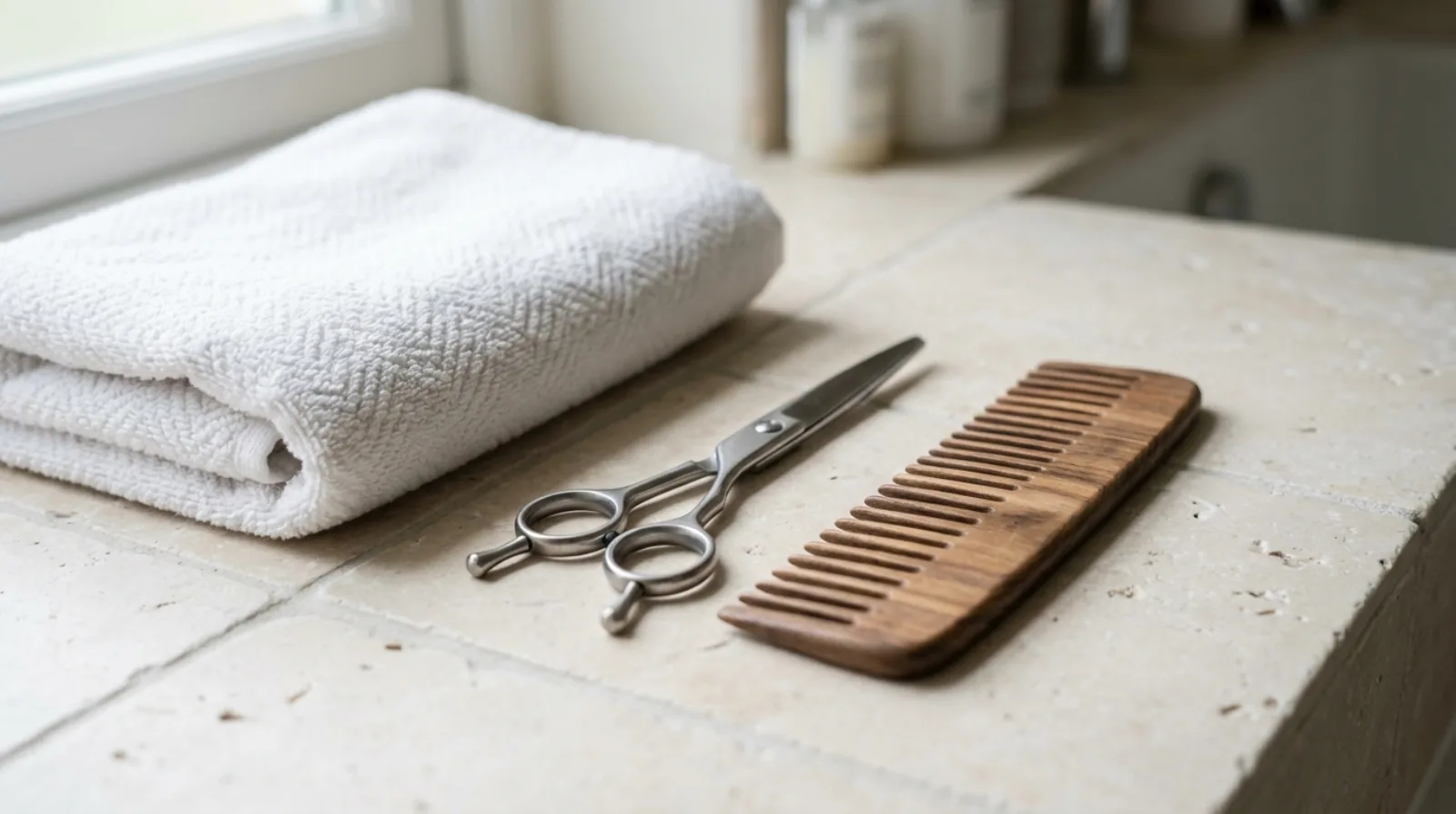
Not every haircut asks the same amount of your hair. A soft, layered shape forgives a rough week. A blunt bob does not, because a blunt bob has one idea only: one line, at one height, on every strand. If a quarter of those strands are frayed, the line disappears, and so does the haircut.
This page goes through the shapes that ask the most of your hair's condition, in order: a blunt line, long layers, a fringe, a pixie, a curly cut, and fine, straight hair worn long. Each one fails in its own specific way when the hair underneath is not ready for it. Then it covers the opposite list: shapes built to survive a bad week rather than expose it.
This is not a page about whether to cut your hair at all. Deciding to change your hair covers that question. This assumes you already have a shape in mind, and checks whether your hair, as it is right now, can actually carry it.
A blunt line: a bob or any blunt cut needs an intact edge
A bob and any other blunt cut are built on one instruction: every strand stops at the same height. That line is the entire design. There are no layers underneath to soften a mistake, and nowhere for a rough section to hide.
Split ends break that instruction quietly. A split does not stay at one point. It divides into two, and each half moves on its own, so multiplying that across a whole perimeter turns the clean line into a soft band, one to two centimetres wide. From across a room, that band reads as regrowth, even on the day the cut was done.
The test takes ten seconds: pinch the last 2 to 3 cm of your hair between two fingers and slide down. If it catches, thins out, or feels rougher than the hair above it, a blunt line will show that roughness as fuzz rather than as an edge. Asking the stylist to remove an extra centimetre to clear the damage buys the clean line the cut is supposed to deliver.
Long layers: built on density and movement
Long layers remove weight in stages, so the hair falls in visible steps rather than one heavy sheet. Whether those steps read as layers or as thin patches comes down to two things: how much hair is actually there, and whether the strands slide past each other or catch.
Layering removes bulk on purpose. Hair that has already thinned at the ends has less material left to work with once that weight is gone, so a layered cut on worn ends can look sparse in the middle rather than light through it, since there is not enough density to fill each step.
Movement matters as much as density. Long layers are sold on a photograph of hair swinging as the head turns. Strands with a rough, lifted surface catch on their neighbours instead of sliding, so the section moves as one stiff piece rather than several loose ones. The cut is still there. It just cannot show itself.
If your ponytail has thinned at the ends over the past year or two, say so before the layers go in, and ask for them to stop above the thinnest section rather than run through it.
A fringe: the one section that touches skin all day
A fringe is the only part of a haircut that sits on skin all day. It touches the forehead, and the forehead has its own oil supply. Sebaceous glands develop on or near the hair follicle, according to Cleveland Clinic, and they release sebum continuously rather than at set times of day.
That is why a fringe separates into strands by the middle of the afternoon on a scalp that runs oily, whatever the shape of the cut. It is a scalp and oil question before it is a styling question. A fringe on hair that is dry and prone to lifting does the opposite: it pulls away from the forehead in humid air, for the same reason the rest of the hairline frizzes.
None of this rules a fringe out. It changes the honest question at the consultation, which is not which fringe suits your face, it is how often you are willing to rinse that one section on its own. Rinsing the front piece alone takes about two minutes and resets it for the rest of the day. People happy to do that can wear almost any fringe. People who are not should ask for a longer, softer one that still looks intentional once it separates.
A pixie: needs a calm scalp and hair that behaves at a short length
A pixie cut puts hair within a few centimetres of the scalp everywhere. At that length there is no distance left between the eye and the skin, because the cut is mostly scalp with a short covering over it.
A scalp that flakes, itches, or produces oil quickly shows through a pixie within a day, since there is no length to absorb it or hide underneath. Matching wash frequency to hair type rather than a fixed rule, which the American Academy of Dermatology bases on whether hair is straight and oily or dry, textured, curly or thick, keeps a pixie from going flat or shiny with oil by the afternoon.
Texture matters too. A pixie asks hair to hold a defined shape at a short length, and hair that is dry and unruly at that length can stand up where the stylist cut it to lie flat.
A pixie is not a shape to book on a whim if your scalp has been giving you trouble. Settle the scalp first, whether that means a change in washing frequency or a period of gentler products, and the same cut holds its shape longer between visits.
Curly cuts: shaped around moisture as much as the curl pattern
A curly cut is shaped around how the curl behaves dry, which means the stylist is cutting a pattern that depends on moisture being present in the hair. The American Academy of Dermatology states that curly hair is drier than other hair types, and recommends conditioning the full length rather than only the ends, followed by a leave-in conditioner or oil to hold that moisture in.
Underneath that recommendation is the reason curly cuts move so much between a good week and a dry one. A curl pattern that is under-moisturised sits closer to the head and reads shorter and flatter than the same curl with enough moisture in it, because the spring in the pattern depends on water content the hair does not have that day.
That is why a curly cut is usually cut on hair worn in its natural pattern, rather than hair washed and blow-dried straight for the appointment. Ask to be cut on dry, styled curly hair where the pattern is doing what it normally does, and keep the moisture routine steady for a week either side of the appointment so the cut is judged on the hair you actually wear.
Fine, straight hair worn long: nowhere to hide a split
Fine, straight hair worn past the shoulders has fewer strands covering more length, and each strand is thin enough that damage shows through it rather than being hidden inside a thicker one. There is also nowhere to add texture that would break up a rough section, because thinning fine hair further only makes it look sparser.
Hair grows about 1 cm a month, or 15 cm a year, according to StatPearls, so hair reaching 40 cm below the scalp has tips over two years old. On fine hair, those tips carry two years of washing, brushing and heat with no thickness to cushion the wear, which is why fine hair worn long tends to show splits and thin, see-through ends before thicker hair of the same length does.
If you want to keep fine hair long, a small, regular trim matters here more than on any other hair type, because there is no layering trick to fall back on once the ends wear out. Split ends and breakage covers how to slow that wear down between visits.
The cuts that forgive a bad week
Some shapes are built to survive exactly the problems the cuts above cannot. Soft, face-framing layers move gradually rather than in one hard line, so a rough section blends into the layer above it instead of standing alone. Damage has no single edge left to interrupt.
Texture works the same way on purpose. A textured cut moves shorter pieces inside the overall shape rather than along the perimeter, which is where worn ends usually sit. Those short pieces catch the light in different directions anyway, so a strand that has lost some shine disappears into the pattern instead of standing out against a smooth one.
Shorter lengths help for a plainer reason: they remove more of the oldest, most worn hair in one visit. A chin-length cut keeps roughly a year of growth on the head at most, against two or three years for hair worn long, so there is simply less time for damage to build up before it is cut away again.
None of these shapes need good condition to look intentional. That is the trade they make: less demand on the hair, in exchange for less of the sharp, graphic look a blunt line or a defined pixie has when everything underneath is in good shape.
Read the hair before you choose the cut
The shapes above are not a ranking of good and bad haircuts. A blunt bob on hair with intact ends is one of the strongest results a stylist can produce, and the same is true of a pixie or a fringe. What decides the outcome is simple: whether the hair matches what the cut asks of it, set before you ever sit in the chair.
A hair consultation checks that match. It reads hair type, texture, density, scalp condition and damage before anyone talks about shapes. Without it, a photograph of a haircut you like tells your stylist what you want the outcome to look like, not whether your hair, this month, can produce it.
The Kurli AI Specialist does the same reading from three photographs and returns one routine with a reason attached to each step, alongside your own photographs marked up to show where the wear actually sits. If you want that reading before booking a cut that depends on your hair being ready, start with the hair plan. And if the ends are already the problem, should I cut off damaged hair works through where to start.
Common questions
What haircut is best for damaged hair?
A shorter length with soft layers or texture, rather than a blunt line. Shorter hair removes more of the oldest, most worn hair in one visit, and layers or texture break up a hard edge so rough sections blend in instead of standing alone against a smooth outline. A blunt bob or a defined pixie can work well again once the ends are in better shape.
Which haircut suits for dry hair?
One with layers or texture rather than one hard line, since dry hair tends to show wear at a single edge more than it does across a softer shape. Curly and coily cuts are the exception: they are shaped around dry curls on purpose, so ask to be cut on dry, undone hair rather than freshly blow-dried straight.
Can I get a haircut with dry hair?
Yes, and for curly or textured hair it is usually the better way to be cut, since the stylist can see the curl pattern doing what it actually does day to day. For straight hair, most stylists still prefer clean, damp hair so the length is even, then dry it to check the finished line.
What's the best hairstyle for damaged hair?
One that removes some of the damaged length and does not depend on a single sharp edge. Soft layers, a textured cut, or a length short enough to leave less old, worn hair on the head all forgive rough ends better than a blunt bob or a fringe does. A blunt shape becomes an option again once the worst of the damage is gone.
Which hairstyle is best for damaged hair?
Ask a stylist, or a hair consultation, to look at where the damage sits before choosing a shape, because damage confined to the ends and damage running through the whole length want different answers. If the wear is only in the last few centimetres, most shapes still work once that section is trimmed. If it runs higher, a shorter cut with soft layers is the safer starting point.
Why do bangs get oily so fast?
Because a fringe sits directly on the forehead, and the forehead has its own oil-producing glands working all day. Sebaceous glands sit on or near the hair follicle and release sebum continuously, according to Cleveland Clinic, so the front section collects oil from the skin underneath as well as from the scalp. Rinsing the fringe alone, without washing the rest of your hair, resets it in about two minutes.
Should I get bangs if I have oily skin?
Yes, as long as you are willing to rinse or dry-shampoo the fringe on its own between full washes. Oily skin will make a fringe separate into strands faster than the rest of your hair, but that is a maintenance habit rather than a reason to avoid bangs entirely. A longer, side-swept fringe shows oil less than a blunt, straight-across one.
Can you have bangs with oily skin?
Yes. Oily skin changes how often you need to touch up the fringe, not whether you can wear one. Keep the front section longer than a straight-across style so it separates into soft pieces rather than sticking together in visible strands once the oil builds up during the day.
Do bangs make your face oily?
Not directly. A fringe sits on skin that already produces oil, and styling products used near the hairline, such as pomade or heavy creams, can transfer onto the forehead and add to it. If breakouts appear along the hairline after growing out a fringe, check what is on the hair touching that area before assuming the fringe caused it.
Why are my bangs always greasy?
Most often because the scalp and forehead in that spot produce oil steadily, and a fringe is styled and touched more than any other section, which spreads that oil through the hair faster. Washing frequency matters more here than product choice. If the rest of your hair stays clean for two or three days and the fringe does not, treat the fringe as its own zone and rinse it separately.
Is pixie cut good for thin hair?
It can be, because a pixie removes weight that thin hair struggles to carry, which is often what makes thin hair look flatter as it grows longer. The trade is that a pixie also shows the scalp more than any longer cut does, so an oily, flaky or irritated scalp becomes visible rather than staying covered by length.
Do pixie cuts work with thin hair?
Generally yes, more reliably than long layers do, because there is less length asking the hair to hold volume it cannot supply on its own. The result depends on the scalp underneath being calm and even, since a pixie leaves almost nothing between the eye and the skin.
Does a blunt bob need healthy hair?
It needs intact ends more than any other shape does, because a blunt bob is one clean line and nothing else. Split or worn ends turn that line into a soft band instead of an edge, and the band is visible from across a room. Hair with a rough last 2 to 3 cm usually needs those centimetres trimmed at every visit to keep the line looking sharp.
Do long layers hide damaged ends?
Only partly, and less than people expect. Layers move weight around, so they can soften a single hard edge, but each layer still ends in its own set of tips, which multiplies the number of worn ends on show rather than hiding them. Long layers hide flat roots and add movement better than they hide damage.
Can fine, straight hair hide split ends?
Less than any other hair type. Fine strands are thin enough that a split shows through immediately, and there are usually too few strands to disguise a worn section inside a thicker one. Regular small trims matter more on fine, long hair than on thick or curly hair of the same length.
Does curly hair need extra moisture before a cut?
Yes, and the cut should usually happen on curls that are dry and styled as normal, not freshly straightened. The American Academy of Dermatology recommends conditioning curly hair through its full length and adding a leave-in conditioner or oil afterwards, since curly hair is drier than straight hair by nature. Under-moisturised curls sit closer to the head and can end up looking shorter than intended.
What haircut forgives damaged hair the most?
A shorter length with soft layers or texture rather than a defined pixie or a blunt line, since it removes more old, worn hair in one visit and has no single hard edge for the remaining damage to interrupt. It does not repair the hair that stays. It only reduces how much worn hair is left to look after.
Should I fix my hair before getting a pixie cut?
Settle an oily, flaky or itchy scalp first if you have one, since a pixie leaves almost no length to cover it. Shine and general condition matter less here than they do for a bob or long layers, because there is so little length left for texture problems to show through.
Sources
Hair biology and hair-care facts on this page are supported by these sources. Styling recommendations are guidance.
- Physiology, Hair, StatPearls, NCBI Bookshelf
- Tips for healthy hair, American Academy of Dermatology
- Sebaceous Glands, Cleveland Clinic
- 6 curly hair care tips from dermatologists, American Academy of Dermatology
See it on your own face
Kurli reads your face from a selfie, recommends styles that suit you, and renders each one onto your photo.