Hair first
Why hair condition matters more than the cut
A cut is a shape you buy six times a year. Condition is what you look at every morning.
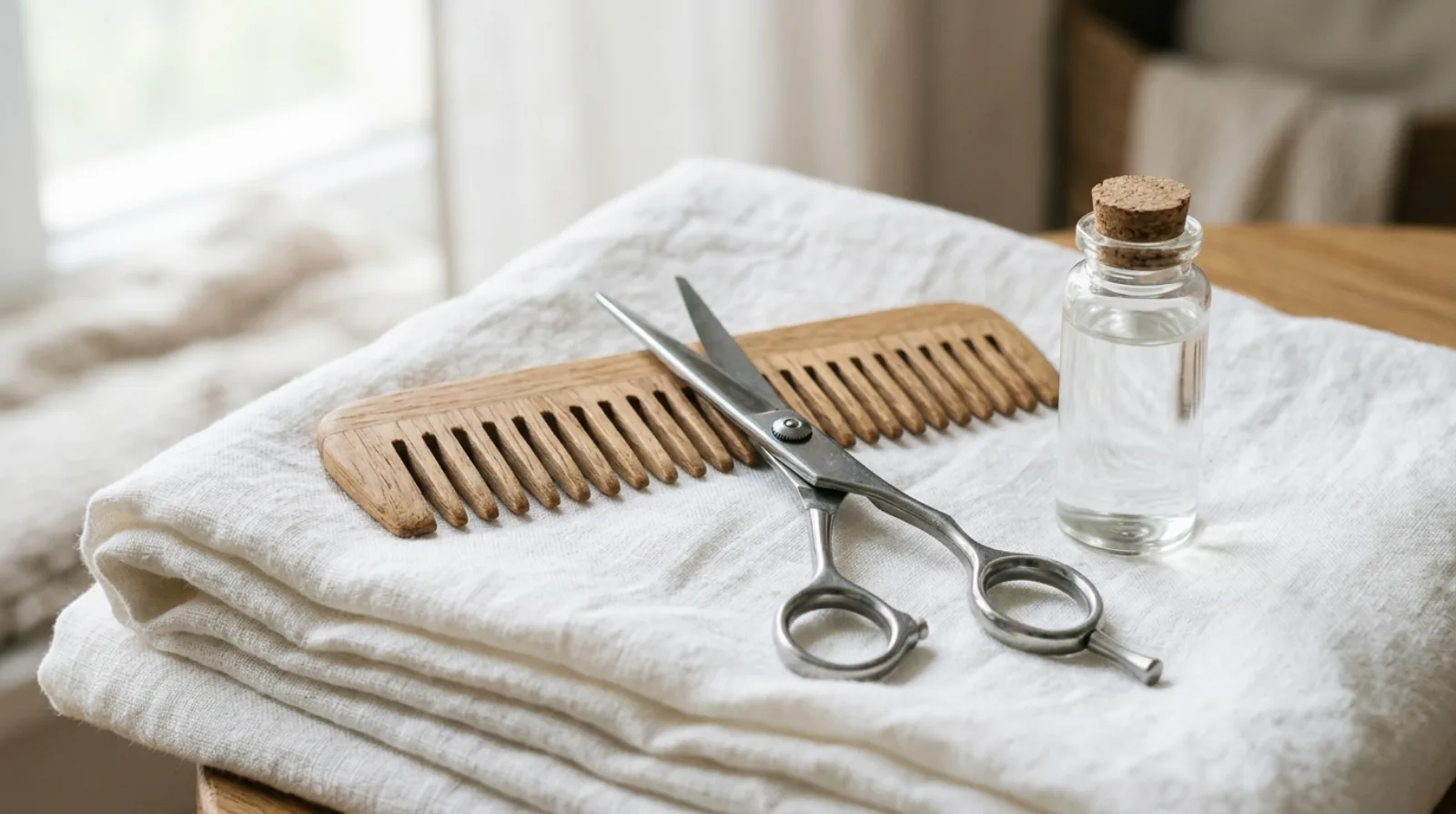
Most people book a haircut when they are unhappy with their hair. Sometimes that is the right move. Often the shape was never the problem, and eight weeks later the same feeling comes back wearing a different outline.
A haircut decides geometry. Where the hair ends, how much weight sits where, which line lands on which part of your face. Hair condition decides the surface. Shine, the state of the ends, whether the hair moves when you turn your head, whether it goes frizzy by midday, whether the style you built at eight in the morning still exists at four in the afternoon. You buy geometry six to eight times a year. You look at the surface every single day.
This page makes the case for working on condition first. It does not tell you whether to cut at all, which is what deciding to change your hair is for, and it does not write your routine, which belongs in hair care.
What a haircut actually decides
A cut controls four things and controls them well: the outline, the length, where weight sits, and where a viewer's eye stops. A stylist can only remove hair, so every one of those four is a subtraction problem, and the good ones are precise about it.
Here is how precise. A blunt line at the jaw puts a horizontal edge at the widest point of your lower face. Move that same line 3 cm down and it sits below the jaw instead, so the jaw reads narrower. Nothing about your hair changed. One measurement did.
The cut is also finished on the day. The shape is at its best the afternoon you leave the chair, and from then on it drifts, because scalp hair grows at about 0.35 mm a day, close to 1 cm a month. By week eight a precise shape has moved about 2 cm out of position. That drift, not a change of mind, is why the appointment repeats.
What hair condition decides
Condition is the surface of each strand, and it runs everything the cut does not: shine, how the ends read along the perimeter, whether the hair swings or sits, how much it frizzes, how colour reads in daylight, how long a blow-dry holds, and how it feels when someone touches it.
StatPearls describes the cuticle, the outer layer of overlapping cells, as being of considerable cosmetic importance because it gives the hair an untangled appearance and shape. That single sentence covers most of what people mean when they say their hair looks good or looks tired.
There is a two-second test. Pinch a section between two fingers and slide down from the middle of the length to the tip. Smooth hair stays smooth all the way. Most hair goes rough at a particular point, and that point is where condition takes over from the cut. Everything below it is the part a haircut can only remove, not improve.
Eight weeks of shape against three hundred mornings
Put a year on paper. Six salon visits means the cut is new on six days. On the other 359 days you are looking at whatever your washing, drying and styling produced that morning.
Six planned days against 359 unplanned ones is a strange place to spend all your attention. People spend the decision energy on the six days and almost none on the rest, then wonder why the good version of their hair is so rare.
It also explains a common complaint: hair that looked wonderful in the salon and never again. The shape did not change much in a fortnight. The surface did, because a professional wash, a controlled dry and a fresh cut are a set of conditions you did not reproduce at home. We wrote about that same-day gap separately in why your haircut looks different at home, and it is worth reading before you blame the stylist.
The same shape on two heads reads as two haircuts
Picture a chin-length blunt bob cut on two people with identical face shapes and identical hair length.
On hair with intact ends, the bottom line is one clean edge. The hair falls as a single piece, the light runs along that edge, and the cut looks like the photograph. On hair where the ends have split and the outer layer has lifted, the same instruction produces a soft band one to two centimetres deep instead of a line. A scanning electron microscope study in the International Journal of Trichology found that bleaching, dyeing and straightening produce breaking off or lifting up of cuticular scales, roughness in the hair surface, tearing and fragmentation of the cuticle. Roughness at the tips is exactly what turns an edge into a fringe of stray hairs.
The stylist cut one line. The hair drew two different ones. Same skill, same instruction, two haircuts, and the person with the second one usually concludes the bob does not suit them.
Your ends are older than you think
Hair grows about 1 cm a month, or 15 cm a year, according to StatPearls. Run that backwards. If your hair reaches 30 cm below the scalp, the tips are roughly 30 months old.
Those tips have been through every wash, every towel, every brush, every hot tool, every summer and every colour service of the last two and a half years. The hair at your roots has been through none of it. That gap between root age and tip age explains why problems nearly always start at the bottom and climb, and why the bottom of a cut is where a shape fails first.
It also explains a rule most stylists follow quietly: the longer you want your hair, the better your condition has to be, because you are asking a two or three year old material to still look new.
Why the effort goes to the wrong half
A haircut is an event. It has a date, a price, a chair, and a visible result the same afternoon. A routine is a habit with no event attached, no receipt, and a result that arrives in weeks rather than hours.
Given a choice between those two, people book the one they can book. That is not a character flaw. It is the difference between something you can schedule and something you have to repeat.
The cost shows up later. A cut bought to solve a condition problem works for about four days, because the salon wash and blow-dry temporarily hid the surface, and the stylist removed some of the worst ends. Then it returns, and the next conclusion is usually that the cut was wrong, which starts the cycle again at a different salon.
The order to work in: scalp, then length, then shape
Scalp first. It sets root volume, how fast the hair looks dirty, itch and flaking, and none of those are things a haircut touches. The American Academy of Dermatology suggests applying shampoo to the scalp rather than down the whole length, and conditioning after every wash. On frequency it is direct: straight hair with an oily scalp may want a daily shampoo, while dry, textured, curly or thick hair can wait, shampooing as needed.
Length second. This is damage control, and it is mostly about heat and friction. The AAD lists blow dryers, hot combs and curling irons among the habits that damage hair, and suggests air drying when possible, the lowest heat setting, and using those tools less often, aiming for once a week or less.
Shape third. Book the cut once the hair you are cutting is the hair you want to keep. A stylist working on hair in good condition can hold a much tighter line, and the result lasts longer between visits.
What condition cannot do
Condition is not a cure for everything, and pretending otherwise is how people end up doing six months of treatments for a problem that needed scissors.
Condition will not give you a different outline. It will not add hair where follicles are not producing any. It will not lift hair that is flat on top because there is too much weight hanging at the bottom, because weight is geometry and geometry is a scissors problem. It will not make a shape that sits wrong on your face sit right.
If your hair feels smooth, shines in daylight, has an even perimeter, and still looks wrong, stop treating it. The answer is the shape, and what a haircut can and cannot fix draws that line properly.
How to find out which half is failing you
The fastest test is not what your hair looks like. It is when it looks wrong.
Hair that looks right on wash day and wrong by day two is a routine problem, because the cut was identical on both days. Hair that looks wrong the moment you step out of the salon, on the best day it will ever have, is a cut problem. Hair that looks wrong at every stage of the week is condition. Hair that looks fine at the top and tired at the bottom is a trim.
That is the short version. Fix the hair or change the cut runs the full test with what to do for each answer, and signs your hair, not your cut, is the problem lists the things to look for on your own head.
Where to start this week
Get the hair read before you change anything. A hair consultation is a reading of what you have, meaning hair type, texture, density, scalp condition, damage and treatment history, rather than a list of styles someone thinks would suit you. Without that reading, any advice you follow is advice written for an average person.
Then change one thing, not six. Six changes at once tell you nothing, because when the hair improves you cannot say which change did it, and when it does not you cannot say which one to drop.
The Kurli AI Specialist does this reading from three photographs and turns it into one routine with a reason attached to every step. If you would rather not wait for a salon appointment to find out what your hair is actually doing, the hair plan is the short way in. Book the cut after that, not before.
Common questions
What does healthy hair look like?
Healthy hair has an even perimeter, reflects light along its length rather than only at the roots, and shows a consistent colour from mid-length to tip. Look at the outline of your hair in daylight. A clean edge with few stray hairs sticking out of it is the strongest visible sign. Hair does not need to be glossy to be healthy, and coarse or curly hair reflects less light by nature.
What does healthy hair feel like?
It feels the same from the middle of the length to the tip. Pinch a section between two fingers and slide down. Healthy hair stays smooth the whole way; damaged hair goes rough at a point, usually somewhere in the last third. It should also feel the same wet and dry. Hair that turns stretchy, spongy or squeaky when wet is telling you the outer layer is compromised.
Does getting a haircut make your hair healthier?
It removes the unhealthy part, which is not the same thing. Cutting takes off split and worn ends so the hair you keep is in better shape, and it stops splits travelling further up the strand. It cannot change what grows next, because growth happens at the follicle under the scalp. A cut improves the hair you have; your routine decides the hair you get.
Do haircuts keep hair healthy?
Regular trims protect length rather than create health. Ends that have already split will keep splitting upward, and a strand that splits high enough snaps, which costs you more length than the trim would have. Trimming every 8 to 12 weeks keeps that damage at the bottom where you can remove it. It does nothing for shine, frizz or scalp oil, which are routine questions.
How often should I get a haircut for healthy hair?
Every 8 to 12 weeks is a safe starting point for most people who want to keep their length, and every 4 to 6 weeks if you have a short precise shape you want to hold. The deciding factor is how fast your ends wear, which depends on heat, colour and how you dry it. If the last 2 cm feel rough again within six weeks, cut sooner or reduce the heat.
Can healthy hair still have split ends?
Yes. Every strand at the tip of long hair is over two years old, since hair grows about 1 cm a month, and no routine keeps a two year old fibre in original condition. A few splits on hair that is otherwise smooth and even is normal wear. What is not normal is splits appearing high up the strand or a perimeter that looks fuzzy rather than defined.
Can healthy hair be frizzy?
Yes, and this is a common misreading. Frizz has two separate causes: damage, where the outer layer has lifted and the strand takes on water unevenly, and hair type, where curly and coily hair is naturally drier along the length because oil from the scalp travels down a bend slowly. Healthy curly hair frizzes in humid air. Healthy straight hair that suddenly frizzes usually has a damage reason.
Is healthy hair shiny?
Shine is a good sign but a poor test on its own. Light reflects evenly off a smooth surface and scatters off a rough one, so a flat outer layer reads as shine. Hair texture changes the result: straight hair shows shine easily, and tight curls scatter light at every bend no matter how healthy they are. Judge curly hair on softness, spring and an even feel instead.
Can you have healthy hair without cutting it?
You can keep the scalp and the new growth healthy without ever cutting, but the ends will keep wearing and cannot recover. Splits travel upward, so uncut hair tends to thin at the perimeter over time and looks see-through at the bottom. Most people who grow long hair trim a small amount regularly, which loses less length in a year than breakage does.
How can I get my hair in better condition?
Start with the two levers that move fastest: reduce heat, and match your washing frequency to your scalp rather than a rule. The American Academy of Dermatology suggests the lowest heat setting and using hot tools as little as once a week, shampooing the scalp rather than the length, and conditioning after every wash. Change one thing, keep it for four weeks, then judge it.
What is the healthiest hairstyle for your hair?
The one that needs the least heat and the least tension. Styles that are pulled tight, worn the same way every day, or rebuilt daily with irons cause the most wear, and the AAD links tight, pulling hairstyles to a type of hair loss. A loose style that works on air-dried hair is easier on your hair than any treatment you can buy to repair the damage afterwards.
If I only have time to change one thing, should it be my cut or my hair care?
Hair care, unless your hair is already smooth and even and still looks wrong. A cut changes six days a year and drifts from the moment you leave. Your washing and drying decide the other 359. The exception is weight: hair that is flat on top and heavy at the bottom is a geometry problem, and no routine fixes geometry.
Are haircuts bad for your hair?
No. Cutting removes the driest, most worn part of each strand and never touches the scalp or the follicle where new hair grows. What can wear hair down is what happens around the cut, not the cut itself: pulling hard with a comb through wet hair, an old blade that tears instead of slicing, or leaving so long between trims that splits climb upward until the hair snaps on its own.
Does a haircut increase hair growth?
No. Hair grows from the follicle under the scalp, at about 0.35 mm a day according to StatPearls, and cutting the visible strand cannot reach that follicle or change its rate. A trim only removes the worn end, which can make long hair look like it is growing faster once breakage stops shortening it from below. The rate itself is the same whether you cut weekly or not at all.
What makes hair unhealthy?
Repeated stress on the outer layer of the strand until it lifts, roughens and finally breaks, the way a rope frays with use. The American Academy of Dermatology lists heat tools, chemical colour or straightening, tight styles and rough brushing on wet hair among the main causes. None of them touch the scalp, so unhealthy hair and an unhealthy scalp are two separate problems with two separate fixes.
Can healthy hair have breakage?
A small amount, yes. Every strand flexes each time you brush it, tie it up or sleep on it, and the oldest hair on a long head, near the tip, is already two years old or more, so some wear there is normal. What is not normal is breakage in the middle of the strand, or hair that looks shorter within a few weeks, which usually points to heat, tension or a chemical service that went too far.
Is healthy hair a sign of good health?
It can be one sign among several, but it is not a reliable test on its own. Hair reflects nutrition and hormones with a delay of weeks to months, since a strand takes time to grow out, so illness or a change in diet sometimes shows up later as dullness or shedding. Hair also reflects nothing more than your last few washes, so shine does not rule out a health issue, and dullness does not confirm one.
Can a fresh haircut hide damaged hair for a while?
Yes, for a few days. A salon wash, a professional blow-dry and the removal of the worst ends all make hair look better than it will look at home, so a cut bought to fix a condition problem can seem to work at first. The look fades once you wash and dry it yourself, usually within a week, because the surface damage was hidden rather than fixed, and it is still there underneath.
Sources
Hair biology and hair-care facts on this page are supported by these sources. Styling recommendations are guidance.
- Physiology, Hair, StatPearls, NCBI Bookshelf
- Tips for healthy hair, American Academy of Dermatology
- 10 hair care habits that can damage your hair, American Academy of Dermatology
- Scanning Electron Microscopy Study of Hair Shaft Damage Secondary to Cosmetic Treatments of the Hair, International Journal of Trichology (2016), via PubMed Central
- How to style hair without damage, American Academy of Dermatology
See it on your own face
Kurli reads your face from a selfie, recommends styles that suit you, and renders each one onto your photo.