Consultation guide
What a hair consultation is, and how it differs from a haircut consultation
One appointment reads your hair and scalp to decide care. The other decides a shape. They share a name and get booked for each other.
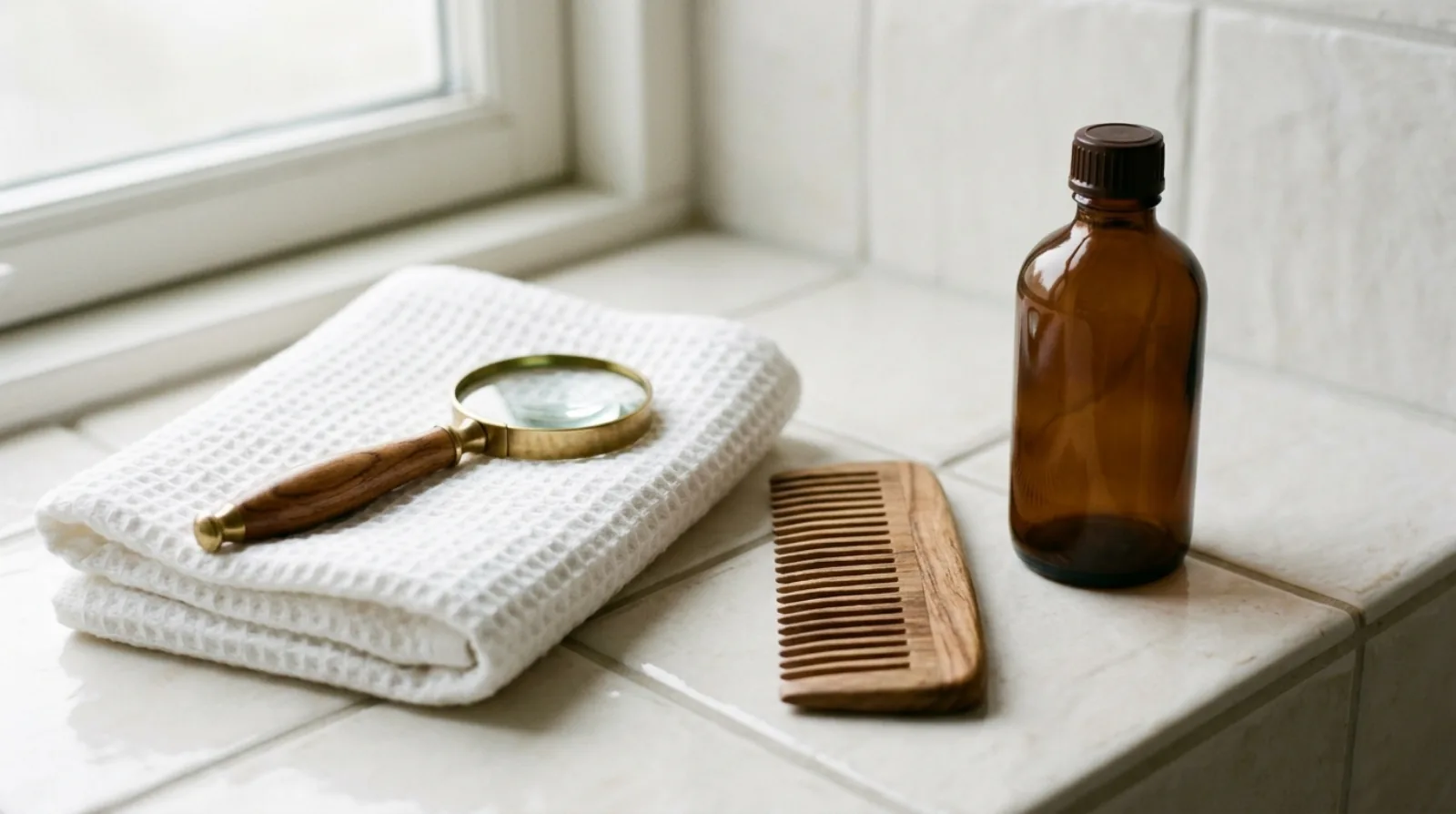
A hair consultation is an appointment where a person reads your hair and scalp, then tells you how to care for them. It is a separate thing from the conversation about what shape to cut. The two often happen in the same chair on the same day, the names get swapped, and people book one expecting the other.
The reading covers a short list. What your scalp is doing at the part and at the crown. How wide one strand is. How many strands you have. Where the damage sits and what kind it is. What colour, heat or chemical work your hair has been through, and when. From that list a person can say which shampoo weight suits you, how often to wash, and what to stop doing.
Here is what happens in a good one, who can give you one, and how to tell when you are being sold to instead.
Two appointments share one name
Ask a salon for a consultation and you will usually be booked for the cut conversation: photographs, length, layers, and what you can manage on a weekday morning. That appointment decides a shape, and this site covers it on questions to ask before a haircut.
A hair consultation asks a different question. Not what should this hair be cut into, but what is this hair and what does it need. The evidence is different as well. A cut conversation runs on photographs and on what you say you want. A hair reading runs on your scalp, your strands and your history, and it is mostly indifferent to what you want, because your hair either is coarse or it is not.
Both are useful. The order matters. If your hair feels rough, snaps at the mid-lengths and goes flat by the afternoon, a new shape will not fix any of that, and a stylist who cuts it anyway is solving a problem you did not have. Read first. Then cut.
What is examined, and in what order
A reading starts at the scalp and works down, because the scalp is where hair is made and the ends are where the evidence collects.
At the part: the colour of the skin, any flaking, any redness, and how wide the part looks compared with the rest of your head. At the crown: the same again, plus how much scalp shows when the hair is parted a second time. Then the mid-lengths, run between two fingers to find where smooth turns rough. Then the ends, held up to the light for splits, white dots, and short pieces standing up in the middle of the length, which are broken hairs rather than new growth.
The flaking question carries more weight than it looks. The American Academy of Dermatology separates dry scalp, which is skin that has lost water, from dandruff, which flakes and is often linked to seborrhoeic dermatitis, and from psoriasis, where the patches are raised and the flakes have a silvery sheen. Those three need different products. A consultation that writes down 'flaky' and moves on has stopped one question too early.
Texture and density are read by hand
Two words get used as if they were one. Texture is how wide a single strand is. Density is how many strands grow on your head. You can have fine hair that is dense, and you can have coarse hair with a widening part.
Someone reading your hair will roll one strand between finger and thumb, near the root and again near the end, and compare it against a sewing thread. They will lift a section and look at how much scalp shows through. If your hair is long enough, they will close a hand around the base of a ponytail. No machine is involved in any of that.
The tests themselves live on hair density and thickness, and you can run them at home in about five minutes. The reason they still belong in a consultation is that a second person is better at them than you are. You have seen your own hair every day for years, so you are the worst available judge of whether it has changed.
Your hair's history is half the reading
Hair keeps a record. Scalp hair grows about 0.35 mm a day, close to 1 cm a month, so a strand hanging 30 cm below your scalp has been on your head for roughly two and a half years. Every bleach, every relaxer and every flat iron pass inside that window is still in the piece of hair you are holding.
That is why the history questions are not small talk. When did you last colour it. Was it lightened or darkened. Have you had a keratin or relaxing treatment, and how long ago. How often do you use heat, and on what setting. Has anything changed since a pregnancy, an illness, a new medicine, or a stretch of bad sleep.
An honest answer here moves the advice more than anything visible does. Two people whose hair looks identical need different routines if one of them bleached it in March. If you cannot remember dates, say that, and say what you do remember. A rough month is more use than a confident wrong year.
Wet and dry are two different readings
Hair behaves differently when it is wet, and both states carry information.
Wet shows the curl pattern with no product holding it, where each section falls from, and how quickly water leaves the strand. Dry shows frizz, real volume, where the hair is breaking, and how the ends sit against each other. A reading taken only on wet hair misses half of it, which is one reason a consultation squeezed into the two minutes before a shampoo is worth less than it sounds.
Wet hair is also weaker. The AAD splits its combing advice by hair type for exactly this reason: let straight hair dry partly before combing it with a wide-tooth comb, and comb textured hair or tight curls while it is still damp. One rule for everyone would damage one of the two groups. A consultation that hands you a rule without first asking which group you are in has skipped the part you came for.
Who gives one
Three kinds of people offer this, and they see different things.
A salon stylist reads your hair with their hands. It usually comes free when it is attached to a cut, and stylists are good at texture, density and how hair behaves under tension. They cannot look inside your body.
A trichologist works on hair and scalp only. The Institute of Trichologists, whose UK register is accredited by the Professional Standards Authority, says on its own FAQ page that trichologists are not medically qualified, and that its registered members refer clients to medical professionals for blood tests, biopsies and prescribed medicine. That is a useful boundary to know before you book.
An online reading works from photographs. It is repeatable, it costs less, and it cannot touch your hair. The Kurli AI Specialist is this third kind: four tapped questions, three photographs, and a written routine that comes back with your own pictures marked up. It does not diagnose, and it says so when something belongs with a doctor instead. The three are compared properly on online, salon or trichologist.
What you should leave with
A consultation that ends with nothing you can check later has delivered nothing. You should come away with the reading written down, or in a file you can open again next month.
That means a description of your hair in plain terms: curl pattern, strand width, density, scalp state, where the damage is and what kind. One change to make first, with the reason it comes first. What to do on wash day, and what to do between washes. What to look for on a label and what to avoid, each with a reason attached. And a note of anything that is not a hair care problem at all and belongs with a doctor or a stylist.
The test is simple. If you cannot repeat the advice to a friend a week later, it was not specific enough to follow. Ask for it in writing before you leave the chair. Someone who has just spent ten minutes reading your hair will not mind writing four lines down.
What a bad consultation looks like
The clearest sign is that every answer ends at a bottle.
A real reading produces at least one instruction that costs nothing. Wash less often. Wash more often. Stop brushing it dry. Move the conditioner to the ends only. Drop the iron temperature. Change the pillowcase. If the entire outcome is a basket of products, you had a sales call with a scalp check in the middle of it.
A few more signs are worth knowing. Nobody asked about your history, so the advice cannot account for the bleach. Nobody touched your hair or looked at your scalp, and a verdict arrived anyway. And the routine you were given is the routine the person before you was given, which you can test in one question: why this one and not the lighter one. Someone who read your hair has an answer ready. Someone selling has a brochure.
How long it takes, and how to prepare
Ten minutes at a salon basin is a reading, and a short one can still be worth having. An hour with a trichologist is a different appointment. The Institute of Trichologists gives one worked example on its FAQ page, from its own clinic in Tooting in London: a consultation of up to an hour, with medication and treatments charged on top.
Prepare by not preparing. Turn up with your hair as it usually is, dry, with the products you normally use in it, and ideally on the second day after washing, so the person can see how fast your roots turn oily and what your texture does without a fresh blow-dry. Bring the bottles you use, or photographs of their labels. The ingredient list answers questions faster than the brand name does.
Write down when you last coloured, relaxed or heat-treated your hair before you go. People lose dates in the chair, and the date is the part that changes the advice.
What a consultation is not
It is not a diagnosis. Hair and scalp changes can come from thyroid disease, low iron, a medicine you started, or a scalp condition that needs a prescription, and none of those are readable off a strand of hair. The AAD's guidance on dry and flaky scalps ends the same way ours does: if over-the-counter products do not fix it, see a board-certified dermatologist for a proper diagnosis.
A haircut plan is a separate matter too. A reading tells you what your hair is; choosing a shape is a different conversation, and it goes better once the stylist already knows what the hair can hold.
Nothing about a reading lasts forever, either. Hair changes with age, with the season, with pregnancy, with colour and with what you do to it. A reading is a snapshot of one month. When your hair starts behaving differently, the reading is out of date rather than wrong, and it is worth doing again. Most people need that far less often than they buy shampoo.
Common questions
What happens at a hair consultation?
Someone looks at your scalp at the part and the crown, feels a single strand for width, checks how much scalp shows through, runs the mid-lengths between two fingers, and examines the ends for splits and breakage. Then they ask about colour, heat and chemical treatments and when each happened. The output is a set of care decisions, not a haircut.
What does hair consultation mean?
It means an appointment where a person reads the condition of your hair and scalp and tells you how to look after them. The word is also used in salons for the cut conversation, which decides a shape instead. If you want the care reading, say that when you book, because the two are scheduled differently and take different amounts of time.
How do hair consultations work?
You arrive with your hair dry and unstyled, ideally on the second day after washing. The person examines your scalp, texture, density, damage and ends, then asks for your treatment history and your morning routine. They finish with a reading of your hair and a small number of changes in priority order. A good one gives you all of that in writing.
What is a consultation in hairdressing?
In hairdressing the word usually means the talk before a cut or a colour: photographs, length, layers, and what the stylist thinks your hair can take. That is a shape conversation. A hair consultation in the care sense is a reading of your hair and scalp that decides products and routine, and it can happen with no scissors involved.
What is a hair and scalp analysis?
It is the same reading described a different way. Hair and scalp analysis covers curl pattern, strand width, density, scalp condition, damage and treatment history, sometimes with a magnifier or a scalp camera. Note that it is an assessment of condition, not a medical test. Blood tests, biopsies and prescriptions come from a doctor.
Do I need a hair consultation?
You probably do if you cannot name your own hair type or density, if you have bought products that went unused, or if your hair looks fine leaving the salon and different at home. You probably do not if your routine works and your hair behaves. It is a diagnosis step, so it earns its place when something is wrong.
Which hair and scalp disorders cannot be treated in the salon?
Anything that needs a diagnosis or a prescription. The American Academy of Dermatology separates dry scalp from dandruff and from psoriasis, and it says to see a board-certified dermatologist when shop-bought products do not clear the problem. Changes that come from thyroid disease, low iron or a new medicine cannot be read off a strand either. The Institute of Trichologists says the same of its own members: they are not medically qualified and refer clients on for blood tests, biopsies and prescribed medicine.
What are hair consultations for?
They exist because hair advice is conditional. The right wash frequency, product weight and heat limit depend on strand width, density, curl pattern, scalp state and what has been done to the hair. A consultation establishes those facts once so the routine that follows is built for your hair rather than for hair in general.
What is a free hair consultation?
Usually a short appointment a salon offers before booking a colour or a cut, paid for by the work that follows. Some are genuine readings. Some are sales meetings. The test is whether you leave with at least one instruction that costs nothing, such as changing how often you wash, rather than only a list of bottles.
Is a hair consultation the same as a haircut consultation?
No. A haircut consultation agrees a shape using photographs and your own preference. A hair consultation reads condition, and your preference does not change the reading. Do the reading first when your hair feels rough, breaks, or behaves differently from how it used to, because the cut is then chosen for hair as it actually is.
Does a hair consultation include my scalp?
It should, and a reading that skips it is incomplete. The scalp decides wash frequency and which shampoo you need, and flaking has several different causes that need different treatments. Ask the person to look at the part and at the crown, since the crown is the area you cannot check for yourself in a mirror.
Can a hair consultation tell me my hair type?
Yes, and it is one of the more reliable parts. Curl pattern is visible on clean, product-free hair, and a second person sees it more accurately than you do in a mirror. Expect more than a single number: most heads carry two patterns, with looser hair at the front than at the back of the crown.
What to do before a hair consultation?
Almost nothing, and that is the point: arrive with your hair as it usually is. Leave it dry, unstyled and on its second day after washing, with the products you normally use in it, so the person can see how fast your roots turn oily and what your texture does without a fresh blow-dry. Bring the bottles you use, or photographs of their labels. Write down when you last coloured, relaxed or heat-treated your hair, because those dates change the advice more than anything visible does.
Is a hair consultation free?
Usually, if it comes attached to a haircut or colour you are already booking, since the salon treats it as part of that appointment. A stand-alone reading with a trichologist is not free; it runs up to an hour and is billed as its own visit. Ask which kind you are getting when you book, because the free version and the paid version answer different questions.
Can I get a hair consultation?
Yes, in three ways. Ask a salon for one when you book a cut or colour, since most stylists read your hair as part of that visit anyway. Book a stand-alone reading with a trichologist, usually up to an hour and billed on its own. Or use an online reading built from photographs, which needs no appointment and works from home.
Is a hair transplant consultation free?
That is a different appointment from the one this page covers. A hair transplant consultation is a medical assessment for a surgical procedure, usually run by a clinic rather than a salon or a trichologist, and clinics vary on whether the first visit is charged. It will not tell you your wash frequency or product weight, because it is answering a different question.
Is a hair consultation the same as seeing a trichologist?
Not exactly. A hair consultation is the general term for any reading of your hair and scalp, whether it comes from a stylist, a trichologist or an online tool. A trichologist is one specific person who does this, working on hair and scalp only. The Institute of Trichologists says its members are not medically qualified and refer clients elsewhere for blood tests or prescriptions.
Does an online hair consultation work as well as one in person?
For parts of the reading, yes. Curl pattern, density, scalp state and colour regrowth all show clearly in good photographs. Strand width, porosity and elasticity need touch, so an online reading is weaker there unless it asks you to run those tests yourself. [Online, salon or trichologist](/guides/hair-consultation/online-hair-consultation-vs-salon-vs-trichologist) compares the three properly before you choose one.
Sources
Hair biology and hair-care facts on this page are supported by these sources. Styling recommendations are guidance.
- Physiology, Hair, StatPearls, NCBI Bookshelf
- Is your dry scalp something more serious?, American Academy of Dermatology
- 10 hair care habits that can damage your hair, American Academy of Dermatology
- Frequently asked questions, The Institute of Trichologists
- Institute of Trichologists, Professional Standards Authority for Health and Social Care
- Tips for healthy hair, American Academy of Dermatology
See it on your own face
Kurli reads your face from a selfie, recommends styles that suit you, and renders each one onto your photo.