Hairstyles by hair type
Hair density and thickness
Do you actually have thick hair? Three simple tests settle it, and the answer changes your best cut.
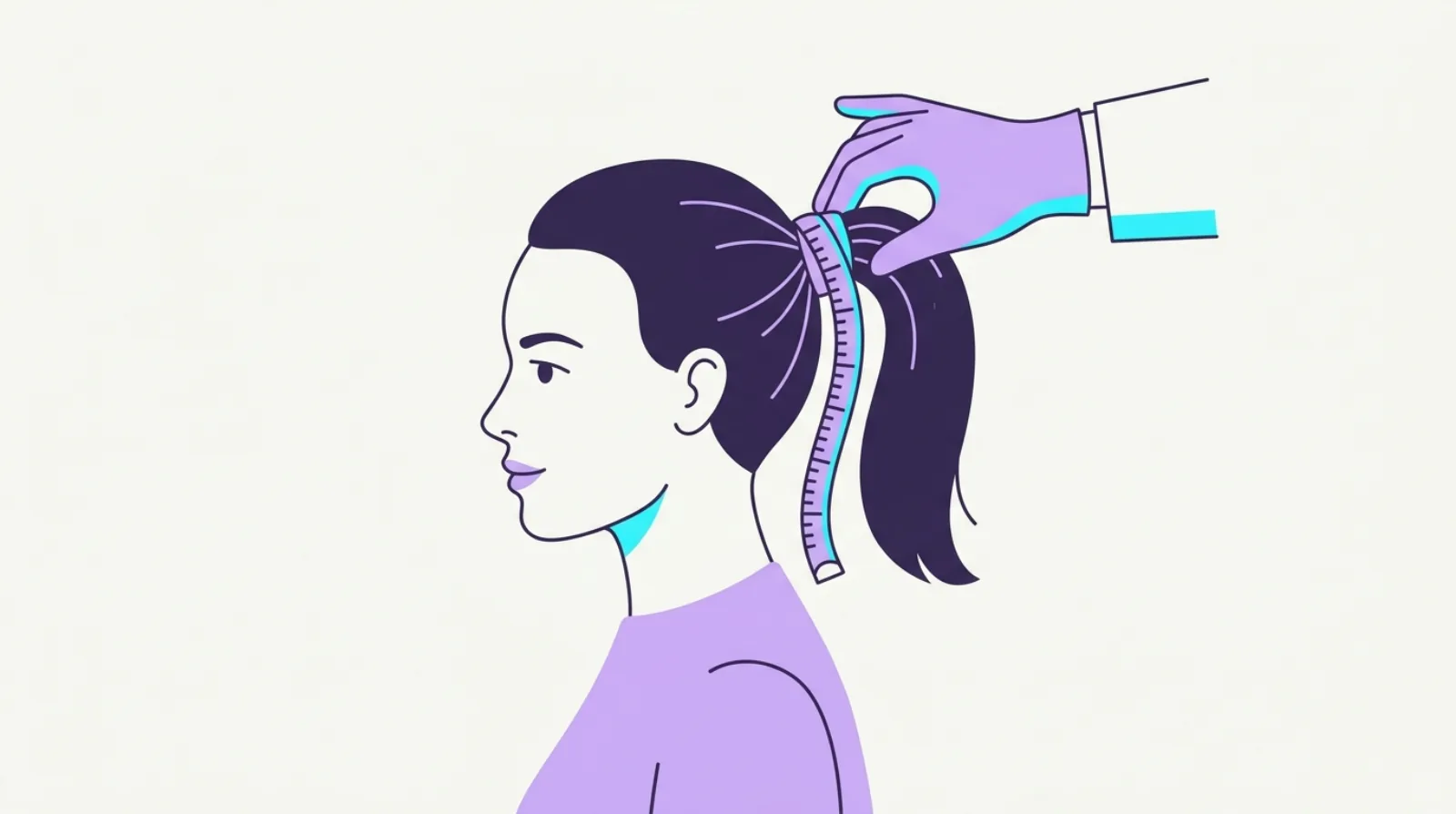
'Do I have thick hair?' sounds like it should have an obvious answer, but most people honestly cannot say. That is because 'thick' mixes up two different measurements: how wide each strand is, and how many strands you have. A person with skinny strands can still have a huge amount of hair, and a person with wide, wiry strands can have surprisingly little. This guide gives you three simple checks you can do at home in five minutes: the strand test, the ponytail test, and the scalp check. Then it explains what your results mean for your cut, your products, and your styling, and what it means when you find one strand that feels far thicker than all the rest.
Find out whether this suits your face. One selfie, and the face-shape read and your top pick are free.
Kurli is an AI hairstyle advisor: upload one selfie and it reads your face shape, recommends the cuts that suit it, and renders any of them onto your own photo before you commit.
Thick, coarse, dense: three words people mix up
Start with the words, because the confusion starts there. Strand width (fine, medium, or coarse) is how wide one single hair is. Density (thin, medium, or dense) is how many hairs grow on your scalp. Volume is the overall impression the two create together, and volume is what most people mean when they say 'thick hair'.
The combinations matter. Fine strands at high density look full but go flat under heavy product. Coarse strands at low density feel wiry but can show scalp. Coarse strands at high density is the classic heavy, bulky 'a lot of hair' head. So when a stylist says coarse, they mean the strand. When they say dense, they mean the count. When you say thick, you could mean either, which is why the two of you sometimes talk past each other in the chair. Run the tests below and you will be able to say exactly which combination you have, in words any stylist will understand.
The strand test: compare one hair to sewing thread
This test reads strand width. Pull one clean, dry, shed hair, ideally from your brush, and lay it on a plain sheet of paper next to a piece of ordinary sewing thread.
Now compare. If the hair is clearly skinnier than the thread, and you can barely feel it when you roll it between two fingers, your strands are fine. If it sits somewhere near the thread's width and you can feel it plainly, your strands are medium. If the hair looks about as wide as the thread or wider, and feels firm, almost like a wire, your strands are coarse.
Test a few hairs from different parts of your head, because strand width varies across one scalp, and use hairs in their natural state rather than heat-styled ones. Fine, medium, and coarse are all normal and healthy. The label only matters because it predicts behaviour: fine strands bend, flatten, and break more easily, while coarse strands resist shaping, hold styles longer, and can feel dry or rough.
The ponytail test: measure around the base
This one reads density, and it takes a hair tie and a soft measuring tape. Gather all of your dry hair into a ponytail, as low and as smooth as you can. Wrap the tape around the ponytail just above the tie and read the number.
Stylists commonly work with benchmarks like these: under about 5 centimetres around points to lower density, 5 to 10 centimetres is medium, and over 10 centimetres points to high density. Treat those numbers as working benchmarks stylists use, not medical cut-offs. Nobody has defined thick hair in a lab, and layering and very short cuts change the reading.
Still, the test is useful because it measures all your hair at once instead of asking you to guess. It also separates the two measurements cleanly. A big, wide ponytail made of skinny strands means fine but dense hair. A slim ponytail of wiry strands means coarse but low-density hair. Write both answers down, because together they explain almost everything your hair does.
The scalp check
The third check needs only a mirror and good light. Part your dry hair down the middle and look at the line of scalp along the part. Then tip your head and look at the crown.
With high density, the part shows as a narrow, clean line and you see hair, not skin, everywhere else. With medium density, the part is a little wider and you may glimpse scalp at the crown under bright light. With lower density, the part looks wide, and scalp shows through the top layer when the light hits it.
One caution: compare like with like. Wet hair clumps and shows far more scalp on everyone, so always judge clean, dry hair. Colour matters too, since dark hair against a pale scalp shows more contrast than blonde hair does. And if what you notice is not low density but a part that has been getting wider over months, that is a change rather than a trait, and the thinning hair guide covers what to do next.
How professionals measure it
For the curious, there are real numbers behind all this. Researchers and dermatologists count density as hairs per square centimetre of scalp, using close-up photography and computer tools such as the phototrichogram, and they measure strand width in micrometres, which are thousandths of a millimetre. The published methods for these measurements are listed in the sources at the bottom of this page.
A full head carries somewhere around 100,000 hairs, and both density and strand width vary from person to person and across one scalp. Clinics only measure these things precisely when they need to track hair loss or a treatment over time. For picking a haircut or a product, the strand test, the ponytail test, and the scalp check give you the answer at the level that actually matters: is my hair fine or coarse, thin or dense? Once you can answer that, the professional numbers add nothing you can act on.
What your results mean for your cut
Here is the payoff. Coarse and dense hair carries real weight, so it needs weight management: long layers, careful internal thinning, and a stylist who removes bulk from inside the shape. The full plan is in the thick hair guide. Fine and dense hair looks full but flattens, so it wants blunt ends to keep visual weight, plus light products so the density can do its job. Coarse and low density does best with structured cuts that gather the hair into a deliberate shape, since the strands are strong but there are fewer of them to fill space. Fine and low density benefits most from shorter, blunter cuts that build the look of fullness, covered in the fine and thin hair guide.
Products follow the same logic. Strand width decides product weight: fine strands drown under butters and oils, while coarse strands drink them up. Density decides quantity and placement. Layer these on top of your curl pattern from the hair type chart and you have the complete picture of your hair.
What one really thick hair strand means
Almost everyone eventually finds one: a single strand that feels far thicker, wirier, or kinkier than the rest, sometimes with a strange colour or a crinkled shape. Finding one of these is almost always normal variation. Your follicles are not identical factories. They vary in size across your scalp, they change gradually with age and hormones, and an individual follicle can produce a coarser or oddly textured strand for one growth cycle and then return to normal in the next. Grey and white strands also often grow in with a different feel, which is why the odd wiry grey stands out so much.
Plucking it does nothing useful, and repeatedly plucking the same follicle can irritate it, so if the strand bothers you, trim it near the root instead. The picture changes only when the texture of your hair changes broadly. If a large share of your strands turn coarse, brittle, or kinked over weeks to months, that is a pattern rather than a stray, and it is covered in the next section.
When a texture change is worth a doctor visit
One odd strand is trivia. A change across your whole head is information. If your hair has clearly changed texture recently, turning noticeably coarser, finer, drier, or more brittle everywhere, or if a texture change arrives together with heavy shedding, a widening part, or bald patches, book a visit with a dermatologist or your family doctor. Broad changes in hair can go along with thyroid conditions, low iron, medication effects, and other health issues, and a doctor can check properly with an exam and simple tests.
We will not guess at causes here, because guessing is exactly what nobody should do with a real change. The practical rule is simple: traits you have had for years are styling questions, and changes over weeks or months are medical questions. Going early is not overreacting. Most changes turn out to have ordinary explanations, and the ones that do not are the ones that benefit most from an early look.
Density is not hair loss
It is worth saying plainly: having lower-density hair is not the same as losing hair. Plenty of people simply grow fewer strands, always have, and always will, just as some people are tall and some are not. Low density that has been stable for years is a trait, and the answer to a trait is smart cutting, styling, and colour, not worry.
Thinning is a trend. It means your density is dropping: the ponytail is slimmer than last year, the part is wider than in old photos, the shed hairs in the drain have multiplied. The best tool for telling trait from trend is your own photo history. Compare a photo of your part or hairline from two or three years ago with one taken today in similar light. Stable means style it and move on. Dropping means read the thinning hair guide and consider the doctor visit it recommends, because many causes of loss respond best when caught early.
Putting it together with your face shape
You now have two of the three facts you need: your strand width and your density. The third is your pattern, from the hair type chart, with porosity as a useful bonus reading. What none of these tell you is where a cut should place volume and length so it flatters you, because that comes from your face, not your hair.
Dense hair adds width wherever it sits, which can balance a long face or overwhelm a round one. Fine, low-density hair does best with cuts that build fullness exactly where your face needs it. So finish the job: take the face shape quiz to get your shape from a selfie, then match your hair facts to a cut that suits your features. If you want to see the result before you commit, Kurli can render recommended styles onto your own photo, which beats imagining it every time.
Not sure which face shape is yours? Kurli reads it from one selfie and shows the cuts that suit it.
Common questions
Do I have thick hair?
Run two quick checks. Roll one hair between your fingers: if it feels firm, close to sewing thread, your strands are thick. Then measure around the base of a full ponytail: stylists often treat over about 10 centimetres as thick density, 5 to 10 as medium, and under 5 as fine. Thick strands, thick density, or both all read as thick hair.
How do you know if you have thick hair?
Compare one strand to a piece of sewing thread: near the thread's width or wider means a coarse, thick strand. Then check how much hair you have overall with the ponytail measurement and by looking at how much scalp shows along your part. Very little visible scalp and a ponytail over about 10 centimetres around point to genuinely thick hair.
How to tell if hair is thick?
Use three checks: the strand test (one hair against sewing thread) for strand width, the ponytail measurement (over about 10 centimetres around suggests high density), and the scalp check (a narrow part line with little visible scalp). The first test measures how wide each hair is, and the other two measure how many hairs you have.
What is thick hair?
'Thick hair' can mean two different things: coarse strands, where each individual hair is wide, or high density, where you have a very large number of hairs. Many people have both. The two behave differently: coarse hair resists shaping and can feel dry, while dense hair builds bulk and takes a long time to dry.
My hair is thick and coarse. What does that mean for styling?
Coarse strands are strong and hold styles well, but they resist shaping, drink up moisture, and can feel dry or wiry. Combined with high density, they create weight and bulk. The fix is a cut that removes weight from inside the shape, richer creams and oils than finer hair could carry, and enough moisture to keep the strands soft.
What does one really thick hair strand mean?
Almost always, nothing. Follicles vary in size across your scalp, and one can produce a coarser, wiry, or crinkled strand for a growth cycle and then go back to normal. Greys often grow in with a different texture too. Trim it near the root if it bothers you. If many strands change texture over weeks or months, see a dermatologist.
What is the difference between coarse and dense hair?
Coarse describes one strand: each hair is wide and firm, like thread. Dense describes the count: many hairs packed on your scalp, whatever their width. Coarse, low-density hair feels wiry but can show scalp. Fine, dense hair feels soft but looks full. Both get called thick, which is why the tests are worth running.
Can hair be fine and thick at the same time?
Yes, and it is common. Fine describes the skinny width of each strand, and thick in the density sense describes having a lot of them. Fine, dense hair looks full but flattens under heavy products and loses volume fast. It does best with light styling products and blunt-ended cuts that keep visual weight.
What does my ponytail measurement mean?
Wrap a soft tape around the base of a full, dry ponytail. Stylists commonly read under about 5 centimetres around as fine density, 5 to 10 centimetres as medium, and over 10 centimetres as thick. These are working benchmarks, not medical cut-offs, and layers or short cuts lower the number, so treat the result as a guide.
Does hair density change with age?
Yes, gradually. Many people lose some density slowly as they get older, and hormones and genetics both play a part. Strand texture can change too, and greys often grow in coarser. A slow drift over decades is normal. A fast drop over months, a widening part, or bald patches deserve a doctor's look.
Can I make my hair denser?
You cannot add follicles, so true density is set. What you can do is stop losing what you have through gentle handling, low heat, and loose styles, make each strand look fuller with volumising products and blunt cuts, and fake density with colour tricks like a root shadow. If density is actually dropping, see a dermatologist early.
Is hair density the same as hair volume?
No. Density is a count: how many hairs grow per area of scalp. Volume is the visual result of density, strand width, curl pattern, and styling combined. Fine, dense, wavy hair can show more volume than coarse, straighter hair at the same density. That is why two thick-haired people can have opposite styling problems.
Sources
Hair biology and hair-care facts on this page are supported by these sources. Styling recommendations are guidance.
- Hair Evaluation Methods: Merits and Demerits, International Journal of Trichology (PMC, NCBI)
- Physiology, Hair, StatPearls, NCBI Bookshelf
- Hair Follicle, Cleveland Clinic
- Tips for healthy hair, American Academy of Dermatology
- Hair Loss Resource Center, American Academy of Dermatology
See it on your own face
Kurli reads your face from a selfie, recommends styles that suit you, and renders each one onto your photo.
The face-shape read and your top pick are free. Your photo is never sold or used to train AI.