Virtual try-on
AI pompadour simulator
Height at the front changes your whole face. See how much before you book.
A pompadour simulator shows real height at the front of your head on your own face. Upload a front-facing selfie to Kurli and the AI renders the hair swept up and back, so you can judge how much the added height changes the apparent shape of your face before booking anything.
Tap to pick a selfieDrop a selfie here, or click to browse
Front-facing, well-lit photos work best.
Your photo is used only to render the style and isn't stored.
Key takeaways
- A pompadour sweeps the front hair up and back into a defined volume above the forehead.
- Height at the front lengthens the face, which balances a round face and can overdo a long one.
- The style needs three inches or more on top, so growing into it takes months from a short cut.
- A pompadour exposes the hairline almost completely, which matters if yours is receding.
- The blow-dry does more work than the product, and most failed pompadours are dried wrong rather than producted wrong.
- Sides are usually faded or tapered, and that choice decides how formal the finished look reads.
Variations to try
Tap any one to load it into the box above, then press see it on me.
Height styles compared
| Style | Height at front | Length needed | Hairline exposed | Product |
|---|---|---|---|---|
| Full pompadour | High | 3 to 5 inches | Almost fully | Heavy |
| Low pompadour | Moderate | 3 inches | Mostly | Medium |
| Quiff | Moderate | 2 to 4 inches | Partly | Medium |
| Slick back | Low | 3 inches or more | Completely | Heavy |
| Textured crop | None | 1 to 2 inches | Covered | Light |
Who a pompadour suits
A pompadour does one dominant thing: it adds height above the forehead, and everything about who it suits follows from that.
Adding height lengthens the face. On a round or square face that is genuinely useful, because it introduces vertical line where the face is otherwise wide, and it is the standard recommendation for men with rounder faces who want structure.
On a long or oblong face the same height is usually too much of a good thing. Stacking volume on top of an already long face stretches it further. If you have a longer face and want the style, a low pompadour with the sides left wider is the sensible adaptation.
A strong jaw balances a pompadour well, because the weight at the top has something to answer it at the bottom. A softer jaw sometimes finds a full pompadour top-heavy, and a beard is the usual fix.
The hairline question is unavoidable. A pompadour sweeps everything back and up, so a receding hairline is fully visible. That is not disqualifying, and plenty of people wear the style with recession quite happily, but you should look at the render before booking rather than after.
The full breakdown by face shape is in the guide linked above.
Glasses are worth rendering with. A pompadour raises the visual weight of the head, and heavy frames add weight low on the face, so the two can either balance each other neatly or fight. Because both sit in the same sightline, seeing them together is the only reliable way to judge it.
The blow-dry matters more than the product
This is the single most useful thing to know about pompadours, and it is the reason most home attempts fail.
The height in a pompadour is built while the hair is drying, not afterwards. Hair sets in the shape it dries in, so if it dries flat, no amount of product will lift it. If it dries with volume at the root, a small amount of product will hold that volume all day.
The technique is to dry the front section backwards and upwards, pushing against the direction the hair naturally falls, using a brush or just your fingers. Most people skip this, apply pomade to towel-dried hair, and wonder why the result collapses within the hour.
Product choice is secondary but still matters. Pomade gives a glossy classic finish. Clay or paste gives a matte modern one with more grip and less shine. A pre-styler such as a sea-salt spray or a mousse applied before drying adds root lift and does a surprising amount of the work.
If you take one thing from this page: dry it up and back first, then add product. That order is the whole technique.
How to describe a pompadour to the AI
Say how much height. Full pompadour or subtle low pompadour. This is the main variable and the render changes dramatically with it.
Say the finish. Glossy or matte. Glossy reads classic and formal, matte reads modern and casual.
Say what the sides do. With a mid fade, with tapered sides, or with a disconnected undercut. The sides set the formality.
Say textured if you want it. A textured pompadour with separated pieces is considerably easier to live with than a smooth one and looks better on thinner hair.
Render a full version and a low one. Most people find the low pompadour is the one they would actually wear on a Tuesday, and it is easy to overlook if you only render the dramatic version.
What the render gets right, and where it is approximate
Reliable. How much height suits your face, whether the volume balances your jaw, how your hairline looks fully exposed, and how the sides change the overall silhouette.
Approximate. The exact shine and how cleanly the sweep holds together, both of which are product and technique dependent.
Not modelled at all. Whether your hair can hold the height. This is the crucial gap. Fine, straight hair often collapses under a pompadour regardless of effort, while coarse or wavy hair holds it easily. No render can tell you which category you fall into.
Also not modelled: your growth pattern at the front. A cowlick at the hairline can push the front section sideways rather than back, which fights a pompadour every morning. Ask a barber to look before you commit to growing it out.
Before you book: growing into it
Unlike most cuts here, a pompadour usually requires waiting rather than cutting. You need roughly three inches on top, which from a short cut means three to six months of growth.
That makes rendering it especially worthwhile. Deciding you want a pompadour and then discovering six months later that it does not suit your face is an expensive mistake in time, and it is exactly the kind the preview is meant to prevent.
While growing, have a barber keep the sides tidy. The awkward stage is much easier to live with when the sides are faded or tapered and only the top is growing, and it also means you can start experimenting with height as soon as there is enough length.
If you already have the length, you can test it tonight. No cut is needed to try a pompadour, only a dryer and some product, which is a genuinely low-risk way to find out whether you like the height on your face.
Once you commit, the sides need attention every three to four weeks if faded. The top can go considerably longer, since more length simply means more height to work with.
What to ask for at the barbershop
Bring the render and point at your own head as you describe it. A landmark beats an adjective, and it removes the ambiguity behind most disappointing appointments.
Ask to be shown how much length will be left on top before anything is cut. Height depends entirely on that length, and it is the number people most often underestimate.
Ask what it looks like unstyled. This style category is heavily product-dependent, so what you leave with is not what you will see on a morning you are running late.
Ask whether your hair will hold the height. Fine, straight, slippery hair collapses under its own weight regardless of product, and a barber who tells you that is saving you a lot of frustration.
Finally, ask which product they used and how they dried it. The blow-dry is at least half of this look, and knowing the technique matters more here than the product itself.
Common questions
What is a pompadour?
A style where the front section of hair is swept up and back into a defined volume above the forehead, usually with shorter sides. The height at the front is what defines it.
Does a pompadour suit a round face?
Yes, it is one of the standard recommendations. Adding height introduces vertical line to a face that is otherwise wide, which gives it more structure.
How long does my hair need to be for a pompadour?
About three inches on top at minimum, and more for a full one. From a short cut that means three to six months of growing, which is why previewing it first is worthwhile.
Why does my pompadour fall flat?
Almost always the drying, not the product. Hair sets in the shape it dries in, so the front must be dried upwards and backwards before any product goes on. Applying pomade to flat hair will not lift it.
Does a pompadour work with a receding hairline?
It exposes the hairline almost completely, so recession will show. Many people wear it anyway and are happy, but it is worth looking at the render before growing your hair out for months.
What is the difference between a pompadour and a quiff?
A pompadour sweeps up and back with height concentrated above the forehead. A quiff sweeps up and slightly forward, is generally less formal, and needs less length.
What product should I use for a pompadour?
Pomade for a glossy classic finish, clay or paste for a matte modern one. A pre-styler like sea-salt spray before drying adds root lift and does more than most people expect.
Is the pompadour simulator free?
Browsing styles and reading the guides is free. Rendering a look onto your own photo uses a credit, because that step runs an image model that costs money each time.
Sources
Hair facts on this page are supported by these sources. What the render will look like on you is a preview, not a promise.
- Tips for healthy hair, American Academy of Dermatology
- How to style hair without damage, American Academy of Dermatology
- Hair Loss Resource Center, American Academy of Dermatology
- Anatomy, Hair, StatPearls, NCBI Bookshelf
Try another style
Keep reading
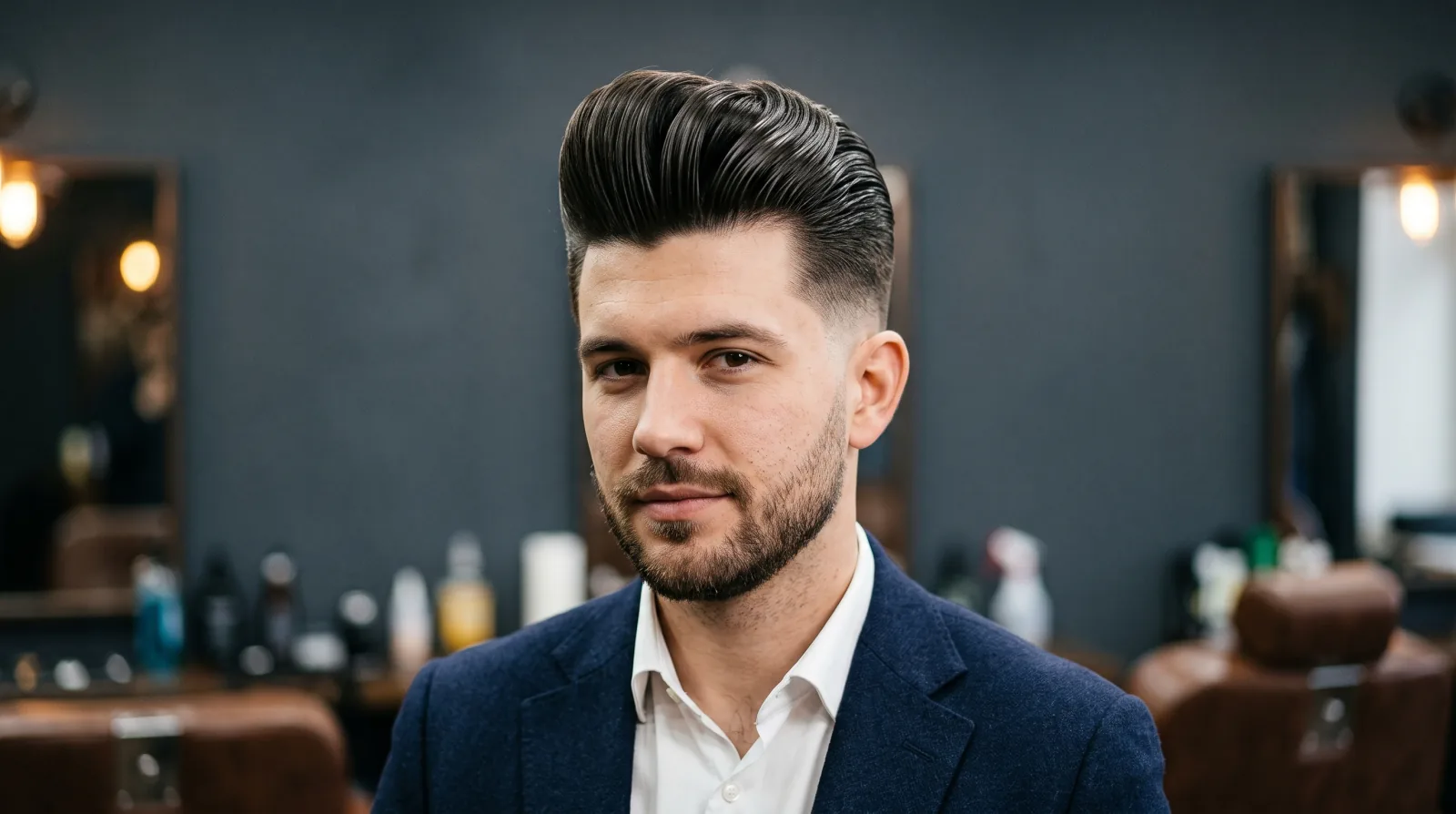
Illustration: Kurli