Hair colour
Temporary, semi, demi, and permanent dye explained
What each type does to your hair, how long it lasts, and when to use which.
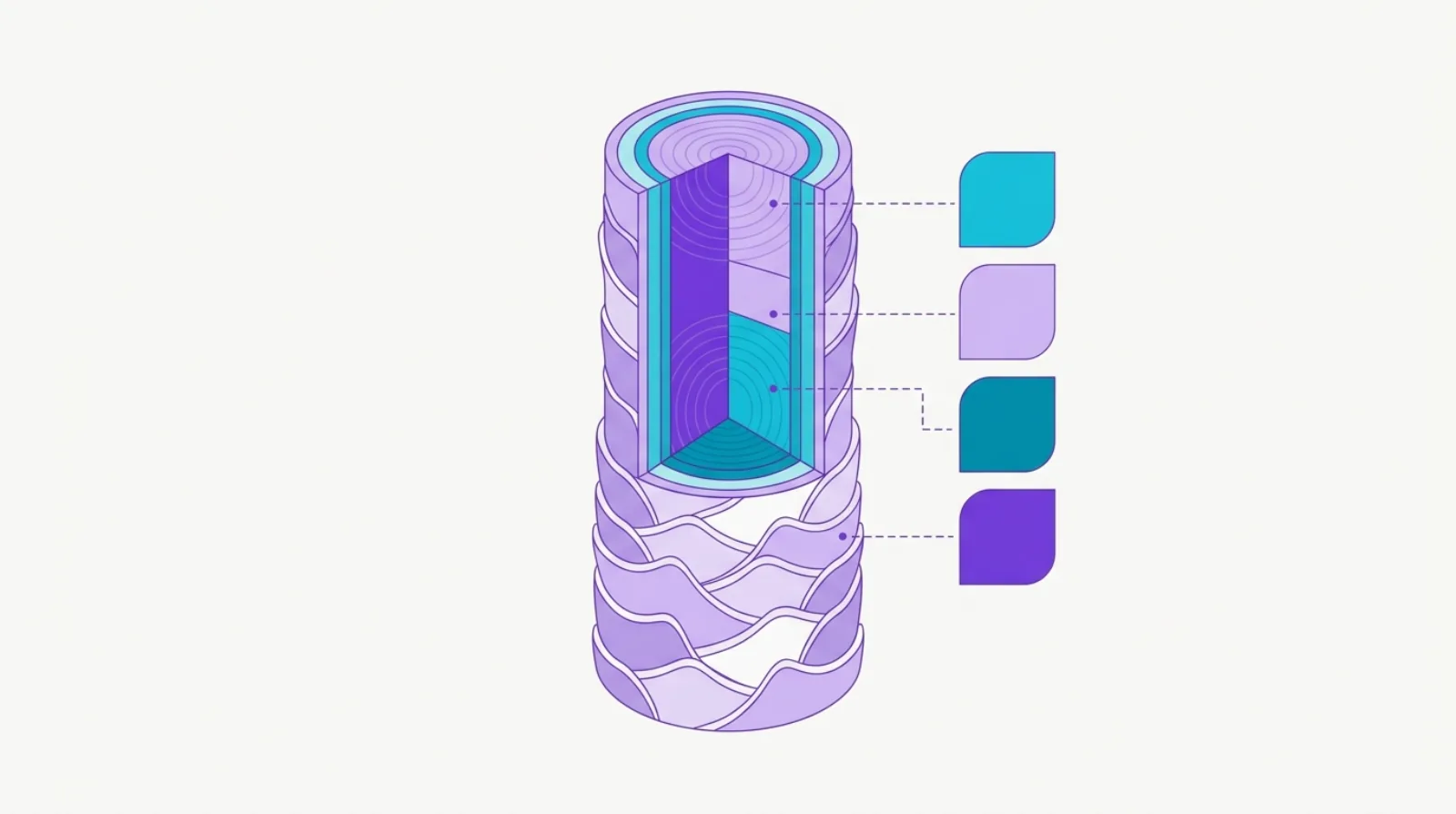
Every hair colour decision starts with picking a type of dye, and the words on the box are genuinely confusing. Semi, demi, permanent, toner, gloss, bleach: they are not just strength levels of the same thing. They work in different ways, they damage your hair by different amounts, and they fade differently. Once you understand what each one actually does to a strand, choosing gets easy. This guide explains all five in plain language.
Find out whether this suits your face. One selfie, and the face-shape read and your top pick are free.
Kurli is an AI hairstyle advisor: upload one selfie and it reads your face shape, recommends the cuts that suit it, and renders any of them onto your own photo before you commit.
First, how a hair strand is built
A hair strand has three parts, and dye types are defined by how deep they reach.
The cuticle is the outside, made of overlapping scales like roof tiles. When it lies flat, hair looks shiny and feels smooth.
The cortex is the thick middle layer. This is where your natural pigment lives, and it is what gives hair its strength and its colour.
The medulla is a soft core in the centre, and it is not always present, especially in fine hair.
A dye that only coats the cuticle washes out fast and does almost no damage. A dye that opens the cuticle to reach the cortex lasts far longer but has to lift those scales to get in, which is where damage comes from. That single fact explains the whole ladder below.
Temporary colour: sits on the surface
Temporary colour includes sprays, chalks, wax, and colour mousses. The pigment sits on the outside of the cuticle and never enters the hair.
Lasts: one wash, sometimes less if you get caught in the rain.
Damage: essentially none, because nothing opens the cuticle.
Can it lighten? No. Nothing that sits on the surface can make hair lighter, so temporary colour only shows up properly on light or pre-lightened hair. On dark hair a bright temporary colour usually barely registers.
Best for: a party, a costume, testing a bold shade with zero commitment, or covering a small patch of grey between appointments. Be aware that it can transfer onto pillowcases and pale collars.
Semi-permanent: a gentle stain
Semi-permanent colour uses small pigment molecules that slip under the edge of the cuticle and stain the outer layer. There is no ammonia and no developer (peroxide), so nothing is chemically changed inside the strand.
Lasts: roughly four to twelve washes. It fades gradually rather than growing out with a hard line, because it is washing away rather than sitting in the cortex.
Damage: very low. This is the gentlest option that still makes a real difference.
Can it lighten? No. Semi-permanent can only add tone or go darker.
Best for: trying a shade before you commit, refreshing faded colour, adding richness, and vivid fashion colours on pre-lightened hair. It is the honest way to test a direction without consequences.
Demi-permanent: the useful middle ground
Demi-permanent is the most underrated option. It mixes colour with a low-strength developer, which lifts the cuticle just enough to deposit pigment into the outer cortex.
Lasts: around twelve to twenty-four washes, usually six to eight weeks. It fades softly rather than leaving a sharp regrowth line.
Damage: low. There is a developer involved, but it is weak and there is normally no ammonia.
Can it lighten? Barely. It can shift tone and go darker, and it can blend grey, but it cannot meaningfully lift.
Best for: blending grey rather than fully covering it, toning brassiness, adding shine, going darker, and refreshing colour without committing to permanent. Most salon glosses and toners are demi-permanent. If you want a real change but hate the idea of a hard regrowth line, start here.
Permanent colour: a chemical change inside the cortex
Permanent colour uses an alkaline agent (usually ammonia) to swell the cuticle open, plus a stronger developer. Once inside, small colourless molecules react with each other in the cortex and become large coloured molecules that are physically too big to wash back out.
Lasts: it does not wash out. It fades a little and it grows out, which produces a visible line at the roots after four to six weeks.
Damage: moderate. Forcing the cuticle open repeatedly is what makes long-term colouring rough on hair.
Can it lighten? Yes, usually one to three levels, though lifting and depositing at once has limits on dark hair.
Best for: full grey coverage, lasting colour, and going darker permanently. The main trade-off is commitment: you cannot simply wash it out if you dislike it, and removing it is harder than applying it was.
Bleach: removal, not colour
Bleach is not a dye. It is a lightener, and it works by opening the cuticle and chemically destroying your natural pigment inside the cortex. Nothing is added. Something is taken away.
This is why bleach is the harshest thing you can do to hair. It permanently removes pigment and weakens the internal structure, and hair does not repair itself, so the damage stays until it is cut off.
Bleach also lifts through a predictable sequence of warm stages: dark brown to red, then orange, then yellow, then pale yellow. That orange and yellow phase is not a mistake. It is the natural warm pigment being exposed, which is why toner exists as a separate step afterwards.
If you want to go significantly lighter than your natural colour, bleach is the only route. See our going blonde from dark hair guide for how to do it with the least harm.
Toners and glosses: the finishing step
A toner or gloss is usually a demi-permanent colour used to correct unwanted tone rather than change the level.
After lightening, hair is left somewhere on the yellow-to-orange range. A toner deposits the opposite colour to cancel it, using basic colour theory: purple cancels yellow, blue cancels orange, and green cancels red.
A gloss does the same job but is often more about shine and richness than correction. Both are low-damage, both wash out over four to six weeks, and both are the reason salon colour looks more finished than most home colour. If your colour is the right level but the wrong tone, a toner is almost always the answer, not a full recolour.
Which one should you choose?
Match the type to the goal, not to how dramatic you want to sound.
Testing an idea: semi-permanent. It washes out and costs you nothing but time.
Going darker: demi-permanent if you might change your mind, permanent if you are certain.
Blending a little grey: demi-permanent, which softens grey into a highlight-like blend.
Covering grey fully: permanent, because it is the only type that reliably holds on resistant grey hair.
Fixing brassiness: a toner or gloss, not a new colour.
Going lighter than your natural colour: bleach, then a toner.
A useful habit: always choose the gentlest type that achieves the goal. People routinely reach for permanent colour when a demi would have done the job with far less damage.
Mixing types, and what not to do
You can layer these, but order matters.
Putting a semi or demi over permanent colour is fine and is how most people refresh faded ends. Putting permanent colour over a build-up of old permanent colour is where hair gets flat and dark, because pigment stacks up on the ends. Ask for colour to be applied to the roots first, then pulled through for only the last few minutes.
Do not bleach hair that already has a lot of permanent colour on it without professional advice. Bleach lifts natural pigment much more predictably than artificial pigment, and the result can be patchy.
Never mix two products from different brands into one bowl, and never apply colour over freshly relaxed or permed hair. The AAD advises doing only one chemical service at a time, and if you want both, perm or relax first and wait about two weeks before colouring.
Henna and plant-based dyes
Plant dyes sit outside the categories above and behave differently enough to need their own note.
Pure henna stains the outside of the hair with a red-orange pigment. It coats the strand rather than lifting it, so it cannot lighten, and on dark hair it usually shows only as a warm tint in sunlight. It is generally low risk and can make hair feel thicker, because it builds up a layer on the surface.
The complication is that it is close to permanent. Henna does not wash out and it resists being lifted, which is why it limits what you can do later.
Compound henna is a different matter. Products sold as black henna or fast-acting henna can contain added chemicals, including PPD, sometimes at high concentrations. These are the ones associated with serious skin reactions, and they can also react unpredictably with bleach.
Always disclose any henna use to a colourist, even from years ago, and expect a strand test before any lightening. "Natural" on a label does not mean low risk, which our allergy and patch testing guide covers in full.
How long each type really lasts
Real-world timing is shorter than the box suggests, because it depends on how often you wash and how porous your hair is.
Temporary: one wash.
Semi-permanent: four to twelve washes, so two to four weeks for most people.
Demi-permanent: twelve to twenty-four washes, about six to eight weeks.
Permanent: does not wash out, roots visible in four to six weeks.
Toner: four to six weeks, often less on very porous hair.
Porous hair, which includes anything previously bleached, grabs colour fast and loses it fast, so expect the shorter end of every range. Washing less often and using cooler water genuinely extends all of these, which our colour care and fading guide covers in detail.
Common questions
What is the difference between semi-permanent and demi-permanent dye?
Semi-permanent has no developer and only stains the outside of the hair, lasting about four to twelve washes. Demi-permanent uses a low-strength developer to lift the cuticle slightly and deposit colour in the outer cortex, so it lasts roughly twelve to twenty-four washes. Demi blends grey better and fades more evenly, but semi is gentler.
Can semi-permanent dye lighten my hair?
No. Nothing without bleach can make hair lighter. Semi-permanent, demi-permanent, toners, and glosses can only add tone or make hair darker. If a product promises to lighten, it contains a developer strong enough to lift, or bleach. On dark hair, a bright semi-permanent colour usually will not show at all.
Which hair dye is least damaging?
Temporary colour does essentially no damage because it never enters the hair. Semi-permanent is next, since it has no developer. Demi-permanent is still low damage. Permanent colour is moderate because it opens the cuticle with ammonia, and bleach is the harshest because it destroys pigment inside the cortex. Always pick the gentlest type that achieves your goal.
Do I need bleach to go lighter?
If you want to go more than about three levels lighter than your natural colour, yes. Permanent colour can lift one to three levels on its own, which is enough for a subtle change. Anything beyond that, and any vivid fashion colour on dark hair, needs bleach first because the natural pigment has to be removed.
What does a toner actually do?
A toner cancels unwanted warmth left behind after lightening. Bleached hair passes through red, orange, and yellow stages, and a toner deposits the opposite colour to neutralise whatever is left: purple against yellow, blue against orange. It changes the tone, not the level, and it usually lasts four to six weeks.
Why does my permanent colour still fade?
Permanent colour does not wash out, but it does fade. Sunlight, hot water, harsh shampoos, and heat styling all break down the colour molecules over time, and red pigments fade fastest because their molecules are largest and sit least securely. What you see as fading is the tone shifting while the level stays roughly the same.
Can I put permanent colour over semi-permanent?
Usually yes, but the result can be unpredictable if the semi-permanent is a vivid or unusual shade, since the old pigment is still sitting in the hair and mixes with the new colour. Wait until the semi has faded as much as possible, and do a strand test first. Tell your stylist what was on your hair before.
What is a gloss and is it worth it?
A gloss is usually a demi-permanent product used to add shine and richness and to refine tone. It is low damage, lasts four to six weeks, and is a large part of why salon colour looks more finished. It is worth it when your colour is the right level but looks dull or slightly off in tone.
How long should I wait between colour appointments?
For permanent colour and grey coverage, four to six weeks is typical, matching regrowth. For bleach and big lightening jobs, leave longer and follow your stylist's timing, since every round reopens the cuticle. Going from dark to blonde often needs several sessions spaced weeks apart on purpose, and rushing it is the main cause of breakage.
Can I colour and perm my hair at the same time?
No. The American Academy of Dermatology advises having only one chemical service at a time. If you want both, perm or relax first and wait about two weeks before colouring. Doing both together, or close together, significantly raises the risk of breakage because each process stresses the same structure.
Why does my colour go darker on the ends?
Because pigment builds up. Ends have been coloured many times and are more porous, so they absorb more and hold it. The fix is application order: colour the roots first, then pull the product through the lengths for only the last few minutes of the processing time, rather than saturating everything from the start.
Is box dye the same product as salon colour?
Not quite. Box dye is formulated to work on any hair type without assessment, so it often uses a stronger developer than a colourist would choose for your specific hair. Salon colour is mixed for your starting level, porosity, and goal. Our box dye versus salon guide covers when each is a reasonable choice.
Sources
Hair biology and hair-care facts on this page are supported by these sources. Styling recommendations are guidance.
- Hair Dyes, U.S. Food and Drug Administration
- Coloring and perming tips for healthier-looking hair, American Academy of Dermatology
- Physiology, Hair, StatPearls, NCBI Bookshelf
- Hair Follicle, Cleveland Clinic
- How to style hair without damage, American Academy of Dermatology
See it on your own face
Kurli reads your face from a selfie, recommends styles that suit you, and renders each one onto your photo.
The face-shape read and your top pick are free. Your photo is never sold or used to train AI.