Men's hairstyles
Curly hairstyles for men
Cuts that work with your curl pattern instead of fighting it, from the curly crop to the curly pompadour.
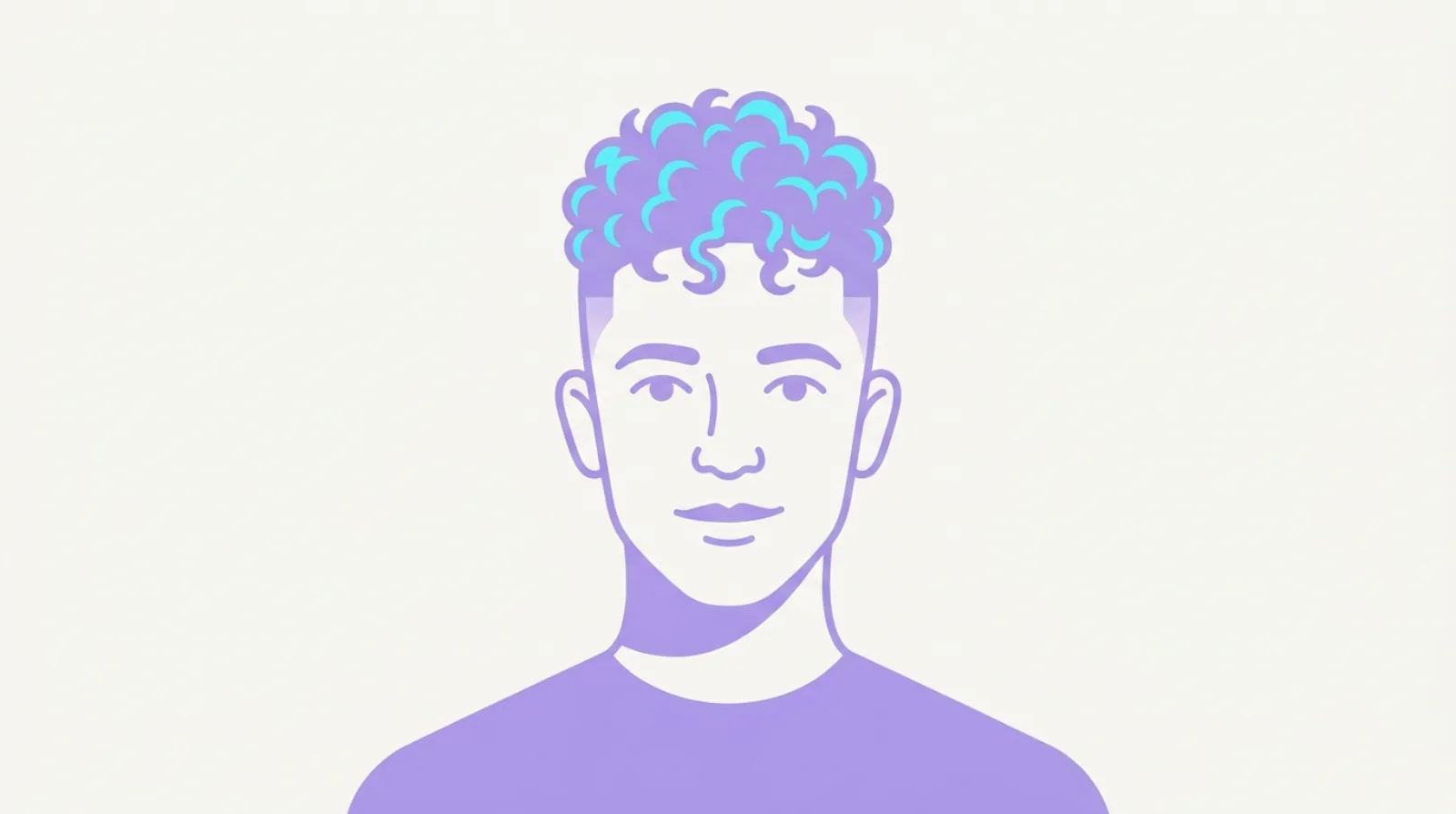
A lot of men treat curly hair like a problem to be managed. It is the opposite. Cut the wrong way, curls puff into a shapeless block, and that is where the frustration comes from. Cut with the curl in mind, the same hair gives you volume, movement, and texture that men with straight hair spend money trying to fake. This guide covers the cuts that make curls look deliberate: the curly crop, the curly fringe, the curly undercut, longer curls, and a full walkthrough of the curly pompadour.
Find out whether this suits your face. One selfie, and the face-shape read and your top pick are free.
Kurli is an AI hairstyle advisor: upload one selfie and it reads your face shape, recommends the cuts that suit it, and renders any of them onto your own photo before you commit.
The one rule: cut with the curl, not against it
Every good curly haircut follows the same idea. Straight hair hangs, so a barber can cut it to a line and it stays there. Curly hair coils, springs, and shrinks as it dries, so a cut that only looks right when the hair is stretched flat will look wrong the moment it dries. Working with the curl means the barber shapes the hair the way it actually sits, curl by curl, instead of forcing straight-hair technique onto it.
Two ideas matter most. The first is shrinkage: curly hair looks much shorter dry than wet, sometimes by half, so length decisions have to account for it. The second is weight: curls need some length and some thickness to clump together and fall nicely. Thin the top out too aggressively and the curls separate into frizz. Cut it too short in the wrong spots and the hair stands up in a puffball instead of curling.
A barber who cuts curly hair every week knows all of this. One who mostly cuts straight hair may not. That single choice, finding a barber who genuinely works with curl, does more for your hair than any product. For the care side of the story, our curly hair guide covers washing, moisture, and frizz in depth, and the men's hairstyles hub shows how curly versions of the classic cuts compare.
Curl types for men, kept simple
You do not need a chart with twelve categories. For picking a haircut, three broad groups cover almost every man.
Wavy hair bends in loose S shapes but does not form full rings. It gives natural texture and body, and it takes almost any men's cut with a little extra character. Our wavy hair guide covers it fully.
Curly hair forms real rings and spirals. This is the middle group, where the advice on this page lands squarely: crops, fringes, undercuts, and pompadours all work, but the cut has to respect shrinkage and weight.
Coily hair forms very tight curls or zigzags, the texture most common in Black hair. It shrinks the most, holds shape and volume the best, and suits sharp short cuts, fades, and freeform length. The coily hair guide goes deeper on care and styling.
Why the groups matter: the tighter the curl, the more moisture the hair needs, the more it shrinks, and the more a fade or taper on the sides pays off, because it clears bulk where you do not want it and leaves definition where you do. When you talk to a barber, naming your group, wavy, curly, or coily, gets you both on the same page faster than any photo caption.
The curly crop
The curly crop is the easiest win in men's curly hair, and if you want a low-effort daily style, it is the one to pick. The idea comes straight from the textured crop: short, choppy hair on top, a fringe pushed forward onto the forehead, and a fade or taper on the sides. With curls, nature does the texturing for you. The top reads as full and deliberate with zero styling skill, because each curl is its own bit of texture.
The fade on the sides is what makes it look sharp rather than accidental. Curly hair grows out as much as it grows down, so untapered sides get wide fast and make the head look round. Clearing the sides with a mid or low fade keeps all the volume where it flatters you, on top.
Styling takes under a minute: a small amount of curl cream or light paste worked through damp hair, fringe pushed forward with your fingers, done. The crop is also kind to a hairline that is starting to move back, since the forward fringe covers the front. Expect a trim every three to five weeks to keep the sides tight. If your curls are on the looser, wavier side, the standard crop guidance applies almost unchanged; tighter curls just need a touch more length on top so the fringe actually reaches forward.
The curly fringe
The curly fringe takes the crop idea and leans into it: more length at the front, so a section of full curls falls forward onto the forehead. It has become one of the defining young men's styles of the past few years, usually sitting over a skin fade or a burst fade, and it photographs extremely well.
The fringe earns its place for a practical reason too. A forward fringe visually shortens a long face and covers a high forehead, and curls do this even better than straight hair because they add width at the same time. If your face is long or your forehead is tall, this is one of the most flattering things you can do with curls. The full logic is in our post on hairstyles for a long face.
Ask your barber for length at the front, roughly eyebrow length when a curl is pulled straight, blending shorter toward the crown, with a fade on the sides. Remember shrinkage: what reaches your eyebrows stretched will sit well above them dry.
One honest caution. On a very round face, a heavy curly fringe adds width up top without adding height, which can make the face rounder. Rounder faces usually do better pushing the curls up rather than forward, which brings us to the next two cuts.
The curly undercut
The curly undercut pairs the boldest side treatment with the thing curls do best: volume on top. The sides and back are clipped to one short length, the top is left as a full block of curls, and there is a clear jump between the two rather than a gradual blend. The result is graphic and intentional, and it solves the widest problem curly hair has, bulk at the sides, by simply removing it.
The standard undercut guide covers the cut itself. The curly-specific advice is about the top. Keep real length there, at least seven or eight centimetres stretched, so the curls have enough weight to clump and fall rather than standing straight up. A top cut too short over disconnected sides is the classic mistake: it reads as a box of frizz sitting on a shaved head. Length is what turns it into a shape.
Styling is genuinely easy. Damp hair, a curl cream or light gel scrunched through, and the top either left to fall naturally or pushed back and to one side. Because the sides are one length, they are cheap and quick to maintain, and many men learn to run a clipper over them at home between barber visits. This cut also converts well into a curly pompadour on days you want more polish, since the length is already there.
The curly pompadour
The pompadour, big volume at the front, swept up and back over short sides, is usually shown on straight, slicked hair. Plenty of men assume curls rule it out. They do not. A curly pompadour keeps the curl and uses it, shaping the texture up and away from the forehead so the height comes from the hair's own body instead of from a comb and heavy pomade. Done well it has more presence than the straight version, because the volume is real. The name, if you are curious, goes back to Madame de Pompadour, an eighteenth-century French noblewoman who wore her hair swept high; the full history is in the pompadour guide.
How to ask the barber. Ask for a curly pompadour with a fade or a tight taper on the sides, low or mid depending on how bold you want it. On top, ask them to keep ten to fifteen centimetres of stretched length at the front, graduating shorter toward the crown, and to cut the top dry or at least to check the shape dry. Dry cutting matters more here than anywhere else, because shrinkage will pull the front up far more than a wet cut suggests. Say clearly that you want the front to sweep up and back, so they leave the weight in the right place.
The shape in daily life. Unlike a crop, a curly pompadour is styled, not just worn. Plan on five minutes in the morning. The payoff is a cut that works in formal settings and casual ones, and that no straight-haired man can copy.
Styling the curly pompadour: steps and products by hold level
Here is the routine, start to finish.
1. Start damp, not dry. Curls set their pattern while wet. Wet the hair fully or style straight out of the shower after a squeeze with a towel.
2. Apply product to damp hair. Work it through the top evenly with your fingers, root to tip.
3. Shape up and back. Use your fingers or a wide-tooth comb, never a fine comb, and push the front up and back off the forehead. A blow dryer with a diffuser on low heat, pointed upward at the front while you lift, builds real height and locks the direction in. The American Academy of Dermatology's advice on low heat applies here: high heat is the fastest way to wreck curl definition.
4. Do not touch it while it dries. Handling drying curls is where frizz comes from. Shape it, then leave it.
Products by hold level. For light hold, a leave-in conditioner or curl cream keeps the curls soft and natural; best for loose curls and casual days, but the front may drop by evening. For medium hold, the everyday answer, layer a curl cream underneath with a matte paste or foam over it; the shape lasts the day and still moves. For strong hold, tight curls, humid weather, or a formal event, use a water-based gel or firm-hold water-based pomade; it dries to a light cast you can scrunch out, and unlike oil-based pomade it washes out with plain shampoo. Skip heavy wax and oil-based pomade entirely: they drag curls down, kill the height, and build up over days.
Growing curls longer, and surviving the awkward stage
Longer curls, from a loose mop to shoulder length, are a genuinely great men's look, and curly hair grows out into more styles than straight hair does. But the road there is bumpier than it is for straight hair, and it helps to know why in advance.
Curly hair does not grow down. It grows out. For several months there is a stage where the hair is too long to be a crop and too short to fall under its own weight, so it expands sideways into the shape men call the broccoli phase. This is normal, it happens to everyone, and it ends once the curls get heavy enough to hang.
Three things get you through it. First, keep getting trims, every eight to twelve weeks, and tell the barber you are growing it out so they only shape the sides and remove damaged ends. Untrimmed split ends fray upward and make the hair look worse, not longer. Second, use the sides: keeping a taper or soft fade during the grow-out makes the in-between months look chosen rather than neglected. Third, lean on moisture, because longer curls are older hair and dry out at the ends first.
The destination is worth it. Everything in our men's long hair guide applies to curls, from buns to shoulder-length flow, and the shaggy, layered territory covered in the wolf cut guide was practically invented for wavy and curly texture.
Drying curls without frizz
Frizz is not a hair type. It is what curls do when they are dry, roughed up, or both. Control those two things and most frizz disappears, whatever cut you wear.
Cut the friction. A regular towel rubbed over wet curls scrapes the hair shafts against each other and breaks the curl pattern apart. Squeeze and blot instead of rubbing, and use a microfibre towel or a plain cotton T-shirt, both of which are far gentler. The same logic applies while the hair dries: hands off. Every time you touch a drying curl, you separate it into frizz.
Keep the moisture in. Dry hair frizzes because the outer layer is rough and reaches for moisture from the air. Condition every time you wash, and do not wash daily; for most curly-haired men, shampooing two or three times a week is plenty, and the days between washes are when curls look their best. Dermatologists make the same point about gentle washing and conditioning for hair health generally, and it goes double for curls.
Use low heat or none. Air drying is the safest. If you use a dryer, fit a diffuser, keep the heat low, and stop while the hair is still slightly damp. Applying your product to soaking-wet hair and then leaving it alone is the single habit that improves curl definition the most. If your scalp itself is flaky, oily, or irritated, that is a separate issue worth a doctor's visit rather than another product.
Which face shapes suit which curly cut
Curly hair adds volume, and where that volume sits changes how your face reads, so the same rules of balance apply as with any cut, just amplified.
Round faces want height, not width. The curly pompadour and the curly undercut are the strong picks, because they stack the volume on top and keep the sides skin-tight, which lengthens the face. A wide curly fringe is the one to be careful with.
Long and oblong faces want the opposite: the curly fringe and the curly crop shorten the forehead and add width, which is exactly the correction a long face benefits from.
Square faces can go almost anywhere; curls soften a heavy jaw naturally, and both the crop and the pompadour look sharp.
Oval faces carry every cut on this page, so the choice comes down to effort and taste.
Heart-shaped faces with a wider forehead do well with a medium crop or moderate pompadour rather than maximum front volume.
If you are not sure which shape you have, the free face shape quiz reads it from a selfie in about a minute, and the hairstyles by face shape hub matches cuts to each result. Kurli can then render a curly crop or curly pompadour onto your own photo, which settles the question better than any description.
Not sure which face shape is yours? Kurli reads it from one selfie and shows the cuts that suit it.
How to ask your barber, and the wet or dry question
The barber conversation decides most of the result with curly hair, so go in prepared.
First, ask the question that filters barbers: do you cut much curly hair, and do you cut it dry? Good curl barbers will say yes without hesitation. Cutting curly hair dry, or at least finishing and checking it dry, lets the barber see where each curl actually sits and how much it shrinks, so the final shape is the shape you leave with. A strictly wet cut on curly hair is how men end up with a top two inches shorter than they wanted. Wet cutting is fine for the clippered sides; it is the scissor work on top where dry matters.
Second, name the cut and the numbers. For example: 'curly crop, mid skin fade, keep the fringe eyebrow length when stretched' or 'curly pompadour, low fade, keep ten to fifteen centimetres stretched at the front, cut the top dry.' Stretched length is the honest measurement for curls, so use that word.
Third, bring a photo of someone with a similar curl tightness, not a looser one, because a style photographed on waves will not translate to tight curls at the same lengths. Our post on how to ask your stylist for the right cut has full scripts, and the men's hairstyles hub is the place to pick your target cut before you book.
Common questions
Can you get a pompadour with curly hair?
Yes. A curly pompadour shapes the curls up and back off the forehead so the height comes from the hair's own volume rather than from combing it flat. You need ten to fifteen centimetres of stretched length at the front, a fade or taper on the sides, and lighter products than the straight version uses. Ask the barber to cut the top dry so shrinkage does not take it too short.
How do men style curly hair?
The short version: apply product to damp hair, shape it with your fingers, and then leave it alone while it dries. A curl cream gives a soft natural hold, a paste or foam gives a medium hold, and a water-based gel gives a strong hold for tight curls or humid days. Rubbing with a towel and touching the hair while it dries are the two habits that cause most frizz.
Should curly hair be cut wet or dry?
The scissor work on top should be cut dry, or at least checked and finished dry. Curly hair shrinks a lot as it dries, so a wet cut can end up much shorter than intended once the curls spring back. Dry cutting lets the barber see where each curl actually sits. The clippered sides are fine to cut wet, since guard lengths do not shrink.
What is the best haircut for curly hair men?
For low effort, the curly crop: choppy curls on top, a short fringe, and a fade on the sides. It styles in under a minute and flatters most faces. If you want more presence, the curly undercut or curly pompadour put the volume on top where curls look best. There is no single best cut, but there is a best cut for your face shape and effort level.
How do men stop curly hair from frizzing?
Keep the hair moisturized and stop roughing it up. Condition every wash, do not shampoo daily, blot with a microfibre towel or T-shirt instead of rubbing, apply product while the hair is still very damp, and do not touch the curls while they dry. If you blow dry, use a diffuser on low heat. Most frizz is dryness plus friction, and both are fixable.
How often should men with curly hair wash it?
For most curly-haired men, shampooing two or three times a week is enough. Daily shampooing strips the natural oils curls depend on, and curly hair is drier by nature because those oils travel down a coiled strand more slowly. Condition every time you wash. Many men find their curls actually look best on the day after a wash.
What product should men use for curly hair?
Match the product to the hold you need. Curl cream or leave-in conditioner for a soft, natural finish. A matte paste or styling foam for medium, all-day hold. A water-based gel or firm water-based pomade for strong hold on tight curls. Avoid heavy wax and oil-based pomade, which drag curls down, flatten the volume, and are hard to wash out.
Does an undercut work with curly hair?
Yes, very well, with one condition: keep real length on top, at least seven or eight centimetres stretched. The short sides remove the bulk curly hair builds around the ears, and the curls on top supply the volume and contrast. If the top is cut too short over disconnected sides, the curls stand up in a puff instead of falling into a shape.
How long does it take to grow out curly hair?
Longer than it feels like it should, because curly hair grows outward before it hangs downward. Expect an awkward, expanding stage for several months, often called the broccoli phase, before the curls get heavy enough to fall. Regular light trims every eight to twelve weeks, a tidy taper on the sides, and patience get you through it with the least pain.
Do curls get looser as hair gets longer?
They usually look looser, yes. Longer hair is heavier, and that weight stretches the curl, so tight rings can relax into waves as they grow. The pattern itself does not change, and the tighter curl returns when the hair is cut shorter. This is worth knowing when you pick a target style, since photos of long loose curls may be tighter hair grown out.
Which face shapes suit curly hairstyles?
All of them, with different cuts. Round faces suit height on top with tight sides, like a curly pompadour or undercut. Long faces suit a curly fringe or crop, which shortens the forehead and adds width. Square and oval faces carry almost any curly cut. The face shape quiz on Kurli reads your shape from a selfie and matches cuts to it.
Can Kurli show me a curly style on my own photo?
Yes. Upload a selfie or use your webcam, and Kurli renders styles like the curly crop or curly pompadour onto your own photo, with your actual curl texture taken into account by the AI. It also detects your face shape and explains why each cut suits it, so you can walk into the barbershop with a picture of yourself instead of a stranger.
Sources
Hair biology and hair-care facts on this page are supported by these sources. Styling recommendations are guidance.
- Tips for healthy hair, American Academy of Dermatology
- Everyday hair care, American Academy of Dermatology
- How to style hair without damage, American Academy of Dermatology
- Hair Problems, MedlinePlus, U.S. National Library of Medicine
- Pompadour: etymology, origin and meaning, Online Etymology Dictionary
See it on your own face
Kurli reads your face from a selfie, recommends styles that suit you, and renders each one onto your photo.
The face-shape read and your top pick are free. Your photo is never sold or used to train AI.