Men's hairstyles
Low taper fade
The fade people ask for by name. Skin at the ear and neck, hair everywhere else.
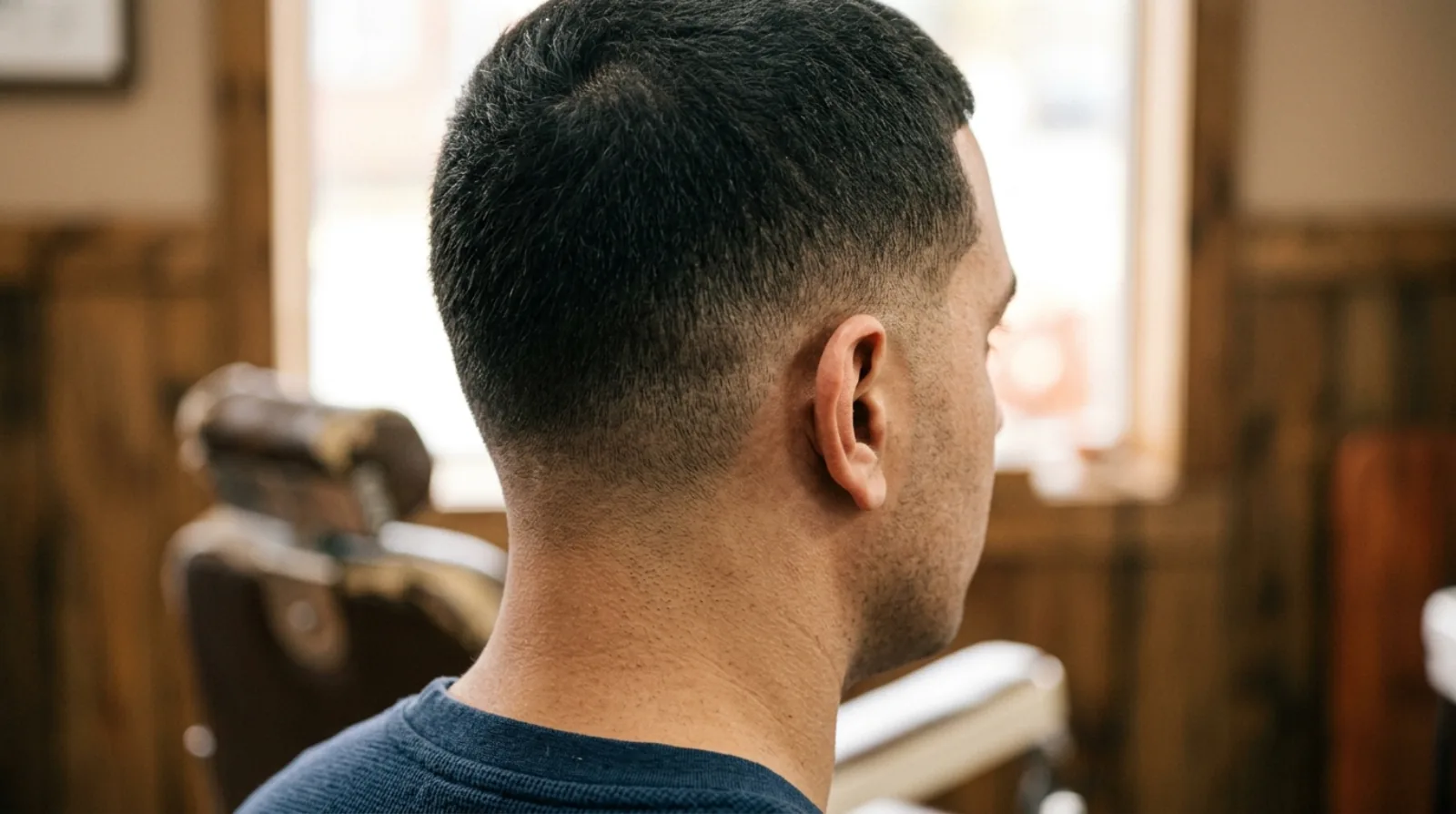
The low taper fade is the haircut people ask for by name. It keeps the hair on the sides at one short length and only fades the edges: around the ear and along the neckline, the hair blends down to the skin, or close to it, over a short band. The result is clean at the edges and natural everywhere else. This page covers that one cut in detail. Our fade haircut guide explains every fade type, from low to high, skin, drop and burst, and is the page to read if you are still choosing. Read this one if you already know the name and want to know what it looks like, whether it suits your face and hair, how long it lasts, and how to ask for it.
What a low taper fade is, and what it looks like
Look at the side of a head with a low taper fade from behind. The hair on the sides sits at one short length, often a number 2 or 3 guard, or scissor length if the top is longer. Then, just above the ear and along the back of the neck, the hair gets shorter over a band about two to three centimetres tall, until it reaches the skin or the shortest guard. That band is the taper. It follows the hairline around the ear and across the nape, and it stops low, well below the temple.
From the front, a low taper fade is easy to miss. The sideburns are neat and the edge of the hairline is clean, but the sides still look like hair, not skin. That is the point of the cut. It gives the clean edges of a fade without the shaved look of a mid or high fade.
A low taper fade is the same cut whatever you have on top. A buzz cut, a textured crop, a crew cut and a long curly top can all sit above the same low taper. The taper only describes the last few centimetres at the ear and the neck. Everything above it is a separate choice, which is why this page and the fade guide split the work: that page compares fade heights and types, and this page goes deep on the one people ask for by name.
Low taper vs low taper fade: are they the same?
Most barbers use the two names for the same cut, and if you ask for either one you will get the cut described above. Where a barber does make a difference, it is in how short the bottom goes.
A taper is any cut where the hair gets shorter as it moves down toward the ear and neck. A fade is a taper that goes all the way to the skin, or close to it, with a smooth blend. So a 'low taper' can stop at a number 1 guard and still be a taper. A 'low taper fade' says: take the lowest part to the skin.
If you want the edges to reach skin, say 'low taper fade' or 'low skin taper'. If you want the edges short but with some hair still showing, say 'low taper, not to the skin'.
A related question is whether you can get a low taper without a fade. Yes. A scissor taper, or a clipper taper that stops at a guard number, is a low taper with no fade. It is the softest version of the cut and the one that changes least as it grows. For the wider comparison between the two words, the fade guide has a section on fade versus taper.
Low taper fade vs low fade, mid taper and high taper
The word 'low' tells the barber where the short part starts. On a low taper fade the blend covers only the band around the ear and along the neckline. On a mid taper the blend starts higher, around the middle of the side of the head, so more of the side is short. On a high taper it starts near the temple. Each step up shows more skin and gives more contrast between the sides and the top.
A low fade differs from a low taper fade in how far the blend reaches around the head. A low fade runs the blend all the way around the sides and back at the same low height, so the whole lower band of the head is faded. A low taper fade concentrates on the two places where the hairline curves, the ear and the neck, and can leave the hair between them at one length. The taper is the more conservative of the two.
If you are choosing between low and mid, ask yourself two questions. How often will you come back to the barber? A low taper hides growth better. How much skin do you want to see from the front? A mid taper shows skin from the front; a low taper mostly does not. Our post on undercut vs fade covers the other cut people confuse with these.
Which face shapes suit a low taper fade
A low taper fade keeps the sides at one length, so it changes the outline of the head less than a high fade does. That makes it the safest fade for most faces. It also means the taper cannot balance a face shape on its own; what you put on top does that work.
Oval face. Any version works. The low taper keeps the outline of the head natural and the oval shape stays balanced.
Round face. A low taper fade works, but keep the sides short (a number 1 or 2 guard above the taper) and add height on top. Width on the sides and a flat top will make a round face look wider. A round face gets more slimming from a mid fade with height on top, so if slimming is your main goal, read the round face guide before you decide.
Oblong (long) face. The low taper is the best fade height for a long face, because it keeps the sides fuller and adds no height. Keep the top short to medium rather than tall. See hairstyles for a long face.
Square face. Works well. The clean edges match the strong jaw, and the fuller sides soften the angles a little. A short, textured top suits it.
Diamond face. Works well, because the sides above the taper keep some width next to the temples, which a diamond face needs. Do not take the sides too short.
Heart face. Works. Pair it with a fringe or a forward-styled top so the forehead does not look wider than the jaw.
So does a low taper fade suit everyone? As a way of cutting the sides, close to it. The top decides the rest. If you do not know your shape, the face shape quiz reads it from a photo, and our post on men's fade haircuts by face shape goes deeper on each one.
Does a low taper fade work with straight hair?
Yes, and straight hair is one of the easiest hair types to taper. The blend shows clearly because straight hair lies flat against the head, so the barber can see every line and fix it.
Two things matter. First, the length above the taper. On straight hair, a number 2 guard on the sides usually looks neat; a longer scissor length on the sides can look bulky unless the top is long too. Second, the top. Straight hair tends to lie flat, so a low taper fade with a flat, unstyled top can look plain. Add a short textured cut on top, or a small amount of matte paste pushed forward or up, and the cut looks finished.
A low taper with a fringe on straight hair works too; the French crop is that exact pairing. If your straight hair is fine, ask the barber not to take the sides too short, so there is no sharp jump between thin-looking sides and the top.
Curly, thick, thin and short hair
Curly hair. A low taper fade on curly hair keeps the edges clean while the curls on top stay full. The barber should cut the taper with the hair dry, or at least check it dry, because curls shrink. Ask for the taper to be blended a little higher than you think you want, since the curl volume above it will make the taper look lower than it is. The curly hairstyles for men page has more.
Thick hair. Works well. Thick hair holds the shape of the taper and the sides do not show scalp. Ask the barber to take some weight out above the taper so the sides do not puff out.
Thin or fine hair. Works, with one rule: do not take the sides to bare skin if the top is thin. A skin edge next to a sparse top makes the top look thinner. A low taper that stops at a number 1 guard keeps the look balanced. If your hair is thinning at the crown or the front, read hairstyles for a receding hairline before you choose the fade height.
Short hair and a buzz cut. Yes, you can get a low taper fade with short hair, and it is a common way to make a buzz cut look finished. The whole head is clipped to one short guard, and the taper cleans up the ear and neck. The difference from a plain buzz cut is small but visible from the side. See the buzz cut guide.
What to put on top
Because the low taper only touches the edges, the top decides the look. Here are the pairings barbers see most.
Textured crop. A short, point-cut top pushed forward. The low taper keeps the sides at a length that suits the shorter top, and it is the pairing shown in most low taper fade photos people bring to the barber. See the textured crop guide and the post on the textured crop by face shape.
French crop. The same idea with a straight fringe across the forehead.
Crew cut. Short all over with a little more length at the front. The low taper and the crew cut are both conservative, so the pairing suits work and school.
Curly top. Medium curls on top with a low taper is a common cut for curly hair.
Longer top, swept back or to the side. A low taper works under a side part or a slick back, because the fuller sides match the weight of a longer top. A high fade under a long top can look top-heavy; a low taper does not.
Mullet and longer backs. A low taper at the ear only, with the neckline left long, is how a modern mullet is usually cut. The mullet guide explains it.
How long it lasts, and how it grows out
A low taper fade looks sharp for about two to three weeks. After that the skin edge at the ear and neck fills in, and the neckline starts to look fuzzy. Healthy hair grows about half an inch, or about one centimetre, a month (MedlinePlus, Cleveland Clinic), so the blend at the bottom of the taper closes up within a few weeks. That is true of every fade.
The low taper has an advantage here. Because the faded band is small and the sides above it stay at one length, a low taper grows out with less change than a mid or high fade. At week four it looks like a short back and sides with a soft neckline, which is still a tidy haircut. A high skin fade at week four looks overgrown and uneven.
So, do low taper fades last long? They stay crisp for two to three weeks and stay acceptable for four to six. Do they grow out well? Better than any other fade. If you can get to the barber every two weeks, a mid or high fade is fine. If you go every four to six, the low taper is the fade to choose.
Between visits you can keep the neckline clean by having someone run a trimmer along the bottom edge only, without touching the blend. For planning trims around growth, our post on how fast hair grows has the numbers.
How to ask your barber for a low taper fade
Say the name, then add four details.
1. The name. 'A low taper fade.' Every barber knows the term.
2. How short the bottom goes. 'Down to skin at the neck and around the ear', or 'not to skin, stop at a zero', or 'stop at a one'.
3. The length above the taper. 'A number two on the sides', or 'scissor cut on the sides, just tidy them'.
4. The top. Say what you want on top, or say 'keep the top as it is and just tidy it'.
Put together it sounds like this: 'A low taper fade, skin at the neck and ear, number two on the sides, and a short textured top pushed forward.' Or: 'A low taper, not to skin, scissor sides, leave the top.'
Two more things help. Show a photo of the back and side of the cut, not the front, because the front of a low taper fade looks like almost any short haircut. And say how often you come in. If you say 'I come every five weeks', a good barber will keep the taper lower and softer so it lasts.
If you are asked 'blocked or rounded neckline', a rounded or tapered neckline is the normal choice with a taper; a blocked (square) neckline is for cuts with no fade at the back. More phrases are in how to ask your stylist for the right cut.
Can you do a low taper fade at home?
You can tidy one at home. Cutting one from scratch is hard, because the blend sits behind your ear and at the back of your neck, where you cannot see it without two mirrors, and the whole cut depends on that blend having no lines.
If you want to try, the plan is this. Use a clipper with guards and, if possible, a lever that adjusts the blade. Clip the sides to your chosen guard (a number two is a safe start). Then, with a guard two sizes shorter, cut a band about two centimetres tall around the ear and along the neckline, moving the clipper up and flicking it out at the top of the band. Then use the shortest guard, or the open lever, on the bottom centimetre only, again flicking out. Finally, run a trimmer along the neckline and around the ears to clean the edge. The flick-out motion is what blends the steps. Go slowly, check with a second mirror, and stop as soon as it looks even.
The practical advice is to have the barber cut the first one, then do the neckline and the ear edges at home between visits. That keeps the cut looking fresh without you having to blend anything.
School, work and uniform rules
A low taper fade is the most conservative fade there is. From the front it reads as a neat short haircut, and it shows less skin than a mid or high fade. That is why it is the usual answer when someone needs a fade that will pass a dress code.
Whether it passes a particular rule depends on the written rule, and those differ by school, employer and service. Some codes limit the contrast between the sides and the top, some ban sections shaved to the skin, and some only require the hair to be neat and off the collar. A low taper that stops at a number 1 guard rather than skin fits more codes than a skin taper.
If a rule matters to you, read the rule, or ask the person who enforces it, and take the wording to your barber. We cannot say what any one school or service allows, and a guide that told you would be guessing.
The low taper fade meme, briefly
People searching for this cut often meet the phrase 'imagine if Ninja got a low taper fade'. Here is where it comes from, in short.
On 5 January 2024 the musician ericdoa sang that line during a freestyle on a Twitch livestream. A clip of it was posted to TikTok on 11 January and spread widely. On 13 January 2024 the streamer Ninja (Tyler Blevins) posted a TikTok showing that he had got the haircut, set to the same audio. Later in 2024 a second phrase followed, 'the low taper fade meme is still massive', taken from a video in which Ninja said the meme was still going. Those are the facts as recorded on Know Your Meme.
The meme is about the phrase and the two people, not about the haircut. The cut itself is a standard barber term and is asked for every day in shops that have never heard of the meme. If you want the cut, none of this changes what to ask for.
Pros and cons of a low taper fade
For it. It is the fade that suits the most faces and the most hair types. It grows out with less change than any other fade, so it costs fewer barber visits over a year. It passes more dress codes. It works under any top, short or long. And it is easy to ask for, because every barber knows the name.
Against it. It is subtle. If you want the strong contrast of skin on the sides, a low taper will look too soft, and you should ask for a mid or high fade instead. It does not slim a round face the way a higher fade does, because it keeps width on the sides. And it still depends on the barber's blending; a low taper with a visible line at the ear looks worse than a plain short back and sides.
If you want the clean edge with the least commitment, this is the fade to get. If you want maximum sharpness, the fade guide covers the higher options, and the men's hairstyles hub has every top style to pair with it.
Common questions
What does a low taper fade look like?
From the side, the hair on the sides sits at one short length, and just above the ear and along the neckline it blends down to the skin over a band about two to three centimetres tall. From the front it looks like a neat short haircut with clean sideburns and a clean hairline. The sides still look like hair, not skin. Only the edges are faded.
Can you get a low taper without a fade?
Yes. A low taper without a fade stops at a guard number, such as a number 1, or is cut with scissors, so the shortest part still shows some hair instead of skin. Ask for 'a low taper, not to the skin'. It is the softest version of the cut and the one that changes least as it grows.
Is a low taper fade the same as a low taper?
In most barber shops, yes. Both names get you the same cut. The only difference some barbers make is that 'fade' means the bottom of the taper goes to the skin, while 'taper' on its own may stop at a short guard. Say which one you want and there will be no confusion.
Does a low taper fade look good on everyone?
As a way of cutting the sides, it suits almost everyone, because it keeps the outline of the head natural and only cleans the edges. Whether the whole haircut looks good depends on the top. A round face needs height on top, a long face needs a shorter top, and a diamond face needs the sides kept at a little length. The taper itself is safe for all of them.
Is a low taper fade good for a round face?
Yes, with two conditions. Keep the sides short above the taper, a number 1 or 2 guard, and add height on top. Width on the sides and a flat top will make a round face look wider. If slimming the face is your main goal, a mid fade with a tall top does more, so read the round face guide before choosing.
Does a low taper fade look good on a square face?
Yes. The clean edges at the ear and neck match a strong jaw, and the sides above the taper keep a little fullness that softens the angles. A short textured top or a crew cut on top suits a square face well.
Does a low taper fade suit an oval or oblong face?
An oval face can wear any version of it. For an oblong (long) face the low taper is the best fade height, because it keeps the sides fuller and adds no height. Keep the top short to medium rather than tall, so the face does not look longer.
Does a low taper fade work with straight hair?
Yes. Straight hair lies flat, so the blend shows clearly and is easy for a barber to get even. Keep the sides at about a number 2 guard and put a short textured cut, or a fringe, on top so the haircut does not look flat. If your straight hair is fine, ask the barber not to take the sides too short.
Can you get a low taper fade with curly hair?
Yes, and it is a common cut for curly hair. The taper keeps the ear and neck clean while the curls on top stay full. Ask the barber to cut or check the taper with the hair dry, because curls shrink, and to blend it a little higher than you think, since curl volume makes the taper look lower than it is.
Can you get a low taper fade with thin hair?
Yes, with one rule: do not take the bottom to bare skin if the top is thin, because a skin edge next to a sparse top makes the top look thinner. A low taper that stops at a number 1 guard keeps the look balanced. If your hair is thinning at the front or the crown, choose the fade height with that in mind.
Can you get a low taper fade with a buzz cut?
Yes. The whole head is clipped to one short guard and the taper cleans up the ear and the neck. It is the usual way to make a buzz cut look finished. The difference from a plain buzz cut is small from the front and clear from the side.
Does a low taper fade last long?
It looks crisp for about two to three weeks, then the skin edge at the ear and neck fills in as the hair grows. It stays acceptable for four to six weeks, which is longer than a mid or high fade, because the faded band is small and the sides above it stay at one length.
Does a low taper grow out well?
Better than any other fade. As it grows, the taper turns into a short back and sides with a soft neckline, which is still a tidy haircut. A high skin fade at the same stage looks overgrown and uneven. If you can only get to the barber every four to six weeks, the low taper is the fade to choose.
Should I get low taper or mid taper?
Choose a low taper if you go to the barber every four to six weeks, need a cut that passes a dress code, or want the sides to look like hair from the front. Choose a mid taper if you go every two to three weeks and want more skin and more contrast. A mid taper also does more to slim a round face.
How do you ask for a low taper fade?
Say the name, then how short the bottom goes, the length on the sides, and what you want on top. For example: 'A low taper fade, skin at the neck and ear, number two on the sides, and a short textured top pushed forward.' Show a photo of the back and side of the cut, and tell the barber how often you come in.
Who is the low taper fade guy?
The phrase 'imagine if Ninja got a low taper fade' was sung by the musician ericdoa on a Twitch livestream on 5 January 2024, and the clip spread on TikTok. The streamer Ninja (Tyler Blevins) then posted a video of himself with the haircut on 13 January 2024. The meme is about the phrase and those two people. The haircut itself is a standard barber cut and is not affected by any of it.
Can Kurli show me a low taper fade on my own photo before the barber?
Yes. Kurli lets you upload a selfie or use your webcam, then it can render a low taper fade with a top style onto your own photo so you see the result before you sit in the chair. It also detects your face shape to suggest which top suits you best. That way you walk into the barber shop knowing exactly what to ask for.
Sources
Hair biology and hair-care facts on this page are supported by these sources. Styling recommendations are guidance.
- Hair Problems, MedlinePlus, U.S. National Library of Medicine
- Hair Follicle, Cleveland Clinic
- Tips for healthy hair, American Academy of Dermatology
- Everyday hair care, American Academy of Dermatology
- How to style hair without damage, American Academy of Dermatology
See it on your own face
Kurli reads your face from a selfie, recommends styles that suit you, and renders each one onto your photo.