Men's hairstyles
Curtains haircut (men)
The middle-parted, forward-falling cut of the 1990s, back as the eboy cut. The length you need, who it suits, and how to keep it from falling flat.
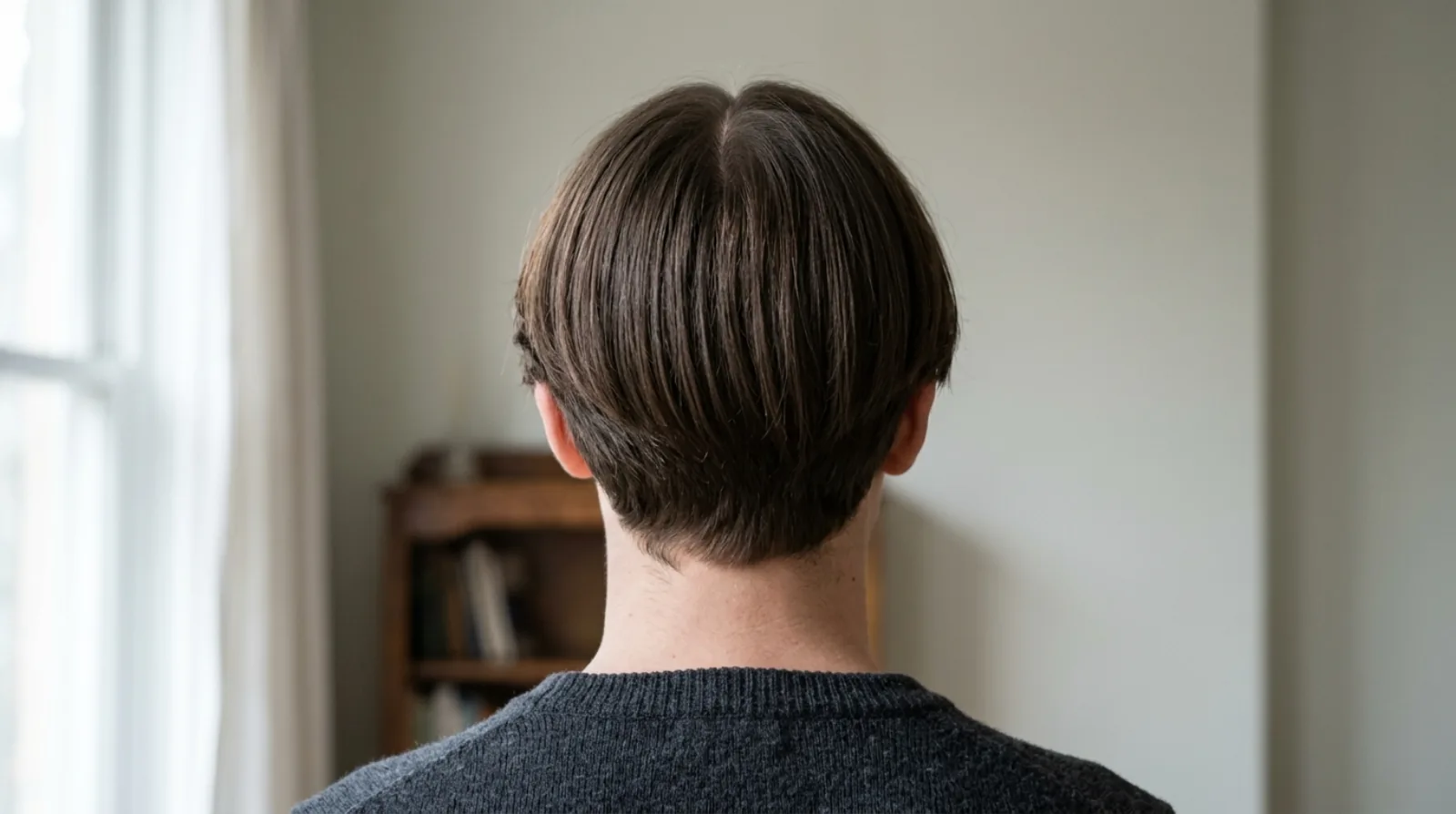
Curtains are a men's haircut where the hair on top is grown long enough to part in the middle and fall forward and outward to both sides of the face. The name comes from the way the hair hangs on each side of the parting. The sides and back are usually cut shorter, so the shape stays clean and the long top stands out. The cut was everywhere in the 1990s, came back in the late 2010s under the name eboy cut, and has stayed in barbershops since. This guide covers what the cut is, how long your hair must be, which face shapes it suits, what to say to your barber, and how to style it so it holds its shape past midday.
What a curtains haircut is
A curtains haircut has three parts. The top is left long, usually 10 to 15 cm at the front, so the hair reaches at least the eyebrows when it is pulled straight down. The parting runs down the middle of the head, or close to it, and the hair on each side of that line falls forward and out toward the temples. The forehead shows in the centre and the hair frames the face on both sides. The sides and back are cut shorter than the top: a scissor taper that blends into the length, a low or mid fade, or, in the grown-out version, close to the same length as the top.
The forward fall is the point of the cut. A side part sends the hair across the head. A slick back sends it straight back. Curtains send it down and out from a centre line, which is why the front needs real length. Short hair parted in the middle stands up instead of falling.
Because the shape depends on the weight of the hair and the parting, not on product, curtains hold their look with little styling once the length is there. The cost is the growing time. Most men need months to get the front long enough, and the middle stage, where the hair is too long to push up and too short to fall, is the part people give up on.
Curtains, the eboy cut, and curtain bangs
Three names describe the same family of cuts, and barbers use them loosely.
Curtains is the classic name for the 1990s cut: a centre or near-centre parting, hair long enough to reach the brows or the cheekbones, and shorter sides. It is the term most barbers know first.
The eboy cut is the version that came back in the late 2010s. It is the same shape with two changes. The hair is often longer, reaching the cheekbones or lower, and the sides are faded or undercut, which makes the contrast between the long top and the short sides sharper. Some versions add a bleached section at the front. If you ask for an eboy cut, expect the barber to leave more length on top and take the sides shorter than a plain curtains request would.
Curtain bangs is the term used in women's hair, and it means the fringe only: a parted fringe that sweeps to each side, worn with long hair everywhere else. When a man asks for curtain bangs he usually means curtains, but the barber may hear a request to reshape only the front. Say curtains, or say the eboy cut, and bring a photo. The side part vs middle part post covers where the parting should sit, and why a line a finger's width off centre is easier to wear than a dead-centre one.
How long the hair must be, and how to get there
The front needs to reach the eyebrows at the minimum, which for most men means 8 to 10 cm of length at the front. The full cut, with the hair reaching the cheekbones, needs 12 to 15 cm. The crown can be shorter than the front, since the parting starts there and the hair only needs to lie down on each side of it.
Growing to that length from a short cut takes months, and the exact time differs from person to person, so plan in months rather than weeks. During the middle stage the hair is too long to push up and too short to fall. Three things help.
Keep the sides and back trimmed, so the shape looks planned while the top catches up. Part the hair where you want the final parting from the first week, so the roots learn the direction. After every wash, blow-dry the front down and to each side, which trains the hair to fall instead of stand.
Our guide to growing out a fringe covers the same months from the other direction. Once the front is past the brows, the cut works. Every extra centimetre after that is a choice, not a need.
Who curtains suit, by face shape
Curtains put hair on both sides of the face and leave a strip of forehead open in the centre. Two things follow. The cut adds width at the temples and cheekbones, and the open centre strip adds visible length down the middle of the face. That decides most of the face-shape logic.
Oval faces wear curtains without adjustment. The parting can sit in the centre, and any length from brow to cheekbone works. See the oval face guide.
Oblong and long faces get the most help from the cut. Hair falling forward over the top of the forehead shortens the visible face, and the width at the sides balances the length. Keep the parting centred and let the front sit low, at the brows or below. The oblong face guide has the full reasoning.
Round faces can wear curtains, but the version matters. A flat, heavy curtain on each side adds width where a round face already has it. The fix is lift at the parting, a longer front that falls past the cheekbones instead of stopping at them, and faded sides so the outline narrows below the ears. The round face guide explains why height and narrow sides help.
Square faces suit curtains well. The forward-falling hair softens a strong jaw and a straight hairline, and the parting adds length. Keep texture in the ends so the curtains do not form a straight line that repeats the jaw.
Heart faces, with a wide forehead and a narrow chin, do better with a cheekbone-length curtain that covers part of the forehead and adds width lower down. A short brow-length version can make the forehead look wider.
Diamond faces, widest at the cheekbones, should keep the curtains light and textured so the hair does not add width at cheekbone level, and can let the front sit at the brows.
If you do not know your shape, the face shape quiz reads it from a photo.
Are curtains attractive, and are they in fashion?
Whether curtains look good on a person depends on proportions, not on the cut itself. Three measurements decide it.
Forehead height. Curtains show the centre of the forehead and cover the corners. A tall forehead looks balanced under a front that sits at the brows. A short forehead is better with the front lifted at the parting so the hair does not cover all of it.
Face width at the cheekbones. Hair falling at the sides adds width at that level. Narrow faces gain from it. Wide faces need the hair to fall past the cheekbones, or to be tucked behind the ears, so it does not add more.
Hairline shape. A straight or rounded hairline sits well under a centre parting. A deep widow's peak or M-shaped corners make the parting harder to place. The section on hairlines below covers that.
Curtains are in fashion now and have been since the eboy version brought them back. Trends move, but the cut is one of the few long-top styles that reads as current and is also simple to keep. If you are asking whether it will still look right in a year: the classic version, with a soft taper and a brow-length front, was popular in the 1990s and came back in the late 2010s, so it has survived one full cycle already. The sharper eboy version, with a skin fade and a bleached front, is the part that dates.
What haircut goes with curtains: the sides
Curtains describe only the top. The sides are a second decision, and it changes how the cut reads.
Scissor taper. The sides are cut shorter than the top and blended into it with scissors, with no clipper line. This is the 1990s version. It looks soft, it grows out well, and it suits workplaces where a fade would look sharp. It keeps some width at the sides, which helps long faces.
Low or mid fade. The sides go from short at the bottom to longer at the top. This is the eboy version. It makes the long top stand out, narrows the head below the ears, and helps round faces. It needs a trim every three to four weeks to stay clean.
Undercut. The sides are one short length with a visible step up to the long top and no blend. It is the boldest option and the one that dates fastest.
Grown-in sides. The sides are the same length as the top, or close to it. This turns curtains into a men's long hair style with a middle parting, and it is where curtains end up if you keep growing.
For a first set of curtains, ask for a scissor taper or a low fade. Both are easy to change later, and both let the barber tidy the sides between full cuts without touching the top.
How to ask for curtains at the barber
Say the name, then give four details.
The parting. Centre, or a finger's width off centre. Off centre is easier for most people, because few hairlines and crowns are symmetrical, and a parting that follows the natural split holds without product. Look at where your hair splits on its own when it is wet and pushed back. That is usually the right line.
The front length. Brow length for a neat, shorter version. Cheekbone length for the full eboy look. If the front is not long enough yet, say you are growing it and ask the barber to leave the front alone.
The sides. Taper, low fade, mid fade, or left long, as in the section above.
The ends. Ask for the ends to be point cut or texturised so the curtains sit in soft pieces instead of one blunt edge. A blunt edge on curtains looks like a bowl cut growing out.
Bring a photo of the version you want, from the front and from the side. Curtains and the eboy cut cover a wide range, and a picture settles the length and the sides faster than words. If you have a cowlick at the front or a strong whorl at the crown, tell the barber, because the parting has to start from the whorl or it will not stay.
How to cut curtains, and why home cuts go wrong
A barber cuts curtains in this order, and the order is the reason a home attempt rarely works.
First the parting is set on damp hair, following the natural split. Then the top is cut to length with the hair combed down on each side of the parting, so both sides match when they fall. The front is checked dry, because hair that reaches the brows when wet can sit above them when dry, and wavy hair shrinks more than straight hair. Then the sides and back are tapered or faded up to the line where the long top begins, and that line is blended so there is no shelf. Last, the ends are point cut to remove weight and make the curtains sit in separate pieces.
The two failures in home cuts are the same every time. The two sides come out at different lengths, because the head was tilted or the parting was in the wrong place when the hair was cut. And the top is cut straight across while wet, so it dries into a hard line above the brows.
If you must trim at home, do only the front, on dry hair, cutting small pieces upward into the ends with the scissor tips rather than straight across. Leave the sides and the blend to a barber. The French crop page explains point cutting in more detail, and the same technique applies here.
How to style curtains
Curtains are styled with a hair dryer first and product second, and the dryer does most of the work.
Start on towel-dried, damp hair. Set the parting with a wide-tooth comb, without dragging, because wet hair breaks more easily when it is combed. Point the dryer down and out on each side, following the direction the hair should fall, and use a flat or round brush to pull the front forward and out toward the temples as it dries. For a moment at the parting, point the dryer at the roots from behind so they lift off the scalp. That stops the hair from lying flat on the head. Use a low or medium heat and keep the dryer moving. The American Academy of Dermatology advises low or medium heat settings and a heat-protection product to limit damage.
Once the hair is dry, work a small amount of light product through the mid-lengths and ends. Sea salt spray on damp hair before drying gives fine hair grip and a matte finish. Light cream or paste on dry hair separates the pieces and controls stray hairs without weight. Matte clay holds thick hair in place through the day.
Avoid gel and heavy pomade. Curtains need to move, and a stiff or shiny finish turns them into two fixed slabs. Keep product away from the roots, which flattens the parting and makes the hair look greasy by afternoon. A second-day refresh needs only water on the fingers to reset the parting and a short dry of the front.
Two minutes with a dryer and a small amount of product is the whole routine. Skipping the dryer and using more product to make up for it is the most common mistake, and it is why so many curtains fall flat by midday.
Curtains on straight, wavy, curly, thick and fine hair
Straight hair is the classic base. It falls cleanly on each side and shows the parting. The risk is flatness, so keep lift at the roots and ask for texture in the ends.
Wavy hair may be the best base for curtains. The wave gives the sides movement and volume without a dryer. Ask for the front to be cut dry so the shrink from the wave is accounted for, and expect to need more length than a straight-haired friend for the same finished look.
Curly hair can wear curtains. The parting is set the same way and the curls fall to each side. Have it cut dry, keep the layers long so the curls do not spring into a rounded shape, and use a leave-in conditioner or curl cream rather than a paste. The curly hairstyles for men page has the product details.
Thick hair needs weight removed from inside the top, or the curtains puff outward instead of falling. Ask for internal thinning or heavy point cutting.
Fine hair should stay at brow length rather than cheekbone length, since long fine curtains separate and show the parting as a wide gap. A low fade rather than a taper adds contrast that makes fine hair on top look fuller.
If you like the look of curtains but your hair does not want to fall forward, a textured crop gives a forward-directed top with a fraction of the length and none of the growing time.
Hairlines, cowlicks and thinning
Curtains show the centre of the hairline and hide the corners. That helps men with receding corners: the hair that falls at each side sits over the temples, where M-shaped recession starts, and the parting draws the eye to the centre, which usually keeps its line the longest. Many men keep curtains into their thirties for this reason.
A widow's peak pushes the parting off centre on its own. Let it, and set the parting a finger's width to whichever side the peak leans. A cowlick at the front hairline is the harder problem, because it lifts one side of the front. The fix is length, since the weight of longer hair holds a cowlick down, plus a dryer aimed against the direction of the cowlick after each wash.
Thinning at the crown is where curtains stop working, because the parting starts at the crown and exposes it. At that stage a shorter, forward-directed cut looks stronger, and our post on hairstyles for a receding hairline walks through the options by stage.
Set the parting with a comb and the dryer rather than dragging the hair into place. If your hairline is changing fast, or in patches, that is a question for a doctor or dermatologist, not a barber. The American Academy of Dermatology's hair loss pages, linked below, explain when to get it checked.
Common mistakes and upkeep
Cutting the front too short. Curtains that do not reach the brows stand up instead of falling. When in doubt, ask the barber to leave one centimetre more than you think you need.
A dead-straight parting on an uneven head. Almost nobody's hairline and crown line up on a perfect centre. Follow the natural split.
Blunt ends. A straight edge across the front makes the cut look like a bowl cut growing out. Point-cut or texturised ends fix it.
No dryer. Air-dried curtains lie flat and split at random. Two minutes of drying down and out is the difference between a haircut and a shape.
Too much product. Heavy product at the roots collapses the parting and shows scalp.
Upkeep is a trim every four to six weeks for a taper or grown sides, or every three to four for a fade. The top needs only the ends dusted every second visit, since the length is the point. Wash with a mild shampoo, apply shampoo to the scalp rather than the lengths, and use conditioner on the mid-lengths and ends, since dry ends are the first thing that makes a long-top cut look untidy. The AAD everyday care page linked below covers the basics.
Before you spend months growing, load a photo into Kurli and see curtains rendered on your own face. It is the quickest way to find out whether the cut suits your proportions before you commit to the growing time.
Common questions
What is a curtain haircut?
A curtain haircut, usually called curtains, is a men's cut where the hair on top is long enough to part in the middle and fall forward and out to both sides of the face, with the sides and back cut shorter. The front reaches at least the eyebrows. The name comes from the way the hair hangs on each side of the parting.
How to get curtains haircut?
Grow the front to at least 8 to 10 cm, so it reaches your eyebrows, then ask a barber for curtains with a centre or near-centre parting, the sides tapered or faded, and the ends point cut. If your hair is short now, keep the sides trimmed while the top grows and blow-dry the front down and to each side after every wash to train it.
How to ask for curtains haircut?
Say curtains, then give four details: the parting (centre or a finger's width off centre), the front length (brow length or cheekbone length), the sides (scissor taper, low fade, or mid fade), and the ends (point cut or texturised, not blunt). Bring a photo from the front and the side, and mention any cowlick at the front.
Is curtain haircut good for oval face?
Yes. An oval face wears curtains without adjustment. The parting can sit in the centre and the front can be any length from the brows to the cheekbones. Choose the sides and length by hair type and taste rather than by the face shape.
Is curtain haircut good for round face?
Yes, with the right version. A flat, heavy curtain on each side adds width where a round face already has it. Keep lift at the parting, let the front fall past the cheekbones rather than stopping at them, and pair it with a low or mid fade so the outline narrows below the ears.
Is curtain haircut attractive?
It depends on proportions, not on the cut. Curtains suit a tall forehead, a narrow or medium face width at the cheekbones, and a straight or rounded hairline. They suit a wide face less, unless the hair falls past the cheekbones, and they suit a short forehead less, unless the front is lifted at the parting. Seeing the cut on your own photo answers it faster than a rule.
Are curtains hairstyle in fashion?
Yes. Curtains came back in the late 2010s as the eboy cut and have stayed in barbershops since. The classic version, with a soft taper and a brow-length front, was also popular in the 1990s, so it has survived one full cycle. The skin-fade and bleached-front eboy version is the part that dates.
What haircut suits curtains?
Curtains describe only the top, so pair them with one of four sides: a scissor taper (soft, office-safe, the 1990s look), a low or mid fade (the eboy look, best for round faces), an undercut (boldest, dates fastest), or grown-in sides, which turns the cut into long hair with a middle parting.
How to cut curtain haircut?
A barber sets the parting on damp hair along the natural split, cuts the top to length with the hair combed down on each side so both sides match, checks the front dry, tapers or fades the sides up to the long top and blends the line, then point cuts the ends. At home, trim only the front, on dry hair, cutting small pieces upward into the ends, and leave the sides to a barber.
How to style curtain hairstyle men?
Set the parting on damp hair, then blow-dry each side down and out with a brush, lifting the roots at the parting for a moment. Use low or medium heat. Finish with a small amount of sea salt spray, light cream, or matte clay through the mid-lengths and ends, and keep product away from the roots. Skip gel and heavy pomade.
Is curtains a good hairstyle?
It is a good hairstyle for men with enough length at the front, an oval, oblong, square, or heart face, and straight or wavy hair. It is a weaker choice for thinning at the crown, since the parting exposes it, and for men who will not use a hair dryer, since air-dried curtains lie flat.
How long does hair need to be for curtains?
At least 8 to 10 cm at the front, so the hair reaches the eyebrows when pulled straight down. The full cheekbone-length version needs 12 to 15 cm. The crown can be shorter, since the hair there only has to lie down on each side of the parting.
What is the difference between curtains and the eboy cut?
They are the same shape. The eboy cut, the name the style picked up when it came back in the late 2010s, is usually longer on top, reaching the cheekbones or lower, with faded or undercut sides and sometimes a bleached front section. Classic curtains sit at the brows with a scissor taper.
Can Kurli show me curtains on my own photo before I grow them out?
Yes. Kurli lets you upload a selfie or use your webcam, then renders curtains onto your own photo so you can see the parting and the falling sides on your face before you spend months growing the length. It also detects your face shape and explains why the cut does or does not suit it, so you walk into the barbershop knowing what to ask for.
Sources
Hair biology and hair-care facts on this page are supported by these sources. Styling recommendations are guidance.
- Tips for healthy hair, American Academy of Dermatology
- Everyday hair care, American Academy of Dermatology
- How to style hair without damage, American Academy of Dermatology
- Hair Loss Resource Center, American Academy of Dermatology
- Hair Problems, MedlinePlus, U.S. National Library of Medicine
See it on your own face
Kurli reads your face from a selfie, recommends styles that suit you, and renders each one onto your photo.